Part 1: Airflow Architecture on Kubernetes
Review baseline: Airflow 3.3.1 / Helm chart 1.22.0 Latest upstream patch checked: Airflow 3.3.2; examples remain on 3.3.1 · October 12, 2026
1. Components and task execution
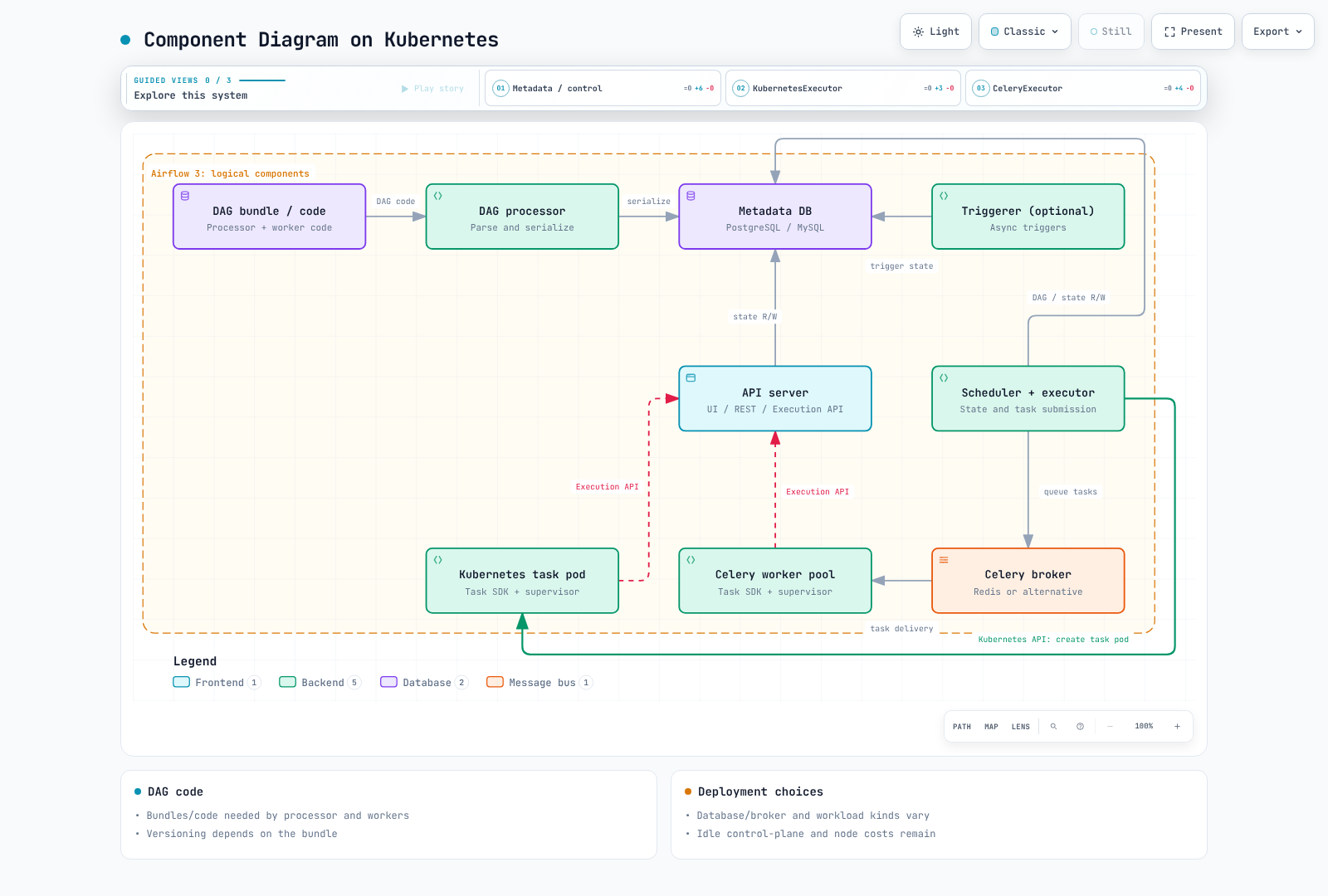
Airflow schedules and observes task instances according to DAG dependencies. Work can execute in an executor's worker, an external pod or a service the task invokes. Kubernetes API servers handle requests/state; the scheduler and kubelet place and start pods.
| Component | Responsibility and scope |
|---|---|
| Scheduler + executor | Evaluate DAG/task readiness, submit work, manage state/heartbeats; read and write metadata |
| DAG processor | Access bundles, parse/serialize DAGs and update version-related metadata; a required separate role in Airflow 3 |
| API server | UI, REST API v2 and Execution API; authentication/authorization via the auth manager and deployment configuration |
| Task runtime / worker | Execute operator/Task SDK code and communicate with execution APIs and required services |
| Triggerer | Run deferred tasks' triggers in an async loop; optional without deferral |
| Metadata database | Shared DAG/task state, serialized structures and related metadata |
Airflow 3's Execution API
In a normal supervised Python Task SDK execution, the worker starts a supervisor process that runs a task-runner subprocess. User task code communicates with the supervisor over a socket; the supervisor calls the Execution API using a short-lived task JWT. Public SDK access to Connections, Variables, XComs and state replaces direct metadata-database access by task code.
Worker-to-API-server addressing, authentication and networking are real dependencies. A scheduler-to-worker arrow alone does not explain Airflow 3. Separately inspect executor internals, system workers and stores such as Celery's result backend; do not generalize this into a claim that no backend process ever connects to any database. In-process execution such as local dag.test also need not use the same subprocess/HTTP path as a supervised deployment.
Triggerer versus worker
An operator starts on a worker and can register a trigger and defer while waiting. The triggerer runs that trigger; after an event, the task is rescheduled and resumes on a worker. It does not run the entire operator in the triggerer. Deferred tasks release worker slots and, by default, pool slots; pool behavior is configurable. Ordinary async tasks can retain worker slots and are distinct.
2. What actually changed between Airflow 2 and 3
Airflow 2 reached EOL on April 22, 2026. The comparison below is migration context.
| Aspect | Airflow 2.x | Airflow 3.x |
|---|---|---|
| UI/API | Flask-based webserver | FastAPI-based api-server and task Execution API paths |
| DAG parsing | Manager and file-processing subprocesses; optional standalone dag-processor | Separate DAG processor is a required role |
| DAG structure | Serialized-DAG scheduling already existed | Continued serialized structures and version metadata |
| Scheduler HA | Database-based multi-scheduler support already existed | HA, capacity and database load still need validation |
| Concurrent executors | Supported from 2.10.0 | Retained and generalized configuration |
| Fixed hybrid executors | LocalKubernetesExecutor and CeleryKubernetesExecutor were available | Unsupported from 3.0 |
It is inaccurate to say Airflow 2 parsed all files in the scheduler's same Python loop or that scheduler HA only became possible in Airflow 3. Separation helps independent tuning, but slow fresh-DAG parsing, shared CPU/memory/database contention and excessive parser concurrency can still affect scheduling latency. Adding replicas alone does not establish reliability.
3. Metadata, brokers and DAG code
Airflow 3.3.1 lists tested PostgreSQL 14–18, MySQL 8.0/8.4/Innovation and SQLite 3.15.0+. SQLite is for development/testing, not production. MariaDB is not supported. PostgreSQL examples in this series do not imply MySQL is unsupported. Managed databases still need actual HA, backup retention and deletion-policy configuration.
CeleryExecutor needs a compatible broker, with choices such as Redis or RabbitMQ. KubernetesExecutor and LocalExecutor do not inherently require Redis. Distinguish metadata storage, the broker and the selected Celery result backend. Connections/ Variables can use a secrets backend; XCom payload storage can also use another backend.
Workers as well as the DAG processor need executable DAG/task code and its packages. Normal task execution does not require the API server to parse DAG files, but plugins, auth managers and triggers still need appropriate code/ dependency distribution.
| DAG bundle | Current versioning support |
|---|---|
| GitDagBundle | Supported |
| LocalDagBundle | Not supported; uses current local code |
| S3DagBundle / GCSDagBundle | Not supported; distinct from object-store versioning |
git-sync remains in chart 1.22.0. Rendering confirms processor/triggerer sidecars and init containers, plus an init container in the Kubernetes task pod template. Choose git-sync, image-baked DAGs, a shared volume or remote bundles as appropriate. Verify whether the bundle preserves the run's code version and which code a retry reads.
4. Executor choices and concurrent executors
| Choice | Execution unit | Cost, latency and isolation considerations |
|---|---|---|
| LocalExecutor | Local task processes on the scheduler side | No separate broker; shares scheduler resources/boundary |
| KubernetesExecutor | Worker pod per task instance | Pod/image startup latency; limits and identity depend on the actual pod spec |
| CeleryExecutor | Worker pool consuming broker messages | Warm workers can start quickly; scaling to zero introduces cold starts |
Even without idle KubernetesExecutor worker pods, control-plane, database, node and logging costs remain. A separate pod does not automatically establish a strong security boundary. KubernetesPodOperator is an operator that launches another pod; it is distinct from KubernetesExecutor.
With concurrent executors, the first configured entry is the default. A task's executor field selects one; a DAG can set task defaults using default_args={"executor": "KubernetesExecutor"}, with per-task overrides. The executor/alias must actually be configured with compatible providers, versions and permissions. This feature dates to 2.10.0, distinct from hybrid removal in 3.0.
5. Prepare for Part 2 and understand validation limits
Chart 1.22.0 targets Helm 3.19.0+ and Airflow 3.1.0+. Airflow 3.3.1's tested Kubernetes list is 1.30–1.35. This is not a blanket promise for future versions or a recommendation to choose old EKS 1.30. Also check EKS support periods and the selected provider/chart compatibility.
Part 2 prepares images, database/broker connections, DAG delivery, permissions and storage. Do not assume the API server, scheduler, processor and triggerer are always lightweight; measure DAG count, parse cost, API load and task concurrency.
helm version --short
helm repo add apache-airflow https://airflow.apache.org
helm repo update apache-airflow
helm show chart apache-airflow/airflow --version 1.22.0
kubectl config current-context
# Prints the namespace manifest; does not create it.
kubectl create namespace airflow --dry-run=client -o yaml
Do not expect exactly four Deployments. In rendered chart variants the triggerer is a StatefulSet or Deployment depending on persistence, with additional StatsD, database, broker or worker resources depending on values. External databases need no PostgreSQL pod in the cluster.
This chapter renders KubernetesExecutor, CeleryExecutor and git-sync variants with a 3.3.1 override. Rendering is not a live database, task, image-pull or HA-recovery test; the environment checks in Part 2 remain necessary.