EKS Networking
Last Updated: September 11, 2026
Overview
This chapter covers VPC/subnet planning and security-group paths for a conventional EKS cluster. AWS manages the control plane in AWS-managed infrastructure; the customer VPC contains the cluster connectivity ENIs, node/Pod interfaces and load-balancer/endpoint resources. Do not interpret the customer VPC boundary as the physical location of the managed control plane or regional S3/ECR/STS services.
EKS Networking Architecture
| Component | Role |
|---|---|
| VPC and subnets | Address/routing boundaries; each subnet belongs to one AZ |
| Route tables | Select next hops for destination ranges |
| Internet gateway | Attaches to the VPC; public subnets route to it |
| Public NAT gateway | Provides a common private-IPv4 internet-egress path when placed in a public subnet with an EIP/IGW route |
| Security groups | Stateful rules associated with supported network interfaces/resources |
| Network ACLs | Stateless subnet-boundary rules, including required return traffic |
| CNI | Configures Pod networking; behavior depends on the selected implementation/mode |
Traffic Paths
Pod-to-Pod traffic can stay on one node or cross node interfaces/VPC routes. Same-node traffic does not necessarily traverse the VPC fabric, so VPC Flow Logs are not a complete record of all Pod communication. Service traffic uses the configured service-proxy path and selected backends; a Service is not a dedicated forwarding appliance. External ingress and egress depend on scheme, routes, target type and security controls. Control-plane traffic is a separate path from application traffic.
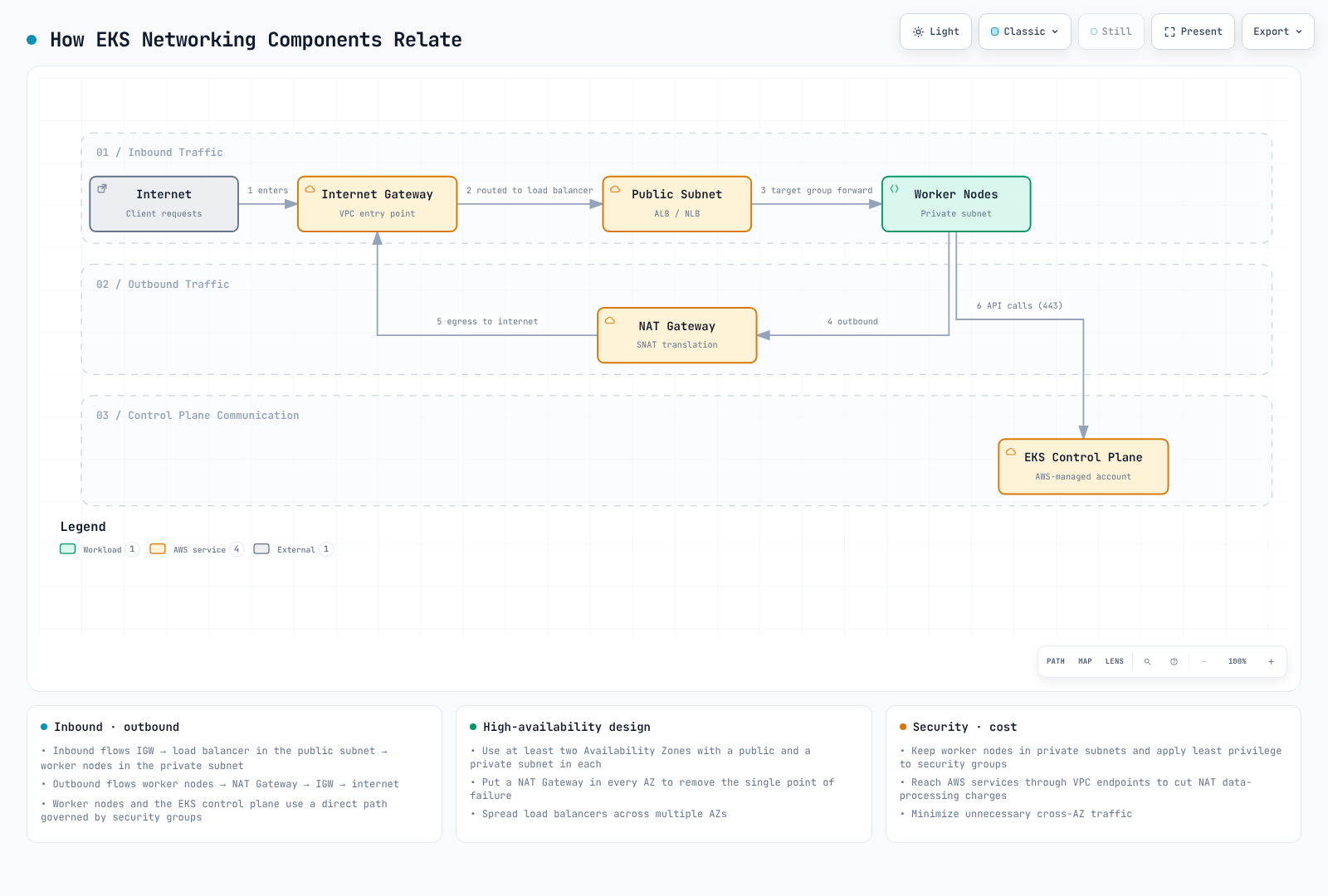
The figure illustrates public ingress and zonal-NAT IPv4 egress. It is one design, not a requirement to create public subnets/NAT for every EKS cluster. Fully private endpoints, centralized egress and native IPv6 paths have different requirements and costs.
VPC and Subnet Requirements
- For a regional EKS cluster, select eligible subnets in at least two AZs. Each cluster subnet needs at least six available IPs for EKS; AWS recommends at least sixteen. Leave room for replacement control-plane ENIs during upgrades and for other resources.
- Enable VPC DNS support and DNS hostnames. Cluster subnets and node/Pod subnets need not be identical, but all paths must be routable as required.
- Nodes need access to the Kubernetes API, image registries and the AWS services they use. This does not always require public internet access: private endpoints/mirrors can supply those paths. The EKS AWS-service endpoint is distinct from the cluster Kubernetes API endpoint.
- Review custom control-plane egress routing if
controlPlaneEgressMode=CUSTOMER_ROUTEDis enabled; cluster-subnet routes and security rules must reach the required webhook/OIDC and other endpoints. - Changing cluster subnets retains the original VPC/AZ-set constraints. Associating a new VPC CIDR is not instantaneous for every control-plane operation; AWS documents reconciliation that can take up to an hour.
CIDR Planning
Plan addresses from expected nodes, ordinary and branch-ENI Pods, warm pools/prefix blocks, control-plane interfaces, load balancers/endpoints, growth and update capacity. Check overlap with service CIDRs, connected VPCs and on-premises networks. Node count alone does not select a safe VPC CIDR, and a fixed 20–30% reserve is not a universal capacity rule.
The following are total IPv4 address counts, not cluster-size recommendations or usable Pod capacity:
| CIDR | Total addresses |
|---|---|
| /24 | 256 |
| /22 | 1,024 |
| /20 | 4,096 |
| /16 | 65,536 |
For ordinary AWS IPv4 subnet allocations, AWS reserves the first four and last address of each subnet: a /24 therefore has 251 assignable addresses and a /22 has 1,019, before workloads and infrastructure consume any. This is per subnet, not five addresses for the entire VPC; BYOIP has documented exceptions. Existing subnet CIDRs cannot simply be enlarged in place. Prefix delegation requires contiguous blocks and does not create new address space.
Example Subnet Design
For a VPC of 10.0.0.0/16, these aligned ranges do not overlap. They illustrate a public-load-balancer/zonal-NAT design, not measured sizing. A public subnet has an associated route to an IGW; a tag or subnet name does not make it public. Private nodes can use NAT or the appropriate private service endpoints.
| Type | AZ | CIDR | Example use |
|---|---|---|---|
| Public | us-west-2a | 10.0.0.0/24 | Public load balancers and zonal NAT |
| Public | us-west-2b | 10.0.1.0/24 | Public load balancers and zonal NAT |
| Private | us-west-2a | 10.0.4.0/22 | Worker nodes/Pods |
| Private | us-west-2b | 10.0.8.0/22 | Worker nodes/Pods |
The former 10.0.2.0/22 and 10.0.6.0/22 were not aligned network addresses. AWS canonicalizes CIDRs; the former first range would become 10.0.0.0/22 and overlap the public subnets. Validate network boundaries and overlap before provisioning. AZ-local NAT paths avoid a cross-AZ NAT dependency, but redundant capacity/routes and workload placement still need review.
Subnet Discovery Tags
Discovery belongs to the selected controller and version. For AWS Load Balancer Controller 3.5, role tags guide public/internal subnet selection; eligible values are 1 or an empty value. Modern LBC does not universally require the old cluster ownership tag. With no role-tag candidates, LBC 2.12.1+ can use route-based discovery when SubnetDiscoveryByReachability is enabled. Cluster-tag filtering, free IPs and per-AZ selection still matter. EKS Auto Mode has its own documented tag requirements.
- Internet-facing placement:
kubernetes.io/role/elb. - Internal placement:
kubernetes.io/role/internal-elb. kubernetes.io/cluster/<cluster-name>may affect filtering/priority;owned/sharedare not security boundaries or automatic routing rules.
# After reviewing subnet ownership and its associated routes, tag the intended public subnet.
aws ec2 describe-subnets --region "${EXAMPLE_REGION:?}" --subnet-ids "${PUBLIC_SUBNET_ID:?}" \
  --query 'Subnets[].{id:SubnetId,vpc:VpcId,cidr:CidrBlock,free:AvailableIpAddressCount,tags:Tags}'
aws ec2 create-tags --region "$EXAMPLE_REGION" --resources "$PUBLIC_SUBNET_ID" \
  --tags Key=kubernetes.io/role/elb,Value=1
Use the internal-elb role tag for a reviewed private/internal placement instead. Do not tag arbitrary existing subnets or disable cluster-tag checks to work around an unreviewed discovery failure. Explicit subnet selection must still meet load-balancer eligibility requirements.
Security-Group Paths
EKS creates a default cluster security group and associates it with cluster ENIs and, normally, managed-node interfaces. It is not a universal two-group layout. Additional cluster SGs are not automatically node SGs; custom launch-template groups and Pod security groups change the paths. Inspect actual associations before editing rules:
aws eks describe-cluster --name "${EXAMPLE_CLUSTER:?}" --region "${EXAMPLE_REGION:?}" \
--query 'cluster.resourcesVpcConfig.{clusterSG:clusterSecurityGroupId,additionalSGs:securityGroupIds,subnets:subnetIds,public:endpointPublicAccess,private:endpointPrivateAccess,publicCIDRs:publicAccessCidrs}'| Flow | Typical destination port | Scope to review |
|---|---|---|
| Nodes / authorized connected clients → private Kubernetes API | TCP 443 | Cluster endpoint SGs and approved sources |
| Control plane → kubelet | TCP 10250 | Target node SGs and routes |
| Nodes/Pods → DNS backend | UDP and TCP 53 | Actual CoreDNS/NodeLocal DNS path |
| Control plane → admission webhook | Configured backend port | Webhook Service/endpoint and SG path |
| Application / load balancer → workload | Configured application/health-check ports | Target type, target SGs and health checks |
AWS documents TCP 443, TCP 10250 and TCP/UDP 53 to the cluster SG as the minimum outbound set when narrowing the default cluster SG, plus the actual application, inter-node and service-access requirements. The old 1025–65535 kubelet range is not that minimum. SGs are stateful; allowed return traffic does not require blindly opening the ephemeral range. NACLs are stateless and must allow the corresponding return paths.
Default self-ingress and self-egress/EFA rules can be recreated on cluster updates. Adding a narrow SG does not negate a broader allow rule in another attached SG. Public API access uses publicAccessCidrs; the cluster SG controls the private endpoint path. Review egress for registries/AWS APIs and use the appropriate endpoints or routes rather than assuming every cluster requires ALL → 0.0.0.0/0.
Next Steps and Quiz
EKS Networking Part 2 covers services, load balancing and policies. Check your understanding with the Part 1 quiz.