Part 2: Spark Operator
Review baseline: Kubeflow operator/chart 2.5.2; Apache operator 1.0.0 / chart 1.8.0
Example runtimes: Kubeflow lab uses Spark 4.0.4, matching its controller image's submission runtime; Apache example uses Spark 4.2.0
Last reviewed: September 12, 2026
Two projects and different APIs
These are separately maintained projects, not interchangeable implementations of one manifest. Select based on the API/lifecycle you need, existing resources, supported runtime combinations and operational tests. Age or an unmeasured popularity claim is not a compatibility guarantee.
| Item | Kubeflow Spark Operator | Apache Spark Kubernetes Operator |
|---|---|---|
| Reviewed release | 2.5.2 | 1.0.0 |
| Helm chart | 2.5.2 | 1.8.0; chart and application versions differ |
| Application API used here | sparkoperator.k8s.io/v1beta2 | spark.apache.org/v1 |
| Main workload types | SparkApplication, ScheduledSparkApplication; separate SparkConnect API | SparkApplication and SparkCluster |
| Configuration model | type/mode/driver/executor/restartPolicy | runtimeVersions/driverSpec/executorSpec/applicationTolerations/sparkConf |
| Admission approach in these charts | Mutating and validating webhooks | No equivalent pod-mutating webhook installed by this chart |
Apache's SparkCluster can manage a resident Spark cluster, a different execution model from the native Kubernetes SparkApplication flow. Its Comet/Gluten examples still require suitable plugin binaries/images, classpaths, configuration and runtime/ architecture compatibility. Installing the operator does not enable acceleration automatically, and those plugins are not a reason to assume one operator always wins.
Both API groups can exist, but coexistence needs deliberate watch scopes, names, webhook selectors and RBAC. The lab below selects one installation path. Use fully qualified resource names to avoid ambiguous sparkapp shortcuts.
What reconciliation adds
Plain spark-submit can wait for completion and expose pod/log/UI/event-log status; scripts, properties and pod templates can also be versioned in Git. It is not inherently fire-and-forget. What it does not itself add is an operator-managed SparkApplication CR, scheduled-resource controller or automatic application retry.
Kubeflow intentionally submits with spark.kubernetes.submission.waitAppCompletion=false and then reconciles pod/application state. It also observes executor pods and performs lifecycle cleanup; “the operator only touches the driver” is incorrect. The Spark driver still requests executor capacity and assigns Spark tasks.
Prepare the lab namespace and identities
Use kubectl/Helm compatible with your cluster. The chart examples were rendered against Kubernetes 1.36; the Apache Spark 4.2 workload requires Kubernetes 1.34+. Do not infer a current recommended Kubernetes floor from an old README table.
The Kubeflow controller's pinned Dockerfile uses Spark 4.0.4 for submission. This chapter aligns that lab workload with 4.0.4; Part 1's direct 4.2 submission is separate. A SparkApplication sparkVersion field does not upgrade the Spark installation inside the controller. Test another submitter/workload combination explicitly before adopting it.
Save/apply job-rbac.yaml before installing either chart. It matches Part 1's namespace-scoped job permissions and separates driver and executor identities. Review existing resources if you already use these names.
apiVersion: v1
kind: Namespace
metadata:
  name: spark-jobs
---
apiVersion: v1
kind: ServiceAccount
metadata:
  name: spark-driver
  namespace: spark-jobs
---
apiVersion: v1
kind: ServiceAccount
metadata:
  name: spark-executor
  namespace: spark-jobs
automountServiceAccountToken: false
---
apiVersion: rbac.authorization.k8s.io/v1
kind: Role
metadata:
  name: spark-driver
  namespace: spark-jobs
rules:
- apiGroups:
  - ''
  resources:
  - pods
  - services
  - configmaps
  verbs:
  - create
  - get
  - list
  - watch
  - delete
  - patch
---
apiVersion: rbac.authorization.k8s.io/v1
kind: RoleBinding
metadata:
  name: spark-driver
  namespace: spark-jobs
roleRef:
  apiGroup: rbac.authorization.k8s.io
  kind: Role
  name: spark-driver
subjects:
- kind: ServiceAccount
  name: spark-driver
namespace: spark-jobskubectl apply -f job-rbac.yamlNo AWS data access is required for SparkPi. Operator API permissions, driver API permissions and AWS data permissions are separate concerns.
Option A: Kubeflow installation
Save as kubeflow-values.yaml. The default chart watches default, not its own installation namespace; watch namespace and job namespace must agree. Here jobs run in spark-jobs, and the chart reuses the job RBAC prepared above. Resource sizes and submission concurrency are lab starting points to measure.
spark:
  jobNamespaces:
  - spark-jobs
  jobNamespaceSelector: ''
  serviceAccount:
    create: false
  rbac:
    create: false
webhook:
  enable: true
  resources:
    requests:
      cpu: 100m
      memory: 128Mi
    limits:
      cpu: '1'
      memory: 512Mi
controller:
  workers: 2
  resources:
    requests:
      cpu: 500m
      memory: 1Gi
    limits:
      cpu: '2'
      memory: 2Gi
webhook.enable is already true by default in 2.5.2. It is stated explicitly to document the choice, not because omitting the flag disables the webhook. Some customizations use admission; others are translated into native Spark configuration. Disabling the webhook does not imply every setting is ignored.
The checksum below matches the downloaded GitHub release asset. During this review, the repository index's digest for this version differed from the asset metadata/download, so this example uses the directly verified release archive.
# Fresh installation after reviewing/applying job-rbac.yaml.
curl --fail --location --silent --show-error 'https://github.com/kubeflow/spark-operator/releases/download/v2.5.2/spark-operator-2.5.2.tgz' -o spark-operator-2.5.2.tgz
printf '%s\n' '762be5b8632ecfe12eb20fff54450ddae0427f09506422107c508a0d1d38655b  spark-operator-2.5.2.tgz' | sha256sum --check -
helm install spark-operator ./spark-operator-2.5.2.tgz \
  --namespace spark-operator --create-namespace \
  --values kubeflow-values.yaml --wait --timeout 5m
kubectl -n spark-operator get deployments,pods
This is a fresh-install example. For upgrades, review the CRD migration procedure: normal Helm upgrades do not automatically replace CRDs in crds/, and this chart's hook.upgradeCrd is an explicit opt-in. Do not delete shared CRDs as a routine upgrade step because their custom resources are affected.
In EKS, verify control-plane access to the webhook Service/endpoints, serving certificate/CA bundle and selectors. The server listens on 9443 in this chart. With failurePolicy=Fail, an unavailable webhook can block matching admissions. Deployment readiness alone does not prove a Spark workload can be admitted.
Kubeflow SparkApplication
Save as spark-pi.yaml. This uses a real example already in the pinned image, avoiding an unspecified S3 object or missing custom ETL class.
apiVersion: sparkoperator.k8s.io/v1beta2
kind: SparkApplication
metadata:
  name: spark-pi
  namespace: spark-jobs
spec:
  type: Scala
  mode: cluster
  image: apache/spark:4.0.4@sha256:94ad730f7510002d8a1615de269f27cdeca4d4eef51657384db3fa9246b5a4d8
  imagePullPolicy: IfNotPresent
  mainClass: org.apache.spark.examples.SparkPi
  mainApplicationFile: local:///opt/spark/examples/jars/spark-examples_2.13-4.0.4.jar
  arguments:
  - '10'
  sparkVersion: 4.0.4
  restartPolicy:
    type: OnFailure
    onFailureRetries: 3
    onFailureRetryInterval: 30
    onSubmissionFailureRetries: 3
    onSubmissionFailureRetryInterval: 30
  driver:
    cores: 1
    coreLimit: '1'
    memory: 1g
    serviceAccount: spark-driver
    podSecurityContext: &id001
      runAsNonRoot: true
      runAsUser: 185
      seccompProfile:
        type: RuntimeDefault
    securityContext: &id002
      allowPrivilegeEscalation: false
      capabilities:
        drop:
        - ALL
  executor:
    cores: 1
    coreLimit: '1'
    instances: 2
    memory: 1g
    serviceAccount: spark-executor
    terminationGracePeriodSeconds: 60
    podSecurityContext: *id001
    securityContext: *id002
driver.serviceAccount and executor.serviceAccount are valid fields in this version. Retry settings apply to submission/application attempts, not merely an in-place container restart. A rerun can repeat output side effects; use idempotent or transactional output design for real jobs.
The executor grace field is applied by the Kubeflow pod mutator. It is distinct from the native Spark 4.2 template override discussed in Part 1. If enabling Spark decommissioning or custom lifecycle hooks, inspect how the selected operator, Spark runtime and webhook compose them.
kubectl apply -f spark-pi.yaml
kubectl -n spark-jobs get sparkapplications.sparkoperator.k8s.io spark-pi \
  -o jsonpath='{.status.applicationState.state}{"\n"}'
kubectl -n spark-jobs describe sparkapplications.sparkoperator.k8s.io spark-pi
DRIVER_POD="$(kubectl -n spark-jobs get sparkapplications.sparkoperator.k8s.io spark-pi \
  -o jsonpath='{.status.driverInfo.podName}')"
: "${DRIVER_POD:?Driver pod name is not available yet; inspect submission events}"
kubectl -n spark-jobs logs "$DRIVER_POD"
Read the current status and events, including submission failures, and then the actual driver pod name. kubectl get -w is an open watch requiring interruption; it is not a finite “wait until success” step. COMPLETED reports process completion, not proof that an external dataset is correct.
Explicit UTC scheduling
Save as scheduled-spark-pi.yaml. This intentionally schedules the same harmless Pi example; replace it with a packaged/tested ETL program for real data processing.
apiVersion: sparkoperator.k8s.io/v1beta2
kind: ScheduledSparkApplication
metadata:
  name: daily-spark-pi
  namespace: spark-jobs
spec:
  schedule: 0 2 * * *
  timeZone: UTC
  concurrencyPolicy: Forbid
  successfulRunHistoryLimit: 2
  failedRunHistoryLimit: 2
  template:
    type: Scala
    mode: cluster
    image: apache/spark:4.0.4@sha256:94ad730f7510002d8a1615de269f27cdeca4d4eef51657384db3fa9246b5a4d8
    imagePullPolicy: IfNotPresent
    mainClass: org.apache.spark.examples.SparkPi
    mainApplicationFile: local:///opt/spark/examples/jars/spark-examples_2.13-4.0.4.jar
    arguments:
    - '10'
    sparkVersion: 4.0.4
    restartPolicy:
      type: OnFailure
      onFailureRetries: 3
      onFailureRetryInterval: 30
      onSubmissionFailureRetries: 3
      onSubmissionFailureRetryInterval: 30
    driver:
      cores: 1
      coreLimit: '1'
      memory: 1g
      serviceAccount: spark-driver
      podSecurityContext: &id001
        runAsNonRoot: true
        runAsUser: 185
        seccompProfile:
          type: RuntimeDefault
      securityContext: &id002
        allowPrivilegeEscalation: false
        capabilities:
          drop:
          - ALL
    executor:
      cores: 1
      coreLimit: '1'
      instances: 2
      memory: 1g
      serviceAccount: spark-executor
      terminationGracePeriodSeconds: 60
      podSecurityContext: *id001
      securityContext: *id002
timeZone is supported in 2.5.2; otherwise the default is Local to the controller. Here the schedule means 02:00 UTC. Forbid checks this scheduled resource's previous run; it does not prevent duplicate effects from retries, manual runs or another scheduler. History limits bound retained child-run history, not data backups.
kubectl apply -f scheduled-spark-pi.yaml
kubectl -n spark-jobs get scheduledsparkapplications.sparkoperator.k8s.io daily-spark-pi -o yaml
# Stop future schedule triggers; this does not itself terminate an active child run.
kubectl -n spark-jobs patch scheduledsparkapplications.sparkoperator.k8s.io daily-spark-pi \
  --type=merge -p '{"spec":{"suspend":true}}'
Option B: Apache operator, a separate path
Use apache-values.yaml instead of Option A for this lab. It watches spark-jobs, uses namespace roles for the operator and reuses the existing job identities. Chart comments may use older property spellings; the rendered configuration sets spark.kubernetes.operator.watchedNamespaces=spark-jobs.
workloadResources:
  namespaces:
    create: false
    overrideWatchedNamespaces: true
    data:
    - spark-jobs
  serviceAccount:
    create: false
  role:
    create: false
  clusterRole:
    create: false
  roleBinding:
    create: false
operatorRbac:
  clusterRole:
    create: false
  clusterRoleBinding:
    create: false
  role:
    create: true
  roleBinding:
create: true# Fresh installation after reviewing/applying job-rbac.yaml.
curl --fail --location --silent --show-error 'https://github.com/apache/spark-kubernetes-operator/releases/download/1.0.0/spark-kubernetes-operator-1.8.0.tgz' -o spark-kubernetes-operator-1.8.0.tgz
printf '%s\n' '7536a8849b8a7c242283d0e393b5e0ec56365f34ec93717b158c76dfa1036a06 spark-kubernetes-operator-1.8.0.tgz' | sha256sum --check -
helm install asf-spark-operator ./spark-kubernetes-operator-1.8.0.tgz \
--namespace spark-operator-asf --create-namespace \
--values apache-values.yaml --wait --timeout 5m
kubectl -n spark-operator-asf get deployments,podsThe Apache release has a different lifecycle model and runtime image from Kubeflow. Use its published image; assumptions about the workload's Java version do not determine the operator image's Java requirements.
This v1 example uses Spark 4.2.0 and keeps resources briefly for inspection:
apiVersion: spark.apache.org/v1
kind: SparkApplication
metadata:
  name: spark-pi-asf
  namespace: spark-jobs
spec:
  runtimeVersions:
    sparkVersion: 4.2.0
  mainClass: org.apache.spark.examples.SparkPi
  jars: local:///opt/spark/examples/jars/spark-examples.jar
  driverArgs:
  - '10'
  sparkConf:
    spark.kubernetes.namespace: spark-jobs
    spark.kubernetes.container.image: spark:4.2.0-scala2.13-java21-ubuntu
    spark.kubernetes.authenticate.driver.serviceAccountName: spark-driver
    spark.kubernetes.authenticate.executor.serviceAccountName: spark-executor
    spark.executor.instances: '2'
  applicationTolerations:
    resourceRetainPolicy: Always
    ttlAfterStopMillis: 600000
ttlAfterStopMillis: 600000 allows the controller to delete the application and associated resources after its final stop. resourceRetainPolicy: Always keeps operator-created resources until cleanup; it does not override the driver's own executor/service deletion settings or preserve resources across retries.
kubectl apply -f apache-spark-pi.yaml
kubectl -n spark-jobs get sparkapplications.spark.apache.org spark-pi-asf -o yaml
The release also serves its older v1beta1 schema, but new examples here use v1. Changing only apiVersion on a Kubeflow resource will not migrate its fields, status or retry/retention behavior. Do not apply Kubeflow's ScheduledSparkApplication or restartPolicy schema to the Apache API.
What happens around pod creation
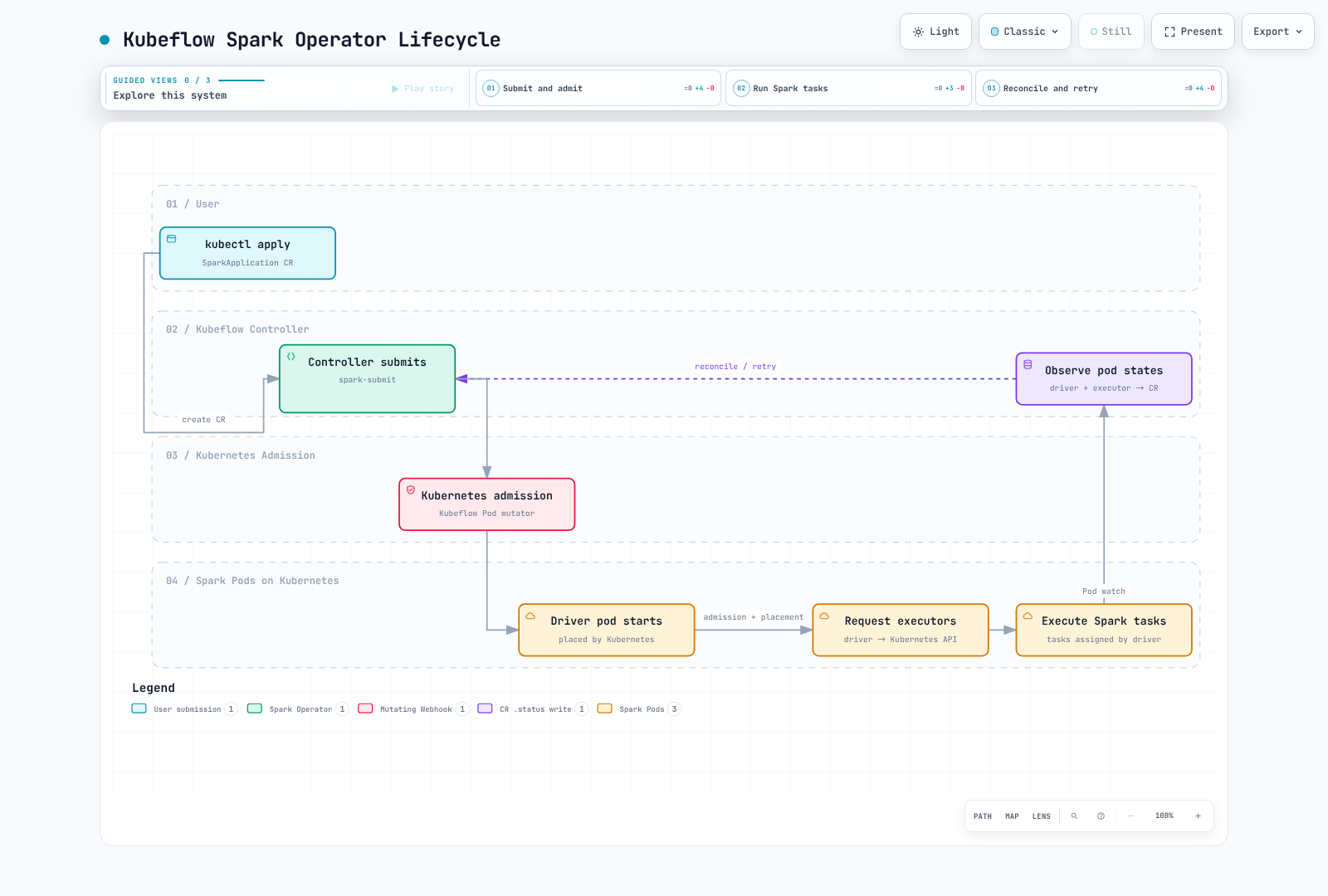
The webhook is part of Kubernetes admission, not a replacement for node scheduling or Spark task scheduling. The two operators need their own architecture/API assessment; this flow illustrates Kubeflow.
Storage, identity and metrics
Correct scratch-volume placement
In the Kubeflow API, volumes belong at spec.volumes, with mounts under driver/ executor. spec.driver.volumes and spec.executor.volumes are not fields in this CRD. This is a merge patch for the complete Kubeflow example:
spec:
  volumes:
  - name: spark-local-dir-scratch
    emptyDir:
      sizeLimit: 8Gi
  driver:
    volumeMounts:
    - name: spark-local-dir-scratch
      mountPath: /var/data/spark-local
  executor:
    volumeMounts:
    - name: spark-local-dir-scratch
mountPath: /var/data/spark-localkubectl -n spark-jobs patch sparkapplications.sparkoperator.k8s.io spark-pi \
--type=merge --patch-file scratch.patch.yamlApply the storage customization before running a real workload; updating an application can trigger resubmission. JSON merge patches replace arrays, so merge existing volume/mount lists into this patch when adapting another application.
The spark-local-dir- prefix has special handling: the operator translates these local volumes/mounts into native Spark volume configuration, while the generic pod-volume mutator skips them. Other custom volumes can use the webhook path. Do not assume all fields are implemented through one mechanism.
An extra emptyDir does not create a separate physical disk or select NVMe. It uses the node's configured filesystem unless backed by memory. The kubelet/ container filesystem might reside on EBS, instance store or another configured layout. Configure/verify node storage or an appropriate persistent volume, and plan ephemeral-storage requests, limits and disk-pressure behavior.
IRSA and Pod Identity are different
For S3 jobs, configure the actual data permissions and trust/association for the driver/executor identities, plus compatible Hadoop S3A/AWS libraries and credential providers. A stock image, an ARN annotation or the text s3a:// alone is insufficient. The process fetching an artifact/template also needs the corresponding access.
- IRSA uses the service-account role annotation, OIDC trust and web-identity credential exchange.
- EKS Pod Identity uses an association and the Pod Identity Agent/container credential path; it does not use the IRSA role annotation as its association.
- Kubernetes RBAC does not grant S3 permissions. Use temporary credentials and test effective identity/data access in the actual pods.
Part 5 covers complete data-access and security examples. Do not put static AWS keys into the application spec or image.
Controller metrics are not workload JMX
The chart's default Prometheus endpoint exposes operator metrics on 8080. It does not automatically add a JMX Java agent to every Spark JVM. Workload monitoring is an explicit application configuration and needs the appropriate exporter JAR/configuration in the image plus scraping/discovery. Native Spark metrics endpoints and event/history logs are additional mechanisms. See Part 5 for the detailed setup.
Cleanup and validation scope
Pause schedules before removing demo runs, and review whether deleting a parent will cascade to child resources. Use the intended API group:
# Kubeflow demo resources, if installed:
kubectl -n spark-jobs delete scheduledsparkapplications.sparkoperator.k8s.io daily-spark-pi
kubectl -n spark-jobs delete sparkapplications.sparkoperator.k8s.io spark-pi
# Apache demo resource, if installed:
kubectl -n spark-jobs delete sparkapplications.spark.apache.org spark-pi-asf
Chart rendering and released-CRD checks validate resource shape, namespaces and configuration paths. They do not prove a live webhook, controller/runtime combination, S3 access, data correctness or retry recovery. Inspect generated pods, status and output before promoting a real workload.
- Kubeflow Spark Operator 2.5.2
- Kubeflow 2.5.2 application API
- Kubeflow 2.5.2 scheduled API
- Kubeflow submission/configuration conversion
- Kubeflow pod mutator
- Apache operator 1.0.0
- Apache operator configuration
- Apache Comet example and prerequisites
- Apache Gluten example and prerequisites
- Spark Kubernetes configuration