Crossplane
Last Updated: September 13, 2026 · Crossplane 2.4.0 / AWS provider 2.7.0
Concepts and v2 Changes
Crossplane reconciles infrastructure and application resources through Kubernetes APIs and controllers. It joined CNCF on June 25, 2020, became Incubating on September 14, 2021 and Graduated on October 28, 2025. The conflicting 2023/2024 graduation claims have been corrected.
| Component | Role and current scope |
|---|---|
| Provider | Installs CRDs/controllers as a package. Select service-specific AWS packages; one package need not cover every AWS API. |
| Managed Resource (MR) | Provider API managing an external resource. The v2 examples here are namespaced. |
| Composite Resource (XR) | Instance of a platform API. XRD v2 defaults to Namespaced. |
| XRD | Defines XR schemas and scope; distinguish v1 LegacyCluster from v2 Namespaced. |
| Composition | Defines a Function pipeline calculating desired resources and status from XR inputs. |
| Claim | Namespaced interface for legacy cluster-scoped XRs, not a mandatory layer for new namespaced XRs. |
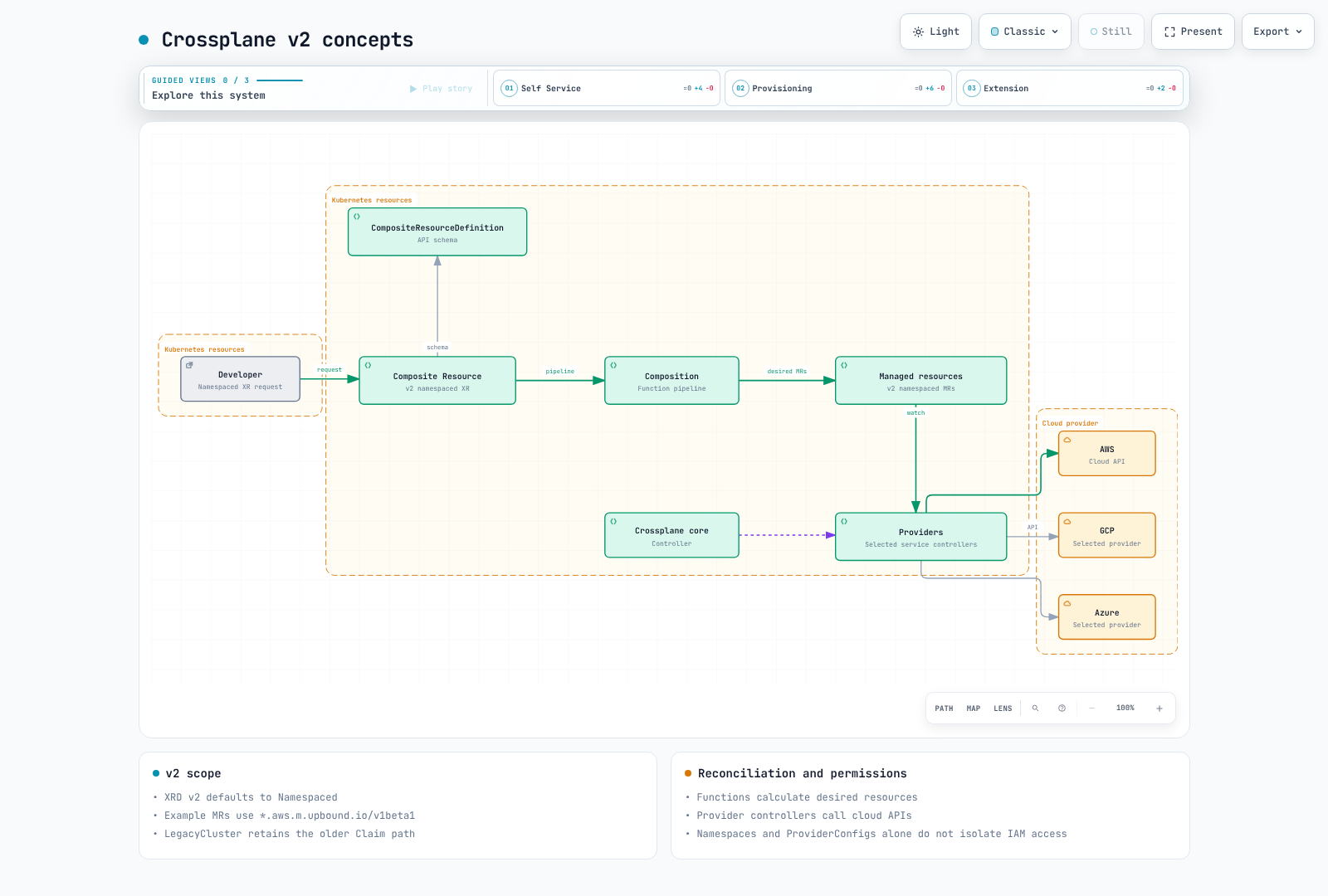
Existing v1 XRDs can continue using LegacyCluster Claims, and legacy cluster-scoped MRs remain supported. Do not merely change the core version while retaining removed Resources-mode Compositions, ControllerConfig or XR-native connection publication. The official v2 migration guide describes preparation from 1.20.
Terraform also uses declarative desired state and can automate plan/apply in CI. The primary difference is execution workflow versus continuous controller reconciliation. Crossplane behavior still depends on managementPolicies, supported fields, errors and quotas; it does not immediately repair every drift.
Core, Providers and Permissions
The reviewed Helm chart is 2.4.0. This command inspects it offline without installing into a cluster.
helm repo add crossplane-stable https://charts.crossplane.io/stable
helm repo update
helm template crossplane crossplane-stable/crossplane   --version 2.4.0 --namespace crossplane-system   --set metrics.enabled=true
Current provider.defaultActivations defaults to ["*"]. Review MRDs, ManagedResourceActivationPolicies and installed service scope when deciding which APIs to activate. Installed Providers do not establish successful AWS authentication or resource readiness.
The IAM role below is a placeholder. Restrict trust to the exact EKS issuer, audience and ServiceAccount subject, and scope service actions/resources. Adding RequestedRegion to s3:/rds:/ec2:/iam: does not make it least privilege. RDS and EC2 Providers need their own reviewed runtime/identity configurations.
apiVersion: pkg.crossplane.io/v1beta1
kind: DeploymentRuntimeConfig
metadata:
  name: provider-aws-s3-reviewed
spec:
  deploymentTemplate:
    spec:
      selector: {}
      template:
        spec:
          containers:
          - name: package-runtime
            resources:
              requests:
                cpu: 100m
                memory: 256Mi
              limits:
                cpu: 500m
                memory: 512Mi
            ports:
            - name: metrics
              containerPort: 8080
        metadata:
          labels:
            app: provider-aws-s3-reviewed
  serviceAccountTemplate:
    metadata:
      name: provider-aws-s3-reviewed
      annotations:
        eks.amazonaws.com/role-arn: arn:aws:iam::123456789012:role/ReplaceApprovedS3ProviderRole
---
apiVersion: pkg.crossplane.io/v1
kind: Provider
metadata:
  name: provider-aws-s3
spec:
  package: xpkg.crossplane.io/crossplane-contrib/provider-aws-s3:v2.7.0
  packagePullPolicy: IfNotPresent
  revisionActivationPolicy: Manual
  revisionHistoryLimit: 2
  runtimeConfigRef:
    name: provider-aws-s3-reviewed
Do not configure several Providers to own the same fixed ServiceAccount. packagePullPolicy governs fetching; revisionActivationPolicy governs activation. With Manual, inspect ProviderRevisions and explicitly activate the reviewed version as required.
The 2.7.0 S3 manifests were accessible from community and Upbound registries, but their digests differed. Matching version strings do not imply identical artifacts. Pin the selected distribution, registry/digest and support expectations.
This example uses a namespaced ProviderConfig with IRSA. Schema 2.7.0 also supports PodIdentity, requiring its actual association/SDK/runtime setup. Per-namespace ProviderConfigs alone do not separate AWS permissions; constrain configuration writes, references and role-assumption boundaries.
apiVersion: aws.m.upbound.io/v1beta1
kind: ProviderConfig
metadata:
  name: team-aws
  namespace: team-alpha
spec:
  credentials:
    source: IRSA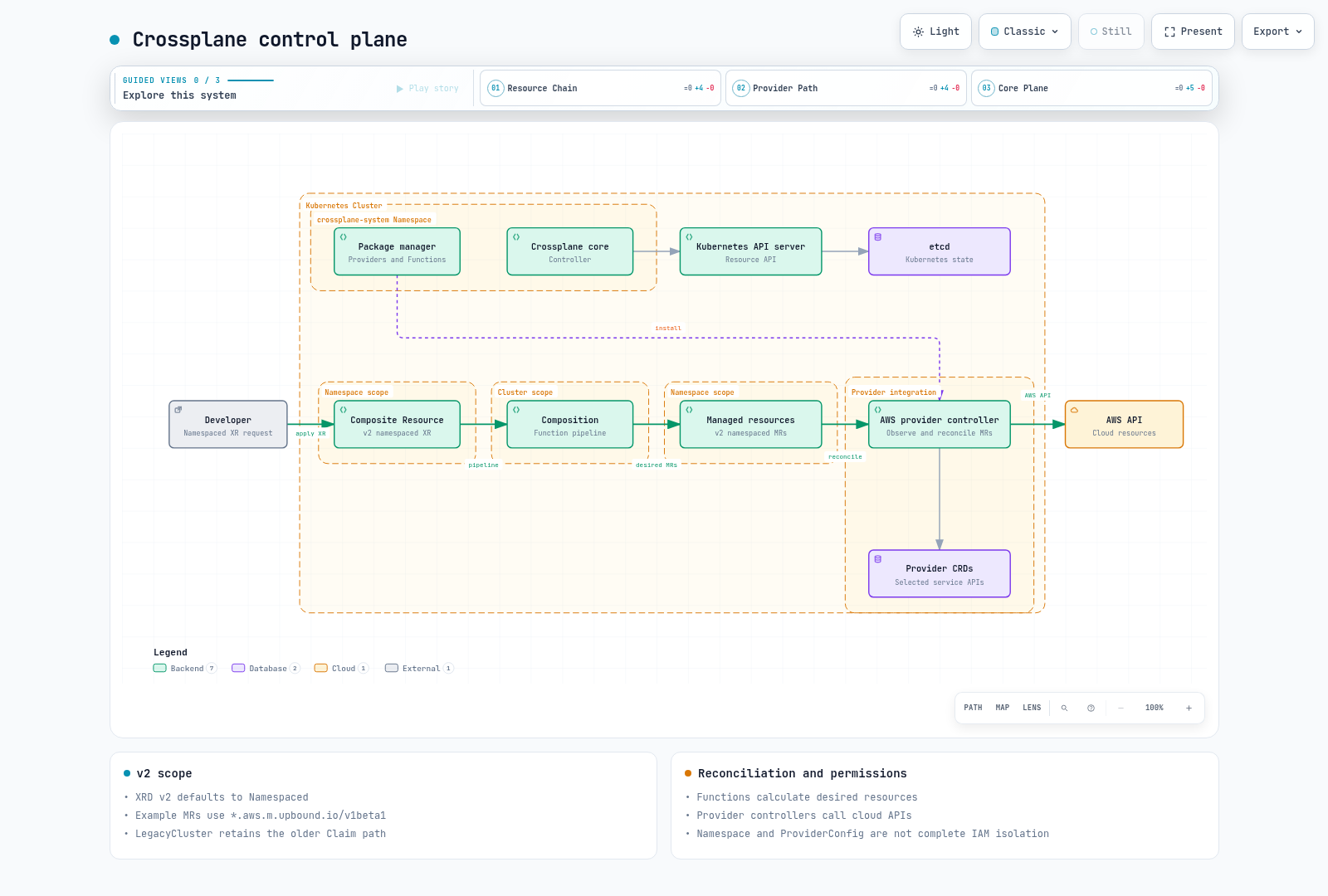
Namespaced S3 Example
The examples use namespaced *.aws.m.upbound.io APIs, distinct from legacy cluster-scoped *.aws.upbound.io APIs. providerConfigRef includes kind/name. managementPolicies excludes Delete to retain external resources; these namespace APIs do not expose the old deletionPolicy field.
Prepare the actual bucket name, region and identity first. Excluding Delete still permits updates; retention is not a backup or cost-cleanup strategy.
apiVersion: s3.aws.m.upbound.io/v1beta1
kind: Bucket
metadata:
  name: app-data
  namespace: team-alpha
  annotations:
    crossplane.io/external-name: replace-with-globally-unique-bucket
spec:
  managementPolicies:
  - Observe
  - Create
  - Update
  - LateInitialize
  forProvider:
    region: us-west-2
    forceDestroy: false
    tags:
      Environment: Development
  providerConfigRef:
    kind: ProviderConfig
name: team-awsapiVersion: s3.aws.m.upbound.io/v1beta1
kind: BucketPublicAccessBlock
metadata:
name: app-data-public-access
namespace: team-alpha
spec:
managementPolicies:
- Observe
- Create
- Update
- LateInitialize
forProvider:
region: us-west-2
bucketRef:
name: app-data
blockPublicAcls: true
blockPublicPolicy: true
ignorePublicAcls: true
restrictPublicBuckets: true
providerConfigRef:
kind: ProviderConfig
name: team-awsapiVersion: s3.aws.m.upbound.io/v1beta1
kind: BucketVersioning
metadata:
name: app-data-versioning
namespace: team-alpha
spec:
managementPolicies:
- Observe
- Create
- Update
- LateInitialize
forProvider:
region: us-west-2
bucketRef:
name: app-data
versioningConfiguration:
status: Enabled
providerConfigRef:
kind: ProviderConfig
name: team-awsapiVersion: s3.aws.m.upbound.io/v1beta1
kind: BucketServerSideEncryptionConfiguration
metadata:
name: app-data-encryption
namespace: team-alpha
spec:
managementPolicies:
- Observe
- Create
- Update
- LateInitialize
forProvider:
region: us-west-2
bucketRef:
name: app-data
rule:
- applyServerSideEncryptionByDefault:
sseAlgorithm: AES256
providerConfigRef:
kind: ProviderConfig
name: team-awsAll four Block Public Access settings are enabled. In this version, versioningConfiguration and applyServerSideEncryptionByDefault are objects, not the old array shapes. Also account for bucket objects/versions and forceDestroy=false during deletion planning.
PostgreSQL Platform API
This example uses an approved VPC, private subnets in distinct AZs, a client SecurityGroup and a password Secret. Network and database provisioning are not one transaction. If managing VPC/Subnet MRs separately, validate CIDRs, routes, egress, DNS and AZs together.
Create the new XR directly in its namespace. Validate dbName separately rather than trying to strip metadata-name hyphens with an incorrect Regexp transform. This example constrains the ProviderConfig name to team-aws.
apiVersion: apiextensions.crossplane.io/v2
kind: CompositeResourceDefinition
metadata:
  name: postgresqldatabases.platform.example.com
spec:
  scope: Namespaced
  group: platform.example.com
  names:
    kind: PostgreSQLDatabase
    plural: postgresqldatabases
  versions:
  - name: v1alpha1
    served: true
    referenceable: true
    schema:
      openAPIV3Schema:
        type: object
        required:
        - spec
        properties:
          spec:
            type: object
            required:
            - parameters
            properties:
              parameters:
                type: object
                required:
                - environment
                - dbName
                - vpcID
                - subnetIDs
                - clientSecurityGroupID
                - passwordSecretName
                properties:
                  storageGB:
                    type: integer
                    minimum: 20
                    maximum: 1000
                    default: 50
                  environment:
                    type: string
                    enum:
                    - dev
                    - production
                  dbName:
                    type: string
                    pattern: ^[a-z][a-z0-9]{0,62}$
                  vpcID:
                    type: string
                  subnetIDs:
                    type: array
                    minItems: 2
                    items:
                      type: string
                  clientSecurityGroupID:
                    type: string
                  passwordSecretName:
                    type: string
                  providerConfigName:
                    type: string
                    default: team-aws
                    enum:
                    - team-aws
          status:
            type: object
            properties:
              endpoint:
                type: string
              port:
                type: integer
Distinguish served and referenceable versions; do not mark multiple versions referenceable. Actual CLI xrd convert checks produced one CRD for Namespaced and two XR/Claim CRDs for LegacyCluster+claimNames. Conversion is not cluster installation or data migration.
Function Pipeline
apiVersion: pkg.crossplane.io/v1
kind: Function
metadata:
  name: function-patch-and-transform
spec:
  package: xpkg.crossplane.io/crossplane-contrib/function-patch-and-transform:v0.10.10
---
apiVersion: pkg.crossplane.io/v1
kind: Function
metadata:
  name: function-auto-ready
spec:
package: xpkg.crossplane.io/crossplane-contrib/function-auto-ready:v0.7.0apiVersion: apiextensions.crossplane.io/v1
kind: Composition
metadata:
name: postgresql-aws-reviewed
spec:
compositeTypeRef:
apiVersion: platform.example.com/v1alpha1
kind: PostgreSQLDatabase
mode: Pipeline
pipeline:
- step: patch-and-transform
functionRef:
name: function-patch-and-transform
input:
apiVersion: pt.fn.crossplane.io/v1beta1
kind: Resources
resources:
- name: securityGroup
base:
apiVersion: ec2.aws.m.upbound.io/v1beta1
kind: SecurityGroup
spec:
managementPolicies:
- Observe
- Create
- Update
- LateInitialize
forProvider:
region: us-west-2
description: Application database security group
providerConfigRef:
kind: ProviderConfig
name: team-aws
patches:
- &id001
type: FromCompositeFieldPath
fromFieldPath: spec.parameters.providerConfigName
toFieldPath: spec.providerConfigRef.name
policy:
fromFieldPath: Required
- &id002
type: FromCompositeFieldPath
fromFieldPath: spec.parameters.environment
toFieldPath: spec.forProvider.tags.Environment
policy:
fromFieldPath: Required
- type: FromCompositeFieldPath
fromFieldPath: spec.parameters.vpcID
toFieldPath: spec.forProvider.vpcId
policy:
fromFieldPath: Required
- name: securityGroupRule
base:
apiVersion: ec2.aws.m.upbound.io/v1beta1
kind: SecurityGroupRule
spec:
managementPolicies:
- Observe
- Create
- Update
- LateInitialize
forProvider:
region: us-west-2
type: ingress
protocol: tcp
fromPort: 5432
toPort: 5432
securityGroupIdSelector:
matchControllerRef: true
providerConfigRef:
kind: ProviderConfig
name: team-aws
patches:
- type: FromCompositeFieldPath
fromFieldPath: spec.parameters.providerConfigName
toFieldPath: spec.providerConfigRef.name
policy:
fromFieldPath: Required
- type: FromCompositeFieldPath
fromFieldPath: spec.parameters.clientSecurityGroupID
toFieldPath: spec.forProvider.sourceSecurityGroupId
policy:
fromFieldPath: Required
- name: subnetGroup
base:
apiVersion: rds.aws.m.upbound.io/v1beta1
kind: SubnetGroup
spec:
managementPolicies:
- Observe
- Create
- Update
- LateInitialize
forProvider:
region: us-west-2
description: Approved private database subnets
providerConfigRef:
kind: ProviderConfig
name: team-aws
patches:
- *id001
- *id002
- type: FromCompositeFieldPath
fromFieldPath: spec.parameters.subnetIDs
toFieldPath: spec.forProvider.subnetIds
policy:
fromFieldPath: Required
- name: database
base:
apiVersion: rds.aws.m.upbound.io/v1beta1
kind: Instance
spec:
managementPolicies:
- Observe
- Create
- Update
- LateInitialize
forProvider:
region: us-west-2
engine: postgres
engineVersion: '17.10'
username: dbadmin
storageType: gp3
storageEncrypted: true
publiclyAccessible: false
skipFinalSnapshot: false
dbSubnetGroupNameSelector:
matchControllerRef: true
vpcSecurityGroupIdSelector:
matchControllerRef: true
passwordSecretRef:
name: replace-secret
key: password
port: 5432
providerConfigRef:
kind: ProviderConfig
name: team-aws
patches:
- *id001
- *id002
- type: FromCompositeFieldPath
fromFieldPath: spec.parameters.dbName
toFieldPath: spec.forProvider.dbName
policy:
fromFieldPath: Required
- type: FromCompositeFieldPath
fromFieldPath: spec.parameters.storageGB
toFieldPath: spec.forProvider.allocatedStorage
policy:
fromFieldPath: Required
- type: FromCompositeFieldPath
fromFieldPath: spec.parameters.passwordSecretName
toFieldPath: spec.forProvider.passwordSecretRef.name
policy:
fromFieldPath: Required
- type: FromCompositeFieldPath
fromFieldPath: spec.parameters.environment
toFieldPath: spec.forProvider.instanceClass
policy:
fromFieldPath: Required
transforms:
- type: map
map:
dev: db.t4g.medium
production: db.r6g.large
- type: FromCompositeFieldPath
fromFieldPath: spec.parameters.environment
toFieldPath: spec.forProvider.multiAz
policy:
fromFieldPath: Required
transforms:
- type: map
map:
dev: false
production: true
- type: FromCompositeFieldPath
fromFieldPath: spec.parameters.environment
toFieldPath: spec.forProvider.deletionProtection
policy:
fromFieldPath: Required
transforms:
- type: map
map:
dev: false
production: true
- type: FromCompositeFieldPath
fromFieldPath: spec.parameters.environment
toFieldPath: spec.forProvider.backupRetentionPeriod
policy:
fromFieldPath: Required
transforms:
- type: map
map:
dev: 7
production: 30
- type: FromCompositeFieldPath
fromFieldPath: metadata.name
toFieldPath: spec.forProvider.finalSnapshotIdentifier
policy:
fromFieldPath: Required
transforms:
- type: string
string:
type: Format
fmt: '%s-final-review-before-delete'
- type: FromCompositeFieldPath
fromFieldPath: metadata.name
toFieldPath: spec.writeConnectionSecretToRef.name
policy:
fromFieldPath: Required
transforms:
- type: string
string:
type: Format
fmt: '%s-mr-connection'
- type: ToCompositeFieldPath
fromFieldPath: status.atProvider.address
toFieldPath: status.endpoint
policy:
fromFieldPath: Optional
- type: ToCompositeFieldPath
fromFieldPath: status.atProvider.port
toFieldPath: status.port
policy:
fromFieldPath: Optional
connectionDetails:
- name: endpoint
type: FromFieldPath
fromFieldPath: status.atProvider.address
- name: username
type: FromFieldPath
fromFieldPath: spec.forProvider.username
- step: readiness
functionRef:
name: function-auto-readyThe pipeline calculates a SecurityGroup, ingress rule, SubnetGroup and RDS Instance. matchControllerRef selectors use common XR ownership, not incorrect metadata.uid label patches. Ingress allows the approved client SG rather than the entire VPC CIDR.
Environment maps preserve Boolean/numeric types. Native Function runs confirmed production db.r6g.large, Multi-AZ/deletionProtection=true and 30-day backup retention. Validate engine 17.10/class availability and storage limits in the actual AWS region.
passwordSecretRef points to a prepared rds-master-password/password Secret in the same namespace. Do not place actual passwords in documentation, CLI arguments or environment variables. This example does not simultaneously enable autoGeneratePassword or RDS-managed master passwords.
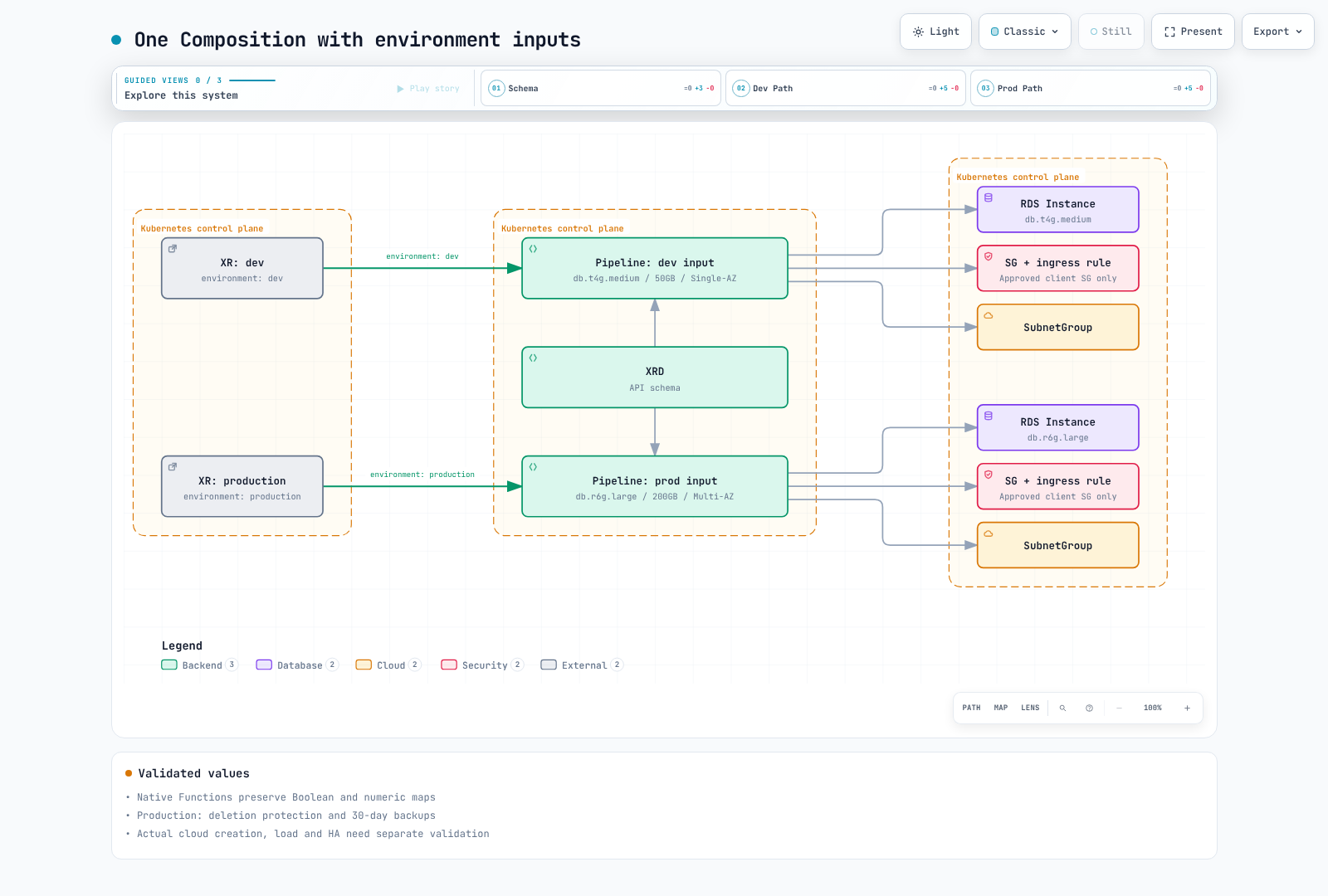
Development and Production Inputs
apiVersion: platform.example.com/v1alpha1
kind: PostgreSQLDatabase
metadata:
  name: orders-db
  namespace: team-alpha
spec:
  crossplane:
    compositionRef:
      name: postgresql-aws-reviewed
  parameters:
    environment: dev
    dbName: orders
    storageGB: 50
    vpcID: vpc-0123456789abcdef0
    subnetIDs:
    - subnet-0123456789abcdef0
    - subnet-0123456789abcdef1
    clientSecurityGroupID: sg-0123456789abcdef0
    passwordSecretName: rds-master-password
providerConfigName: team-awsapiVersion: platform.example.com/v1alpha1
kind: PostgreSQLDatabase
metadata:
name: orders-db
namespace: team-alpha
spec:
crossplane:
compositionRef:
name: postgresql-aws-reviewed
parameters:
environment: production
dbName: orders
storageGB: 200
vpcID: vpc-0123456789abcdef0
subnetIDs:
- subnet-0123456789abcdef0
- subnet-0123456789abcdef1
clientSecurityGroupID: sg-0123456789abcdef0
passwordSecretName: rds-master-password
providerConfigName: team-awsThese files are alternative inputs for the same named XR. Use distinct real namespaces/names/policies for simultaneous environments. spec.crossplane.compositionRef is the v2 management field, unlike the legacy Claim's spec.compositionRef.
Connection Secrets and Readiness
Core-native XR connection publication was removed in v2. MR writeConnectionSecretToRef remains; these namespace MRs specify only its name. P&T 0.10.10 can aggregate connectionDetails into a composed Secret.
This example puts only observed RDS address and username into orders-db-connection. It does not claim automatic password inclusion. Applications should mount endpoint and prepared password Secrets as files, handling rotation, TLS and retries. Base64 is not encryption.
To send data to an external Secrets Manager, evaluate appropriate PushSecret/provider support. ExternalSecret normally imports external values into Kubernetes; the original reverse-direction example was incorrect.
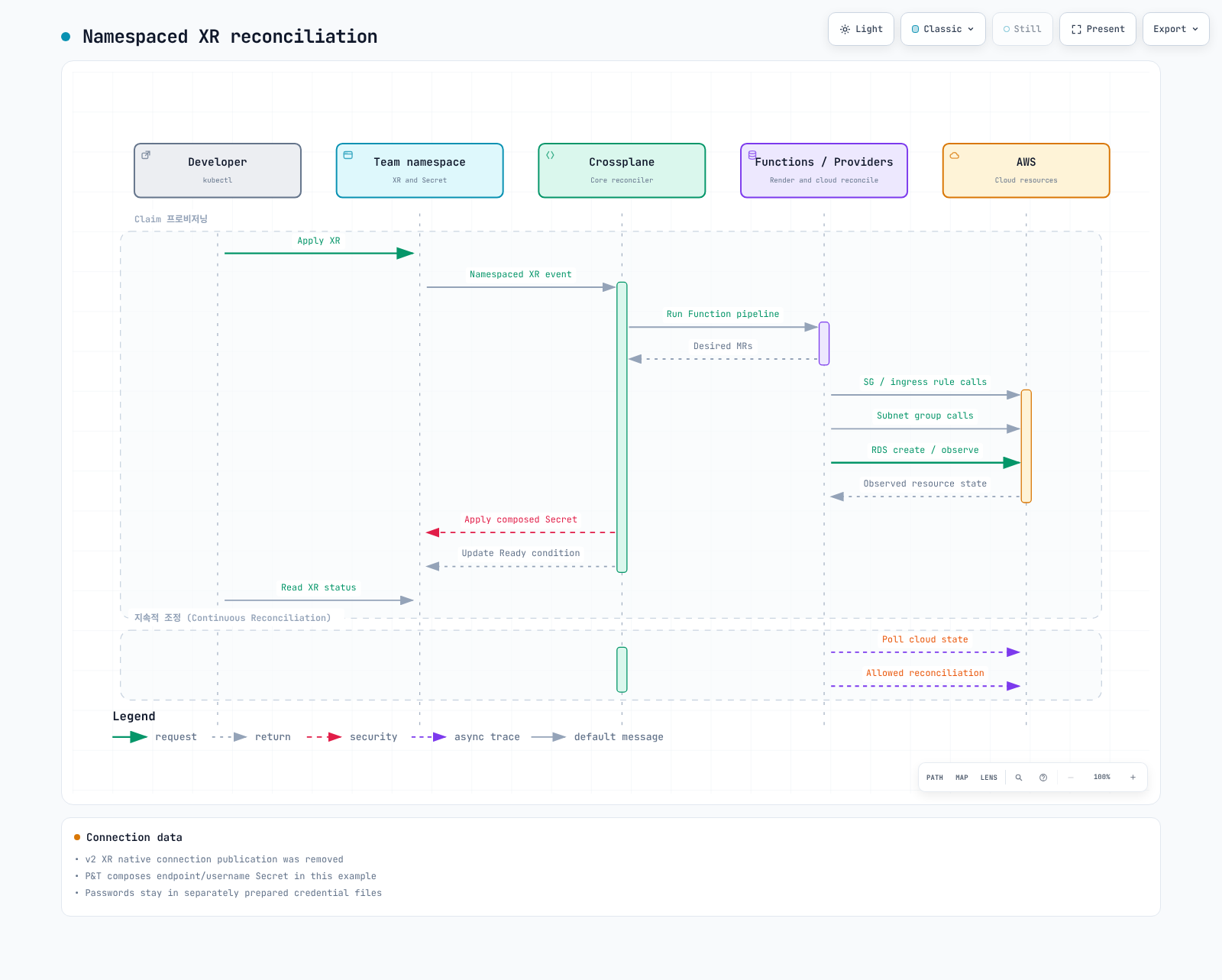
New-resource rendering produced Ready=False. With synthetic Ready=True/address observations, XR status and the composed Secret were populated. Rendered dates, names and state are simulation outputs, not actual AWS provisioning records. Rendering success is distinct from service readiness.
Adoption, Deletion and Upgrades
Do not attach external-name and immediately enable full creation/update/deletion on existing resources. First inspect supported Observe behavior, identifiers, region and ownership, then expand management after reviewing desired fields. Distinguish initProvider from reconciled forProvider.
For these namespace MRs, exclude Delete from managementPolicies for retention. Distinguish this from legacy deletionPolicy: Orphan and verify policy/provider support. RDS deletionProtection, final snapshots and backups are separate layers. Review finalSnapshotIdentifier for collisions before any actual deletion.
Deleting an XR can remove MRs and composed Secrets while retaining AWS resources whose policies exclude Delete. Plan credentials, backups and subsequent ownership for retained databases. Verify current protection.crossplane.io Usage/ClusterUsage APIs and scopes rather than using the old alpha Usage as a default.
Pin core, provider and function versions independently and validate revision, CRD and IAM changes. Simply changing a live Composition to namespace API groups can recreate resources; use new Compositions and a deliberate migration. Do not promise zero downtime without snapshot/restore and data verification.
Observability and Reconciliation
The reviewed AWS provider defaults to --poll=10m and --sync=1h with poll jitter. Its --max-reconcile-rate is used for both global rate and concurrency configuration, so it is not merely a fixed concurrency count. These are runtime settings, not part of the IRSA ProviderConfig example.
This example connects actual core/provider Pod labels and metrics ports. Enable core chart metrics.enabled and prepare Prometheus Operator/scraping separately.
apiVersion: monitoring.coreos.com/v1
kind: PodMonitor
metadata:
  name: crossplane
  namespace: crossplane-system
spec:
  jobLabel: app
  selector:
    matchLabels:
      app: crossplane
  podMetricsEndpoints:
  - port: metrics
    interval: 30s
---
apiVersion: monitoring.coreos.com/v1
kind: PodMonitor
metadata:
  name: provider-aws-s3
  namespace: crossplane-system
spec:
  jobLabel: app
  selector:
    matchLabels:
      app: provider-aws-s3-reviewed
  podMetricsEndpoints:
  - port: metrics
    interval: 30s
Avoid hardcoding changing ProviderRevision-name labels in selectors. kube_customresource_status_condition is not an automatic Crossplane metric; it needs configuration such as kube-state-metrics custom-resource metrics. Verify real names/labels before using rate/increase for counters and correctly grouped histogram quantiles.
ACK, Backstage and GitOps
ACK resources are also namespaced and can be composed with tools such as kro. Claims that ACK only provides cluster-scoped CRs or is a CNCF project were incorrect. Crossplane namespaces do not replace IAM or ProviderConfig/Composition authoring controls. Assign one mutation owner per external resource across ACK, Terraform and Crossplane.
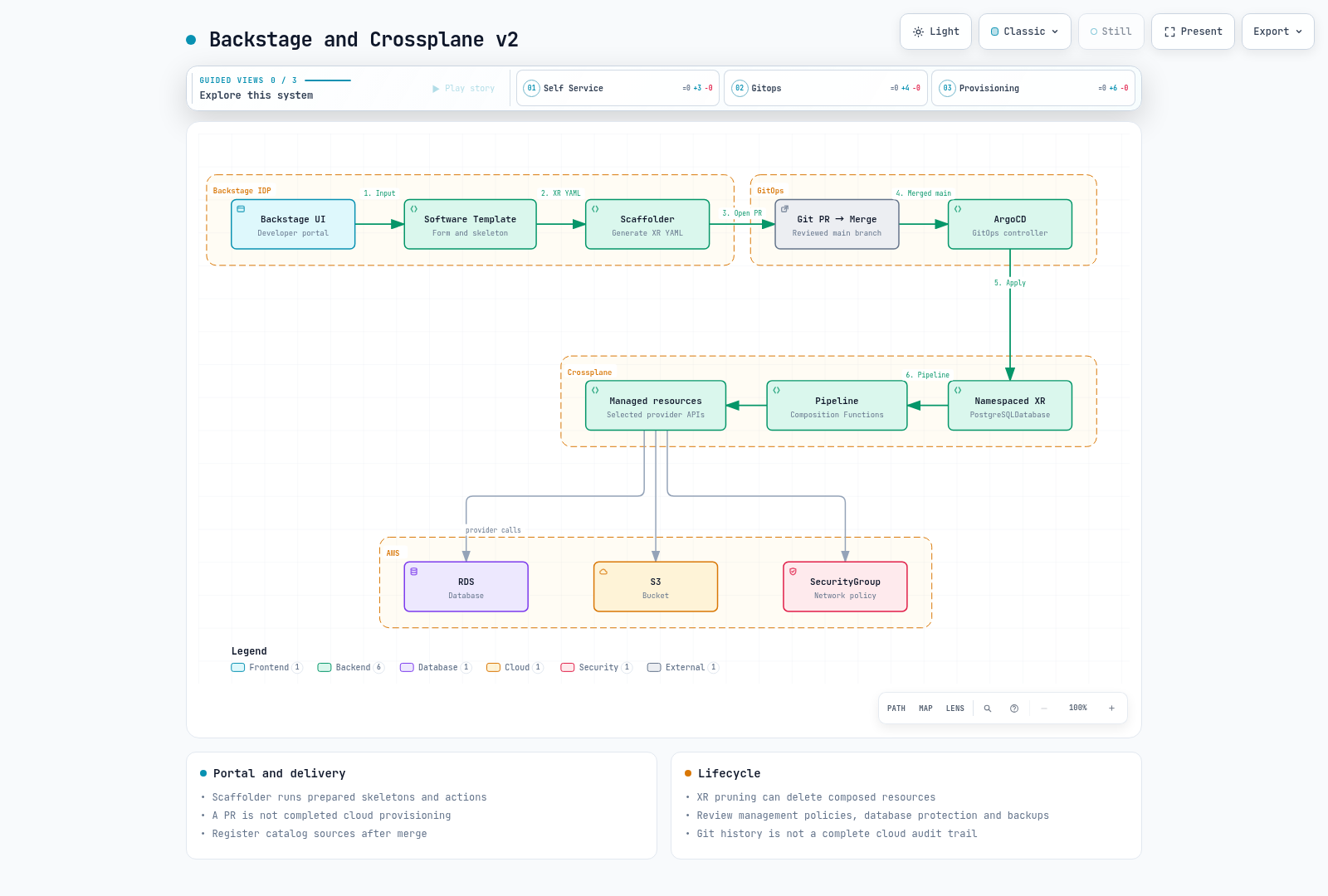
Use prepared Backstage skeletons/actions to create XR YAML, a reviewed GitOps PR and ArgoCD reconciliation. Opening a PR does not create a database, and unmerged main-branch catalog files cannot yet be registered. Git history and cloud API audit logs are separate. Review ArgoCD pruning with external-resource deletion/retention policy.
Verification Scope
The original 1,958-line Korean and 1,827-line English guides, both 143-line quizzes, 83 unique fenced blocks and additional indented blocks were read. Official CLI/core 2.4.0 binaries and P&T 0.10.10/auto-ready 0.7.0 sources were verified.
Actual localhost Functions and the core render engine processed development, production and observed-state cases. The CLI's API-server validation library checked MRs, XRs, DRCs and Providers; the core Secret was separately checked against official Kubernetes OpenAPI. Invalid database names, provider choices and storage inputs were rejected. Function processes were stopped afterward.
No AWS/Kubernetes resources, real RDS/network/IAM authentication, backup/restore, HA, load or Prometheus scrape was executed. Local output is not represented as production deployment success.