Resilience
Last Updated: September 11, 2026 · Istio 1.31. These are independent sidecar examples in
defaultwith HTTPmyappon port 8080. Do not apply every same-host example together. Validate actual proxy configuration and capacity; these examples have not been deployed or load-tested. Ambient L7 behavior requires a waypoint and a supported policy attachment.
Istio's resilience features help contain failures when configured for the application's semantics and capacity.
Table of Contents
Additional Resilience Patterns
This documentation also covers the following patterns:
- Circuit Breaker: Circuit breaking through Connection Pool
- Retry: Retry policies
- Timeout: Request time limits
- Fault Injection: Fault injection testing
Overview
Resilience is a critical characteristic in distributed systems. Istio can automatically implement various resilience patterns.
Core Resilience Patterns
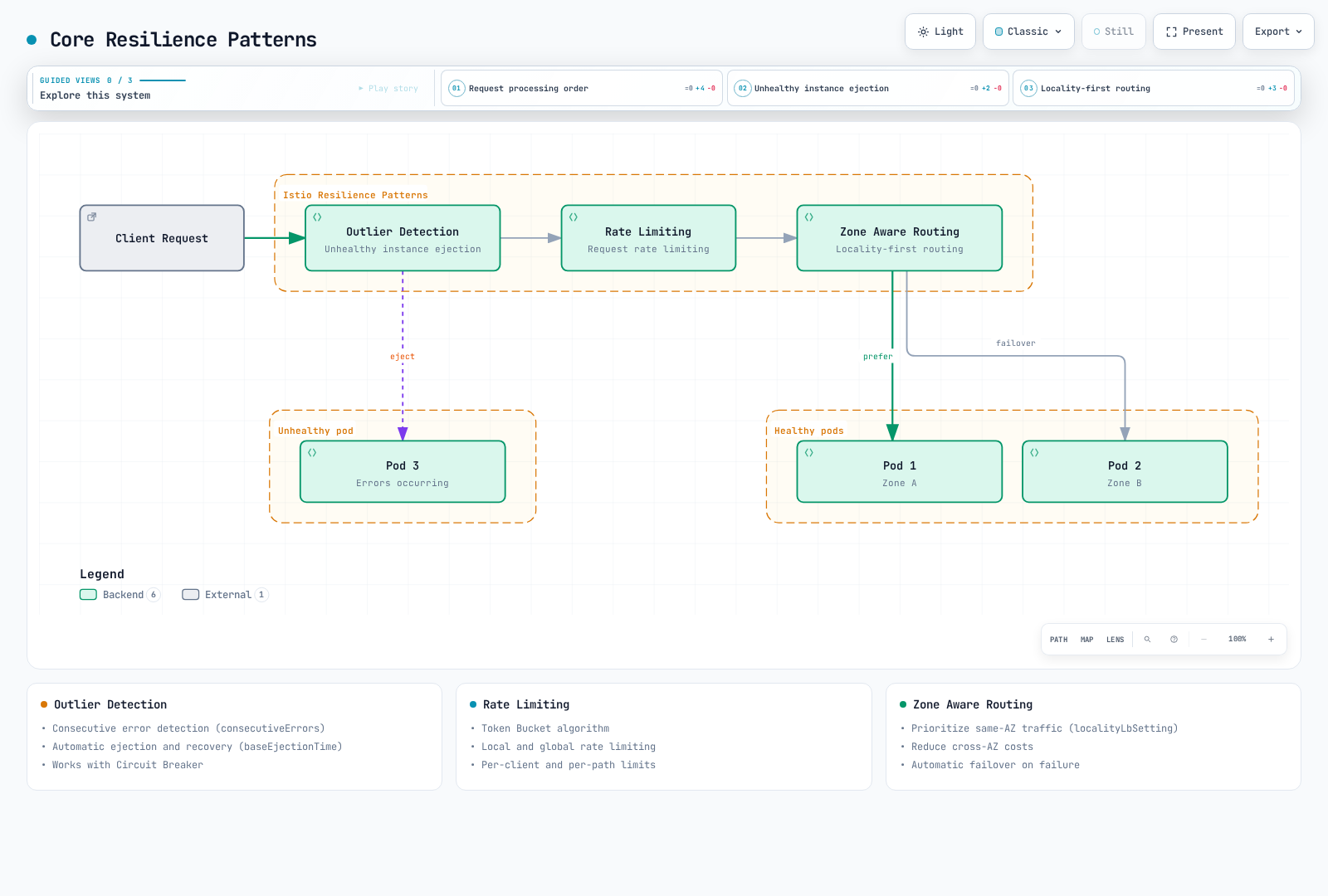
The figures summarize concepts, not a fixed sequence of network services. Outlier detection and locality selection are proxy load-balancing decisions; configured HTTP rate-limit filters run at the selected listener/route.
1. Outlier Detection
Automatically detects service instances exhibiting abnormal behavior and excludes them from the traffic pool.
apiVersion: networking.istio.io/v1
kind: DestinationRule
metadata:
  name: myapp
  namespace: default
spec:
  host: myapp
  trafficPolicy:
    outlierDetection:
      consecutive5xxErrors: 5
      interval: 30s
      baseEjectionTime: 30s
      maxEjectionPercent: 50
Key Features:
- Consecutive error detection
- Temporary ejection and eligibility for later traffic
- Works with Circuit Breaker
Ejection is local to each observing proxy, not deletion of a Pod or a mesh-wide health verdict. Consecutive failures can trigger detection immediately; interval is the sweep period. Ejection expires and can recur; it does not prove recovery.
2. Rate Limiting
Limits request rate to protect services from overload.
apiVersion: networking.istio.io/v1alpha3
kind: EnvoyFilter
metadata:
  name: ratelimit
  namespace: default
spec:
  configPatches:
  - applyTo: HTTP_FILTER
    match:
      context: SIDECAR_INBOUND
      listener:
        portNumber: 8080
        filterChain:
          filter:
            name: envoy.filters.network.http_connection_manager
            subFilter:
              name: envoy.filters.http.router
    patch:
      operation: INSERT_BEFORE
      value:
        name: envoy.filters.http.local_ratelimit
        typed_config:
          '@type': type.googleapis.com/envoy.extensions.filters.http.local_ratelimit.v3.LocalRateLimit
          stat_prefix: http_local_rate_limiter
          token_bucket:
            max_tokens: 100
            tokens_per_fill: 10
            fill_interval: 1s
          filter_enabled:
            default_value:
              numerator: 100
              denominator: HUNDRED
          filter_enforced:
            default_value:
              numerator: 100
              denominator: HUNDRED
  workloadSelector:
    labels:
      app: myapp
Key Features:
- Token Bucket algorithm
- Local and global rate limiting
- Per-client and per-path limits
The example enforces a local token bucket per Envoy process for the matched HTTP listener: initially 100 tokens, then 10 per second. It is not a service-wide quota; replica count and traffic distribution affect aggregate throughput. A global quota needs a rate-limit service and matching descriptors. Client/path limits need additional trusted classification; a caller-supplied header is not authenticated identity.
3. Zone Aware Routing
Optimizes traffic between Availability Zones to reduce latency and save costs.
apiVersion: networking.istio.io/v1
kind: DestinationRule
metadata:
  name: myapp
  namespace: default
spec:
  host: myapp
  trafficPolicy:
    loadBalancer:
      localityLbSetting:
        enabled: true
        distribute:
        - from: us-east-1/us-east-1a/*
          to:
            us-east-1/us-east-1a/*: 80
            us-east-1/us-east-1b/*: 20
    outlierDetection:
      consecutive5xxErrors: 5
      interval: 10s
      baseEjectionTime: 30s
      maxEjectionPercent: 50
      minHealthPercent: 0
Key Features:
- Prioritize same-AZ traffic
- Reduce cross-AZ costs
- Configure a separate locality failover policy when required
Locality paths are region/zone/subzone. This example intentionally distributes 80/20 while both zones are healthy; the 20% is ordinary cross-zone traffic, not standby failover. Use the separate locality-failover pattern for same-zone preference with spillover, and do not combine distribute with failover/failoverPriority. Outlier detection, ready endpoints and spare destination capacity are prerequisites; cost savings depend on actual billed traffic.
4. Circuit Breaker
Limits connection and request counts to prevent service overload.
apiVersion: networking.istio.io/v1
kind: DestinationRule
metadata:
  name: circuit-breaker
  namespace: default
spec:
  host: myapp
  trafficPolicy:
    connectionPool:
      tcp:
        maxConnections: 100
      http:
        http1MaxPendingRequests: 10
        http2MaxRequests: 100
        maxRequestsPerConnection: 2
    outlierDetection:
      consecutive5xxErrors: 5
      interval: 30s
      baseEjectionTime: 30s
How It Works: 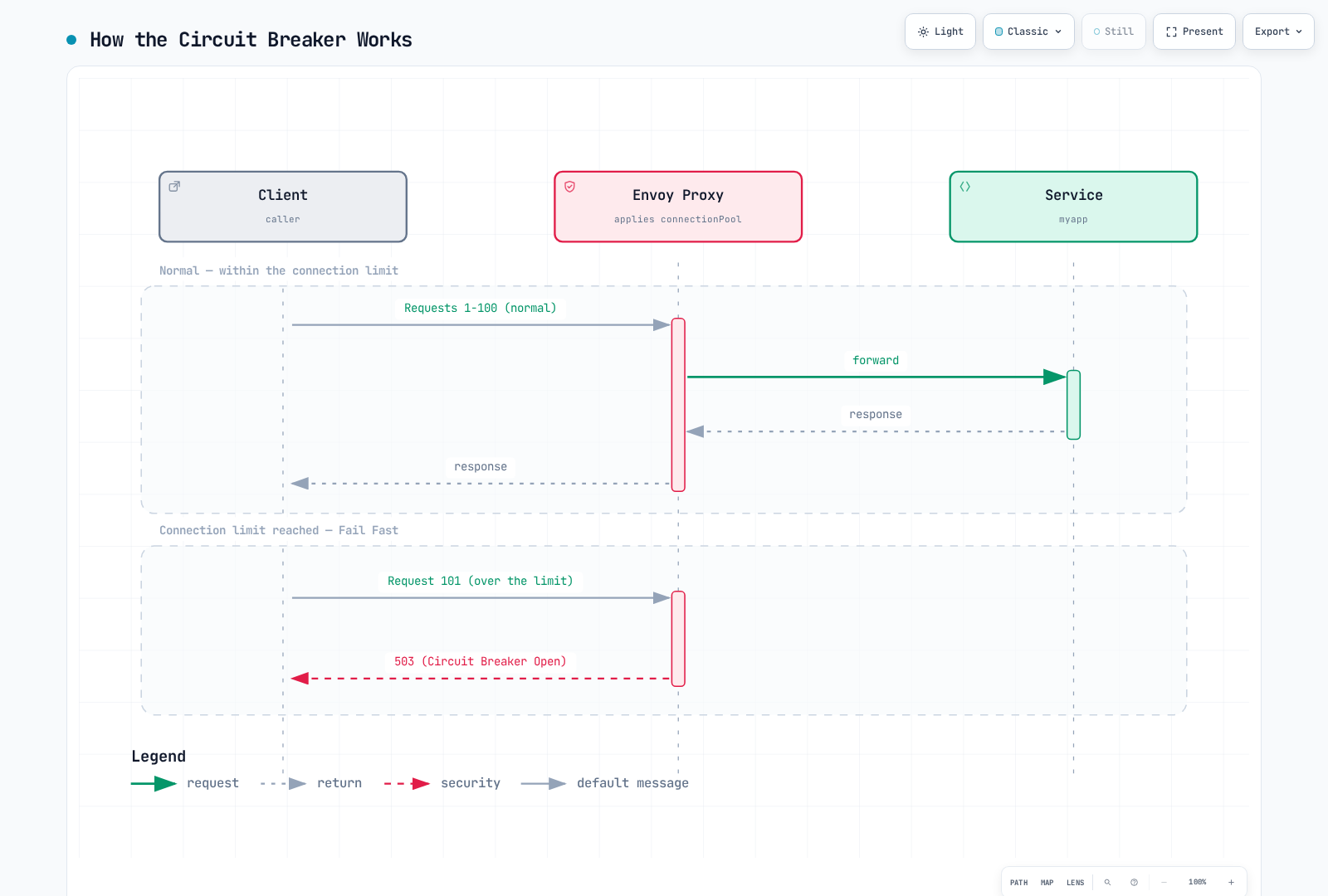
Key Features:
- TCP connection limits
- HTTP request limits
- Pending request limits
- Fail Fast on overflow
Connection/request breakers are local to each proxy’s upstream cluster and priority, not a global per-server-Pod capacity limit. http2MaxRequests also applies to HTTP/1.1. A connection-limit hit may queue a request until pending/request limits are exceeded; the diagram illustrates HTTP overflow returning 503/UO, not every connection reaching its threshold. TCP overflow has no HTTP status.
5. Retry
Automatically retries requests on transient failures.
apiVersion: networking.istio.io/v1
kind: VirtualService
metadata:
  name: myapp
  namespace: default
spec:
  hosts:
  - myapp
  http:
  - name: writes-no-retry
    match:
    - method:
        regex: ^(POST|PUT|PATCH|DELETE)$
    route:
    - destination:
        host: myapp
    timeout: 10s
    retries:
      attempts: 0
  - route:
    - destination:
        host: myapp
    retries:
      attempts: 3
      perTryTimeout: 2s
      retryOn: gateway-error,connect-failure,refused-stream
    timeout: 10s
    name: idempotent-reads
    match:
    - method:
        regex: ^(GET|HEAD|OPTIONS)$
  - name: other-methods-no-retry
    route:
    - destination:
        host: myapp
    timeout: 10s
    retries:
      attempts: 0
Retry Conditions (retryOn):
5xx: Server errors (500, 502, 503, 504)reset: TCP connection resetconnect-failure: Connection failurerefused-stream: HTTP/2 stream refusedretriable-4xx: HTTP 409 only under this Envoy policygateway-error: Gateway errors (502, 503, 504)
Backoff and locality (fragment for the matched read route above):
retries:
  attempts: 5
  perTryTimeout: 2s
  retryOn: gateway-error,connect-failure,refused-stream
  backoff: 25ms
  retryRemoteLocalities: true
How It Works: 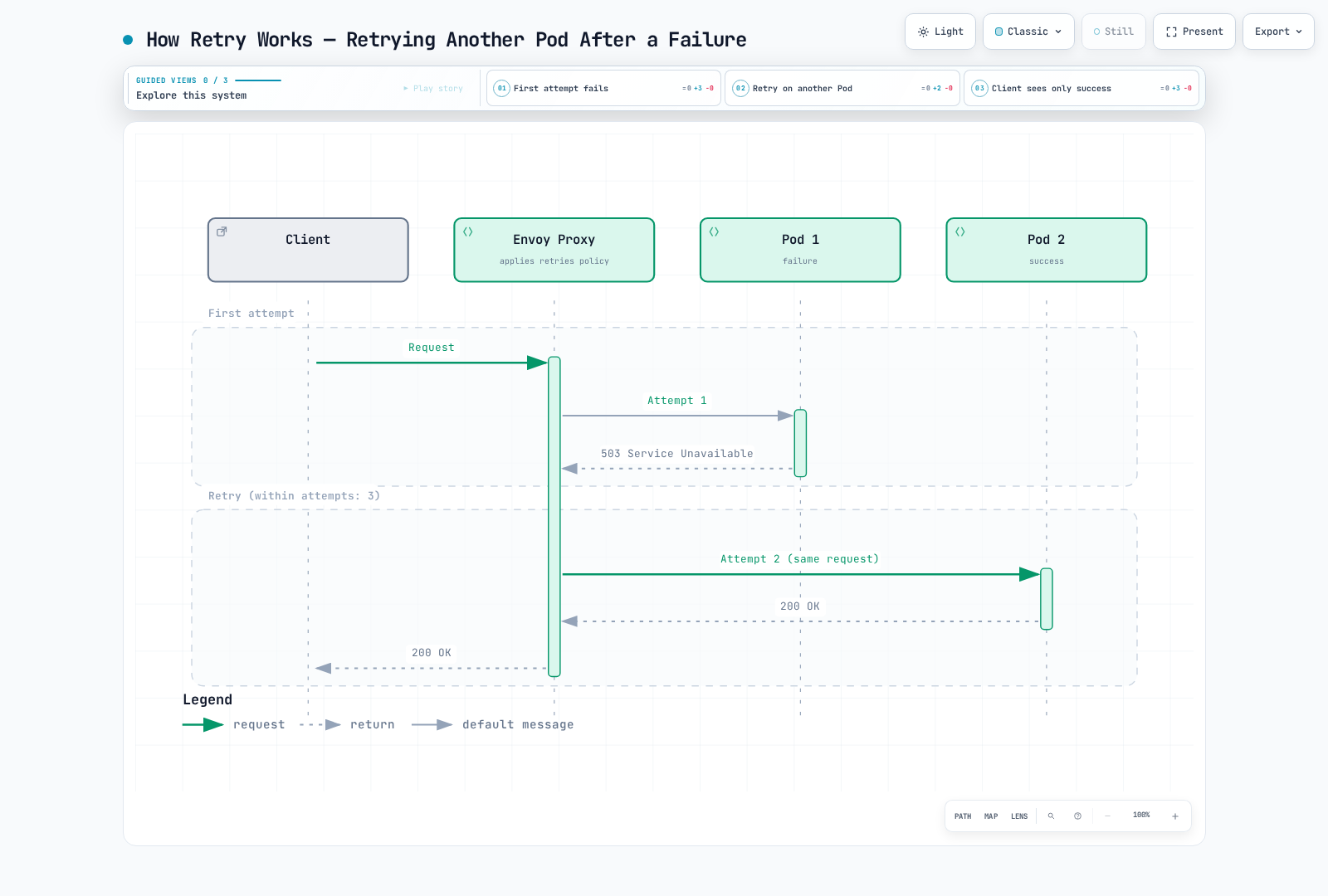
attempts: 3 allows up to three retries after the initial attempt. The route timeout may stop earlier. Read-method matching assumes application idempotency; PUT/DELETE semantics and application idempotency keys still require verification before enabling their retries. Omission can inherit mesh retries, so write/fallback routes explicitly use attempts: 0. A retry can revisit a host and does not guarantee success. Backoff is exponential with jitter; allowing remote localities does not set the backoff.
6. Timeout
Sets time limits to prevent requests from waiting indefinitely.
apiVersion: networking.istio.io/v1
kind: VirtualService
metadata:
  name: myapp
  namespace: default
spec:
  hosts:
  - myapp
  http:
  - name: writes-no-retry
    match:
    - method:
        regex: ^(POST|PUT|PATCH|DELETE)$
    route:
    - destination:
        host: myapp
    timeout: 5s
    retries:
      attempts: 0
  - route:
    - destination:
        host: myapp
    timeout: 5s
    retries:
      attempts: 3
      perTryTimeout: 2s
      retryOn: gateway-error,connect-failure,refused-stream
    name: idempotent-reads
    match:
    - method:
        regex: ^(GET|HEAD|OPTIONS)$
  - name: other-methods-no-retry
    route:
    - destination:
        host: myapp
    timeout: 5s
    retries:
      attempts: 0
Timeout Hierarchy (requires a separately configured my-gateway in default):
apiVersion: networking.istio.io/v1
kind: VirtualService
metadata:
  name: gateway-timeout
  namespace: default
spec:
  gateways:
  - my-gateway
  hosts:
  - example.com
  http:
  - route:
    - destination:
        host: frontend
    timeout: 30s
    retries:
      attempts: 0
---
apiVersion: networking.istio.io/v1
kind: VirtualService
metadata:
  name: service-timeout
  namespace: default
spec:
  hosts:
  - backend
  http:
  - route:
    - destination:
        host: backend
    timeout: 5s
    retries:
      attempts: 0
Illustrative budget ranges (derive actual values from SLOs and dependencies):
- Gateway -> Frontend: 30-60 seconds (user-facing)
- Service -> Service: 5-10 seconds (internal communication)
- Database queries: 2-5 seconds
- External APIs: 10-30 seconds
HTTP route timeouts do not configure database client/query timeouts or guarantee cancellation of downstream work. Propagate application deadlines; a smaller total timeout intentionally permits fewer retries.
7. Fault Injection
Intentionally injects faults for chaos engineering.
apiVersion: networking.istio.io/v1
kind: VirtualService
metadata:
  name: fault-injection
  namespace: default
spec:
  hosts:
  - myapp
  http:
  - fault:
      delay:
        percentage:
          value: 10.0
        fixedDelay: 5s
      abort:
        percentage:
          value: 5.0
        httpStatus: 503
    route:
    - destination:
        host: myapp
Use Case Scenarios:
- Network Latency Simulation:
fault:
  delay:
    percentage:
      value: 100.0
fixedDelay: 7s- Intermittent Failure Testing:
fault:
  abort:
    percentage:
      value: 20.0
httpStatus: 500- Inject Faults for Specific Users Only:
apiVersion: networking.istio.io/v1
kind: VirtualService
metadata:
  name: fault-injection-user
  namespace: default
spec:
  hosts:
  - myapp
  http:
  - match:
    - headers:
        end-user:
          exact: test-user
    fault:
      abort:
        percentage:
          value: 100.0
        httpStatus: 503
    route:
    - destination:
        host: myapp
  - name: ordinary-traffic
    route:
    - destination:
        host: myapp
    retries:
      attempts: 0
Fault injection is a controlled lab operation. On a client-side route with fault, Istio does not enable that route’s retries/timeouts. Test retry behavior using faults at a separate downstream hop. A test-user header only scopes traffic; enforce who may supply it. The ordinary-traffic fallback prevents other requests from becoming unmatched.
Resilience Pattern Combinations
Outlier Detection + Circuit Breaker
apiVersion: networking.istio.io/v1
kind: DestinationRule
metadata:
  name: myapp-resilient
  namespace: default
spec:
  host: myapp
  trafficPolicy:
    connectionPool:
      tcp:
        maxConnections: 100
      http:
        http1MaxPendingRequests: 50
        maxRequestsPerConnection: 2
    outlierDetection:
      consecutive5xxErrors: 5
      interval: 30s
      baseEjectionTime: 30s
      maxEjectionPercent: 50
      minHealthPercent: 0
Rate Limiting + Retry
apiVersion: networking.istio.io/v1
kind: VirtualService
metadata:
  name: myapp
  namespace: default
spec:
  hosts:
  - myapp
  http:
  - name: writes-no-retry
    match:
    - method:
        regex: ^(POST|PUT|PATCH|DELETE)$
    route:
    - destination:
        host: myapp
    timeout: 10s
    retries:
      attempts: 0
  - route:
    - destination:
        host: myapp
    retries:
      attempts: 3
      perTryTimeout: 2s
      retryOn: gateway-error,connect-failure,refused-stream
    timeout: 10s
    name: idempotent-reads
    match:
    - method:
        regex: ^(GET|HEAD|OPTIONS)$
  - name: other-methods-no-retry
    route:
    - destination:
        host: myapp
    timeout: 10s
    retries:
      attempts: 0
---
apiVersion: networking.istio.io/v1alpha3
kind: EnvoyFilter
metadata:
  name: ratelimit
  namespace: default
spec:
  workloadSelector:
    labels:
      app: myapp
  configPatches:
  - applyTo: HTTP_FILTER
    match:
      context: SIDECAR_INBOUND
      listener:
        portNumber: 8080
        filterChain:
          filter:
            name: envoy.filters.network.http_connection_manager
            subFilter:
              name: envoy.filters.http.router
    patch:
      operation: INSERT_BEFORE
      value:
        name: envoy.filters.http.local_ratelimit
        typed_config:
          '@type': type.googleapis.com/envoy.extensions.filters.http.local_ratelimit.v3.LocalRateLimit
          stat_prefix: http_local_rate_limiter
          token_bucket:
            max_tokens: 1000
            tokens_per_fill: 100
            fill_interval: 1s
          filter_enabled:
            default_value:
              numerator: 100
              denominator: HUNDRED
          filter_enforced:
            default_value:
              numerator: 100
              denominator: HUNDRED
Resilience Architecture
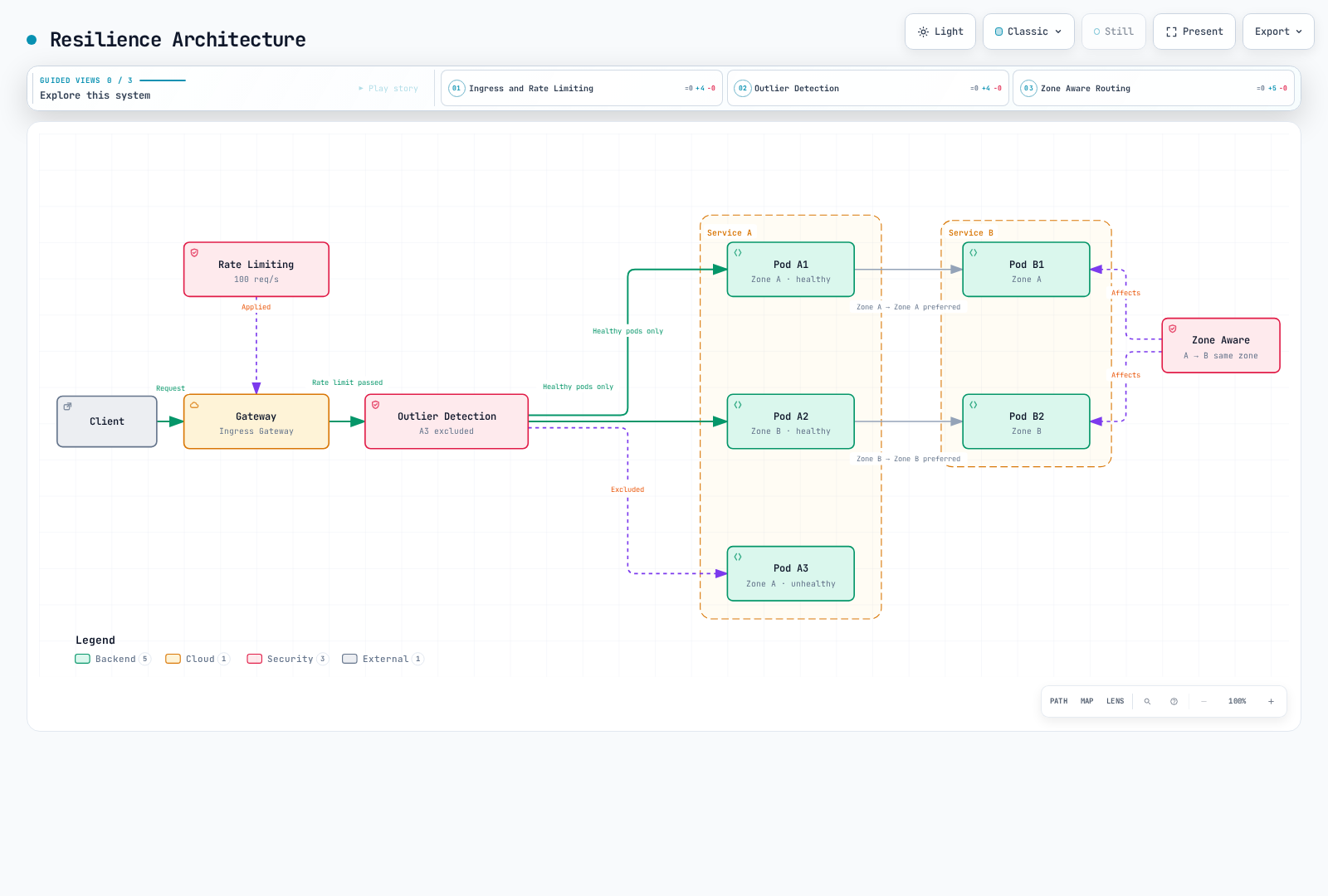
Resilience Metrics
Scrape one intended proxy endpoint per Pod as described in metrics. Envoy does not export every optional stat by default. Merge this annotation into the relevant Pod template and roll out new proxies before checking the actual names/labels:
spec:
  template:
    metadata:
      annotations:
        proxy.istio.io/config: |
          proxyStatsMatcher:
            inclusionRegexps:
            - ".*outlier_detection.*"
            - ".*circuit_breakers.*"
            - ".*upstream_rq_retry.*"
            - ".*upstream_rq_timeout.*"
            - ".*upstream_rq_.*overflow.*"
            - ".*http_local_rate_limit.*"
            - ".*fault.*"
Prometheus Queries
Rates are per second; _open is a 0/1 capacity-state gauge, and ejections_active is a current host count. These single-cluster examples assume scrape labels namespace/pod; narrow the destination cluster for a specific dependency. The local-rate-limit prefix depends on stat_prefix and the emitted stat name. rate_limited counts token shortages even without enforcement; enforced counts applied limits. Active-request overflow counters differ by Envoy version: inspect upstream_rq_active_overflow if exposed rather than assuming every overflow increments the pending counter.
# Active ejections per observed cluster
 envoy_cluster_outlier_detection_ejections_active{namespace="default"}

# Locally rate-limited requests per second, retaining Pod identity
sum by (namespace, pod) (rate({__name__=~"envoy_.*http_local_rate_limit_enforced",namespace="default"}[5m]))

# Request circuit breaker currently at capacity (not a cumulative count)
envoy_cluster_circuit_breakers_default_rq_open{namespace="default"}

# Pending-queue circuit-breaker overflows per second
sum(rate(envoy_cluster_upstream_rq_pending_overflow{namespace="default"}[5m]))

# Retry attempts and retry-success events per second (different event counters)
sum(rate(envoy_cluster_upstream_rq_retry{namespace="default"}[5m]))
sum(rate(envoy_cluster_upstream_rq_retry_success{namespace="default"}[5m]))

# Upstream request timeouts per second
sum(rate(envoy_cluster_upstream_rq_timeout{namespace="default"}[5m]))

# Observed destination HTTP 2xx/3xx fraction; define your own SLI for 4xx/gRPC
sum(rate(istio_requests_total{reporter="destination",destination_service_namespace="default",response_code=~"[23].."}[5m])) /
sum(rate(istio_requests_total{reporter="destination",destination_service_namespace="default"}[5m]))
source_zone and destination_zone are not standard Istio labels. An AZ report needs validated topology enrichment or another source of zonal flow data; cluster IDs are not AZ IDs. Destination metrics exclude requests that never reach the service, so inspect source-side failure signals too.
Grafana Dashboard Panels
Display active connections, open/closed state and overflow rate separately. There is no standard envoy_cluster_circuit_breakers_default_cx_max capacity gauge or ...rq_overflow breaker gauge. Use effective cluster thresholds when calculating capacity, and never divide by a 0/1 open flag.
envoy_cluster_upstream_cx_active{namespace="default"}
envoy_cluster_circuit_breakers_default_cx_open{namespace="default"}

# Source-side observed final HTTP 5xx fraction, not hypothetical no-retry errors
sum(rate(istio_requests_total{reporter="source",destination_service_namespace="default",response_code=~"5.."}[5m])) /
sum(rate(istio_requests_total{reporter="source",destination_service_namespace="default"}[5m]))
Retry counters cannot reconstruct a counterfactual “error rate without retries.” Correlate attempts, final outcomes, latency and load using scoped measurements; no-traffic/missing series require separate handling.
Best Practices
1. Outlier Detection Threshold Tuning
# Adjust according to service characteristics
outlierDetection:
  consecutive5xxErrors: 5          # 5 consecutive failures
  interval: 30s                 # Evaluate every 30 seconds
  baseEjectionTime: 30s         # 30 second ejection
  maxEjectionPercent: 50        # Maximum 50% ejected
  minHealthPercent: 0           # Disable unhealthy-pool fail-open threshold
minHealthPercent is not a guarantee of healthy capacity: below a nonzero threshold, outlier detection is disabled and the proxy can use healthy and unhealthy hosts. 0 disables that threshold. Repeated ejections can last longer than baseEjectionTime; monitor actual ejected hosts and remaining capacity.
2. Staged Rate Limiting
# Apply limits at Gateway -> Service stages
# Gateway: Overall traffic limit
# Service: Individual service limit
3. Zone Aware Routing Priority
For same-zone preference with failover, use locality priorities rather than an 80/20 distribution. Confirm node region/zone labels and available endpoints. The zone-aware chapter covers distribution and failover as separate modes.
4. Circuit Breaker Configuration
Size each caller proxy's destination-cluster limits against measured concurrency and destination capacity. The number of callers, HTTP multiplexing, load distribution and rollout surges all matter; Pod count multiplied by an arbitrary factor is not a global admission limit. Large queues can hide overload.
# DestinationRule trafficPolicy fragment; example values require load tests
connectionPool:
  tcp:
    maxConnections: 100
  http:
    http1MaxPendingRequests: 10
    http2MaxRequests: 100
    maxRequestsPerConnection: 0
    maxRetries: 10
maxRequestsPerConnection: 0 permits reuse without this request-count cap; 1 disables keep-alive. Values 1–5 are not a general optimization. maxRetries bounds concurrent outstanding retries per upstream cluster, not retries per request.
5. Retry Policy
Use the explicit write guard and read-method match in the complete example above. A YAML comment saying “GET only” does not limit matching. Retry only operations whose application semantics are safe to repeat, with bounded attempts/backoff and a total deadline. Do not automatically retry 429 or overload responses: retries can defeat rate limiting and worsen a failure. The combined example uses a larger local bucket (1000 initial tokens, refill 100/s), not a global quota.
6. Timeout Configuration
Budget the entire call graph, including the first attempt, retries, backoff and application processing. If all attempts are intended to fit:
route budget >= (1 + attempts) × perTryTimeout + backoff + other overheadWith attempts: 3 and perTryTimeout: 2s, four full attempts use 8 seconds before backoff/other overhead. timeout: 10s is an example budget, not a guarantee; timeout: 5s intentionally cannot fit four full two-second attempts. Application deadlines must also cover request upload/streaming semantics and propagate cancellation appropriately.
7. Fault Injection Testing
Use the complete header-matched route and ordinary-traffic fallback above. Separate the fault-producing hop from a retry/timeout policy being tested. Start in a disposable test environment, then use a bounded cohort and abort criteria in staging. Any production experiment needs workload-specific authorization, observability and rollback thresholds; a fixed 1%→5%→10% schedule is not universally safe.
Troubleshooting
Outlier Detection Not Working
# 1. Check DestinationRule
kubectl get destinationrule -A

# 2. Check Envoy cluster status
istioctl proxy-config clusters <pod-name> -n <namespace>

# 3. Check Outlier Detection metrics
istioctl x envoy-stats <pod-name> -n <namespace> --output prom | grep outlier
Rate Limiting Not Applied
# 1. Check EnvoyFilter
kubectl get envoyfilter -A

# 2. Check Envoy configuration
istioctl proxy-config listener <pod-name> -n <namespace> -o json

# 3. Check Rate Limit metrics
istioctl x envoy-stats <pod-name> -n <namespace> --output prom | grep rate_limit
Zone Aware Routing Not Working
# 1. Check DestinationRule
kubectl get destinationrule -A

# 2. Map Pods to node topology; Pod zone labels are not added automatically
kubectl get pods -n <namespace> -o wide
kubectl get nodes -L topology.kubernetes.io/region,topology.kubernetes.io/zone

# 3. Check Locality information
istioctl proxy-config endpoints <pod-name> -n <namespace>
Circuit Breaker Not Opening
# 1. Check DestinationRule connectionPool settings
kubectl get destinationrule <name> -o yaml

# 2. Check Circuit Breaker metrics
istioctl x envoy-stats <pod-name> -n <namespace> --output prom | grep circuit_breakers

# 3. Check for overflow
istioctl x envoy-stats <pod-name> -n <namespace> --output prom | grep overflow

# 4. Check active connection count
istioctl x envoy-stats <pod-name> -n <namespace> --output prom | grep upstream_cx_active
Retry Not Working
# 1. Check VirtualService
kubectl get virtualservice <name> -o yaml

# 2. Check Retry metrics
istioctl x envoy-stats <pod-name> -n <namespace> --output prom | grep retry

# 3. Inspect enabled access/debug logs; default logs need not contain each retry
kubectl logs -n <namespace> <pod-name> -c istio-proxy | grep retry

# 4. Check retry conditions
istioctl proxy-config routes <pod-name> -n <namespace> -o json | \
  jq '.[] | .virtualHosts[]? | {name, domains, routes: [.routes[]? | {name, match, retryPolicy: .route.retryPolicy}]}'
Timeout Not Applied
# 1. Check VirtualService timeout
kubectl get virtualservice <name> -o yaml | grep timeout

# 2. Check Timeout metrics
istioctl x envoy-stats <pod-name> -n <namespace> --output prom | grep timeout

# 3. Check request duration
istioctl x envoy-stats <pod-name> -n <namespace> --output prom | grep request_duration

# 4. Check Envoy route configuration
istioctl proxy-config routes <pod-name> -n <namespace> -o json | \
  jq '.[] | .virtualHosts[].routes[].route.timeout'
Fault Injection Not Working
# 1. Check VirtualService fault configuration
kubectl get virtualservice <name> -o yaml | grep -A 10 fault

# 2. Check request headers (if match conditions exist)
curl -H "end-user: test-user" http://your-service/api

# 3. Check Envoy filters
istioctl proxy-config routes <pod-name> -n <namespace> -o json | \
  jq '.[] | .virtualHosts[]?.routes[]? | select(.typedPerFilterConfig["envoy.filters.http.fault"] != null) | {name, fault: .typedPerFilterConfig["envoy.filters.http.fault"]}'

# 4. Check Fault metrics
istioctl x envoy-stats <pod-name> -n <namespace> --output prom | grep fault
Next Steps
- Outlier Detection: Automatic unhealthy instance detection
- Rate Limiting: Request rate control
- Zone Aware Routing: Locality-aware routing
References
Official Documentation
- Istio Resilience
- Outlier Detection
- Circuit Breaking
- Request Timeouts
- Retries
- Rate Limiting
- Fault Injection
- Locality Load Balancing
AWS Related Resources
Patterns and Architecture
- Microservices Patterns - Circuit Breaker
- Release It! - Stability Patterns
- Chaos Engineering Principles
Quiz
To test your knowledge from this chapter, try the Istio Resilience Quiz.