MLflow on EKS Deep Dive
Review baseline: MLflow 3.16.0 Latest patch checked: MLflow 3.16.1 (September 17, 2026) Documentation reviewed: October 12, 2026
Overview
MLflow provides experiment tracking, model logging and registration, version management, GenAI evaluation, and tracing. Tracing arrived in 2.14.0; 3.x expanded LoggedModel, evaluation, and UI integration. Version 3.16.0 was released on 2026-09-04.
Patch 3.16.1 followed on 2026-09-17 and removed the shipped default basic-auth administrator password. The examples below were checked with 3.16.0 and were not rerun on 3.16.1. MLflow 3.17.0 (2026-10-07) is a later minor release that requires a coordinated SQL schema upgrade for SQL-backed servers; this series does not cover it.
Use it locally with the SDK and SQLite, or operate an HTTP tracking service with separate SQL metadata and artifact stores. A logical service need not be one Pod or storage system. This series covers Tracking, Registry, and EKS deployment; it does not validate every MLflow feature or successful GPU training.
Component Map
| Concept | Problem It Solves | Deep Dive |
|---|---|---|
| Tracking | Log and query experiment parameters, metrics, artifacts, models, and GenAI traces | Part 1 |
| Model Registry | Give a model a stable, versioned identity independent of any one training run | Part 2 |
| EKS Deployment | Run the tracking server, backend store, and artifact store on EKS | Part 3 |
Why Run This on EKS
The trade-off is the same one covered elsewhere in this documentation site's data/ML sections: a team already running EKS can reuse the same deployment, IAM (IRSA/Pod Identity), and observability patterns for MLflow's tracking server as for everything else on the cluster, in exchange for operating the tracking server, its backend database, and its artifact store directly rather than using a managed alternative.
The SageMaker AI guidebook describes a Qwen comparison design. That example has separate historical version pins and currently blocks GPU execution because its DLC reached end of patch. This series' MLflow 3.16.0 local checks are not end-to-end validation of that example.
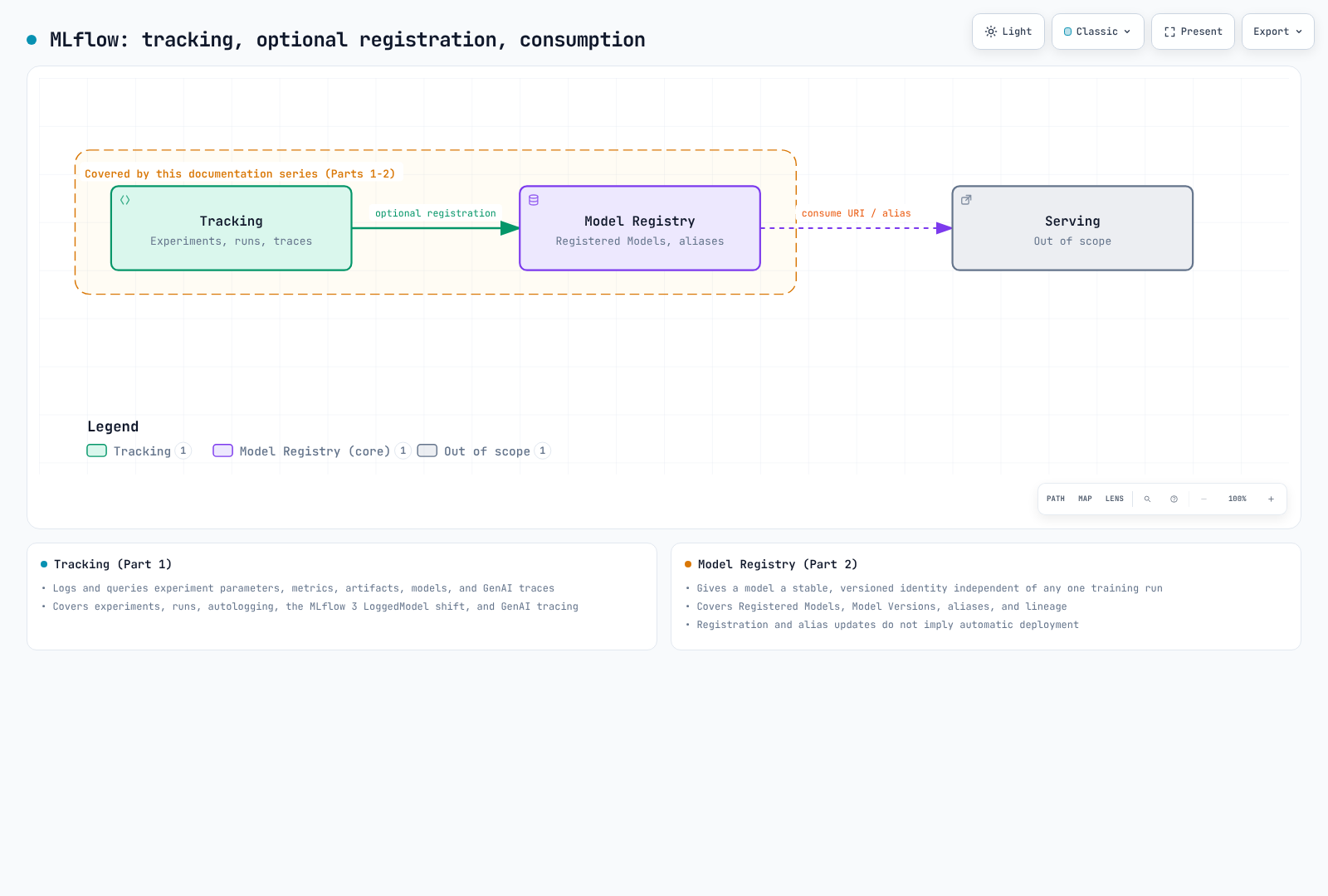
Model Registry registration is an optional lifecycle step. Serving systems consume model URIs or aliases through separate configuration; registration or an alias change does not automatically deploy a model.
Currently Covered
- Part 1: MLflow Tracking — experiments, runs, autologging, the MLflow 3
LoggedModelshift, and GenAI tracing - Part 2: MLflow Model Registry — Registered Models, Model Versions, aliases, and lineage
- Part 3: Deploying MLflow on EKS — tracking server, PostgreSQL backend store, S3 artifact store, and IAM access