Part 5: Kubeflow Trainer and Distributed Training
Review baseline: Trainer 2.2.0 / Community Distribution 26.03.1; separate 2.3.0 upgrade comparison Last Updated: September 12, 2026
Lab Environment Setup
Use compatible Kubernetes, Trainer controller/CRDs, runtimes and their dependencies such as JobSet. GPUs are workload-dependent; CPU training is possible. GPU workloads additionally require drivers, device plugins, node capacity and networking. Validation here is Helm rendering and schema inspection, not training execution.
From Framework-Specific Operators to a Unified API
Distributed training on Kubernetes has gone through a real architectural shift inside the Kubeflow project, and this is the most important thing to understand before touching any YAML.
The original Training Operator (v1)
The Training Operator that Kubeflow consolidated in 2021 took a framework-specific CRD approach. Each supported ML framework got its own Custom Resource Definition, each with its own controller implementing that framework's particular distributed-training semantics:
PyTorchJob— the controller understood PyTorch's distributed launch conventions, injecting environment variables likeMASTER_ADDR,RANK, andWORLD_SIZEinto each worker Pod sotorch.distributedcould form a process group.TFJob— the controller instead constructed aTF_CONFIGenvironment variable (a JSON blob describing the cluster's task roles — chief, worker, parameter server) that TensorFlow's distribution strategies expect.MPIJob— the controller handled launching an MPI job across Pods, coordinating anmpirun-style launcher against a set of worker Pods.
Beyond these three, the v1 Training Operator also shipped CRDs for a handful of other frameworks. Each CRD encoded a different framework's idea of "how workers find each other and agree on their roles" directly into a separate controller, so adding a framework required integration, while shared Job-controller plumbing could still be reused.
The shift to Kubeflow Trainer v2
Kubeflow Trainer v2 replaces this with a single, unified API built around two concepts instead of one CRD per framework:
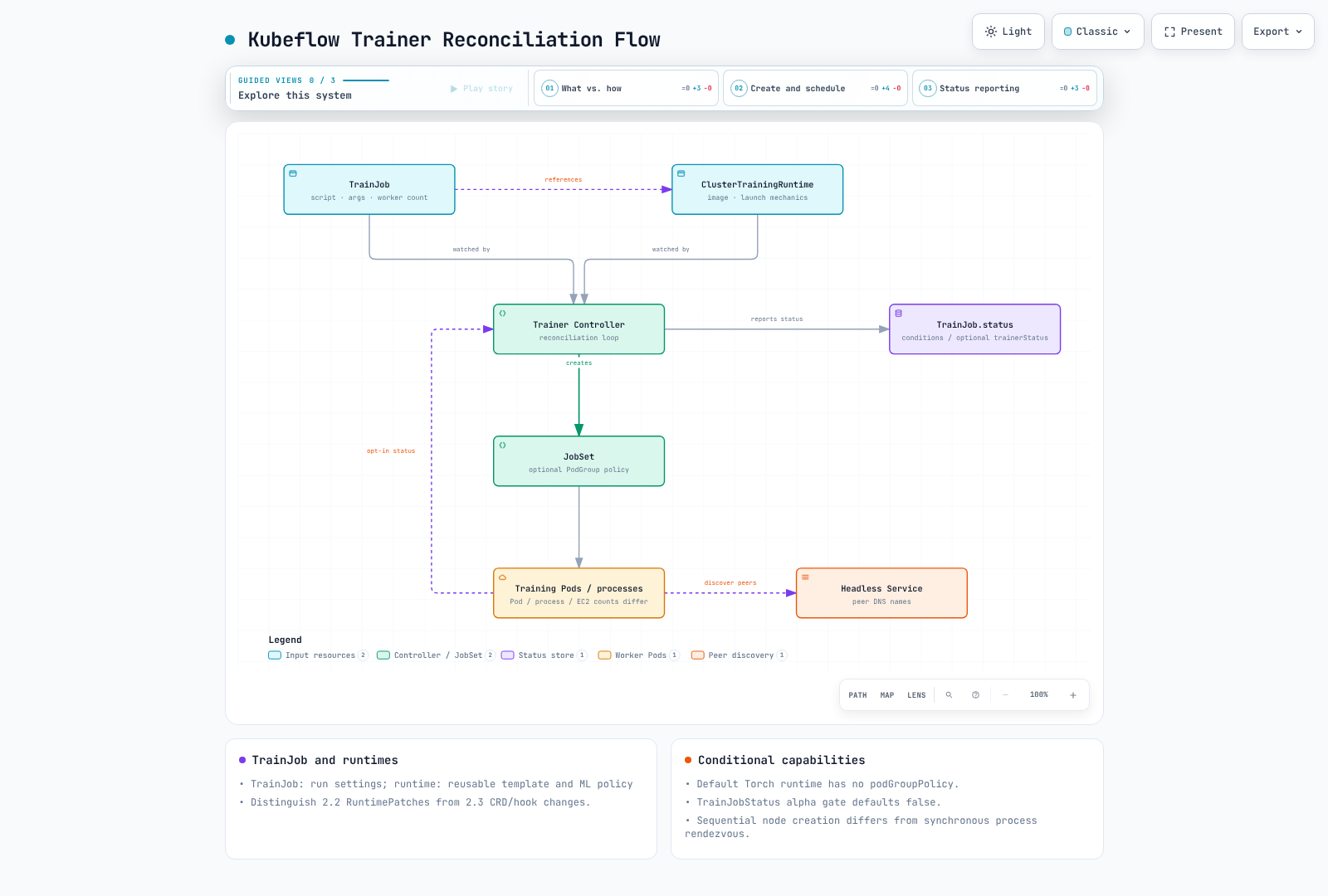
TrainJob— describes what to run: the training script/entrypoint, arguments, resource counts (e.g., number of workers), and a reference to the runtime that should execute it. This is the object an ML practitioner creates for an individual training run.TrainingRuntime/ClusterTrainingRuntime— describes how to run it: a reusable, framework-specific execution template covering the container image, the distributed launch mechanics (how workers discover each other, what env vars or launcher process gets used), and default resource shape. A platform team defines a small set of these once — say, a PyTorch DDP runtime, an MPI runtime — and many differentTrainJobs reference the same runtime across many training runs.
This mirrors a pattern seen elsewhere in Kubernetes: separating a reusable "template" resource from the "instance" that consumes it, similar in spirit to how a StorageClass is a reusable template that many PersistentVolumeClaims reference. The practical benefit is that a platform team can own and version the tricky distributed-launch mechanics in one place (the runtime), while ML practitioners submitting jobs only need to supply their script and ask for a runtime by name — the runtime reduces repeated setup, while training code must still handle compatible distributed initialization, data sharding, checkpointing and recovery.
Differences Between 2.2.0 and 2.3.0
Trainer 2.2.0 was released March 20, 2026 and is bundled in 26.03.1. It adds JAX/XGBoost runtimes and Flux policy/integration; feature inclusion does not prove compatibility with every image, network or accelerator configuration.
2.2.0 also replaces PodTemplateOverrides with RuntimePatches and removes numProcPerNode from the Torch policy and removes ElasticPolicy. Do not confuse a runtime Torch policy with per-run trainer.numProcPerNode. Earlier 2.x manifests can require migration too.
Runtime progress/metrics in status.trainerStatus require the alpha TrainJobStatus feature gate, disabled by default. Training code must report to the status server with working TLS/projected ServiceAccount-token access. Injected token/CA environment values are file paths, not secret contents. Printing logs alone does not automatically populate status metrics.
2.3.0, released August 7, 2026, changes runtime finalizers/snapshots and Helm CRD placement. Its release notes require 2.0/2.1/2.2 installations to pass through 2.3 before later versions. Review CRD Helm ownership and release-specific migration before upgrading; deleting existing CRDs is not a routine upgrade fix.
The published OCI charts also differ: 2.2 renders eight default runtimes directly, while 2.3 packages them in a runtimes.yaml ConfigMap applied by a post-install/post-upgrade installer Job. The 2.3 hook installs kubectl at runtime, force-applies resources server-side and prunes by its management label; a pre-delete hook also exists. Review GitOps hook handling, network access and runtime ownership. This review rendered the hooks without executing them.
Migrating Legacy APIs
26.03.1 includes Trainer 2.2.0 and legacy Training Operator 1.9.2. Their coexistence does not reveal any team's migration progress. PyTorchJob/TFJob/MPIJob and TrainJob are different APIs and are not automatically converted.
The pinned official migration document provides a PyTorchJob-to-default-Torch-runtime example and SDK direction, not an exhaustive mapping for every framework/field. Compare replica roles, launch commands, environment, retries, storage, scheduling/networking and checkpoint recovery for each workload.
TrainJob and Runtime Responsibilities
TrainingRuntime is namespaced; ClusterTrainingRuntime is cluster-scoped. Both contain execution templates and ML policies. TrainJob.runtimeRef selects kind/name, while trainer fields can configure command/arguments, training Pod count and resources per Pod. Permissions and allowed overrides need separate management.
The default torch-distributed runtime has mlPolicy.numNodes: 1, torch: {} and a JobSet template. In 2.2.0 it references pytorch/pytorch:2.10.0-cuda12.8-cudnn9-runtime. Record image/runtime revisions and verify architecture, drivers and communication libraries; this review did not execute the image or train a model.
Here numNodes represents training Pod count, not a one-to-one EC2 instance count. Calculate processes, GPUs per Pod and placement of multiple Pods separately.
Distributed Training Mechanics on Kubernetes
JobSet and runtimes compose Jobs/Pods and use Service/DNS plus rank/rendezvous configuration for process discovery. A headless Service alone does not preserve process state or IPs; stable Pod naming, hostname/subdomain and network conditions still matter.
Installing Trainer does not automatically enable gang scheduling. The 2.2.0 default Torch runtime has no podGroupPolicy. Coscheduling/Volcano policies, CRDs and scheduler integration must be installed/configured for those PodGroup paths. Kueue admission is also distinct from actual Pod scheduling.
Fixed-size synchronous training needs all required processes ready for communication, but nodes need not be created at the same instant. Sequential provisioning can succeed within rendezvous timeouts; supported elastic workloads have different rules. Gang admission reduces partial allocation but cannot solve every EC2 shortage or application deadlock. Coordinate Karpenter capacity with JobSet, scheduler and framework timeouts/retries.
Cross-Reference: Katib and TrainJob
Katib 0.19.0 can use TrainJob in a configured Trial template. Match trialResources registration, runtime, success/failure conditions, primary Pods/containers and metric collection. Katib metrics reporting is separate from Trainer's opt-in status server. A successful TrainJob does not automatically deploy a model to KServe.
Validation and Sources
Official OCI Trainer Helm charts 2.2.0 and 2.3.0 were pulled and rendered with default runtimes enabled; CRD/runtime schemas were inspected. API admission/CEL, actual upgrades, JobSet creation, distributed/GPU training and status-server reporting were not executed.
- 2.2.0 TrainJob API
- TrainJobStatus default feature gate
- Conditional Coscheduling PodGroup creation
- Default Torch runtime
Next Steps
With the shift from framework-specific CRDs to the unified TrainJob/runtime model in place, Part 6: KServe — Model Serving on Kubernetes covers what happens to a model once training against a TrainJob completes: serving it for inference.
Quiz
To test what you've learned in this chapter, try the Topic Quiz.