Part 2: Architecture
Review baseline: Calico Open Source 3.32.2 / operator 1.42.6; Calico 3.32 is tested against Kubernetes 1.34–1.36. Last Updated: September 12, 2026. Examples are configuration references, not a live-cluster validation.
Overview
This section provides an in-depth exploration of Calico's architecture. Understanding how each component works and interacts is essential for effective deployment, troubleshooting, and optimization of Calico in production environments.
Full Architecture Diagram
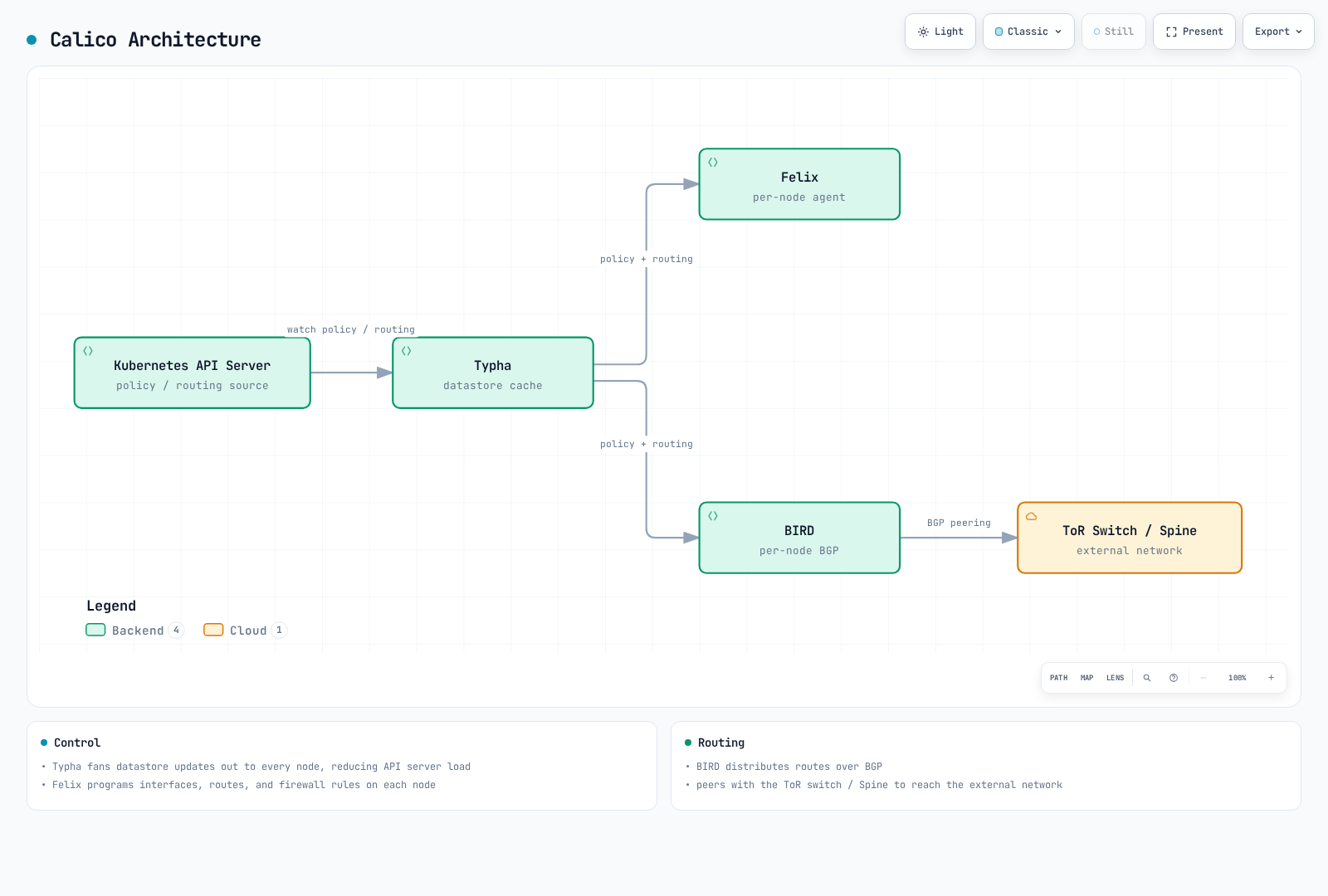
This is a simplified control-state diagram. The BIRD edge omits confd, which renders its configuration; Typha is not a direct BIRD configuration API. BIRD/confd and Typha depend on the installation mode, and control-plane components are not all shown.
Felix: The Calico Agent
Felix runs in the Calico node agent on selected workload nodes and programs applicable routes, interface settings and policy in the kernel. In the Linux full-networking path, the container runtime invokes the CNI chain, and the CNI/IPAM plugins create interfaces and allocate addresses. Felix observes endpoint changes asynchronously; it is not the handler of a direct CNI ADD call. Operator, platform and networking mode determine the exact components.
Felix Responsibilities
Linux CNI/IPAM creates Pod interfaces and addresses. Felix reconciles endpoint state and kernel policy. HTTP health serving and datastore status reporting are separate functions.
Core Functions
- Route Programming: Reconciles applicable workload and tunnel routes; BIRD's kernel protocol also installs learned routes in BGP mode
- ACL Enforcement: Programs iptables/nftables/eBPF rules for network policies
- Interface Management: Reconciles endpoint interface state and relevant kernel settings; Linux veth creation belongs to the CNI path
- Health Reporting: Reports node and endpoint health to the datastore
- Endpoint reconciliation: Watches workload endpoint state and programs applicable policy/routes; the CNI/IPAM plugins allocate addresses and create Linux Pod interfaces
Felix Data Plane Options
Felix supports multiple data plane backends:
| Data Plane | Description | Best For |
|---|---|---|
| iptables | Traditional Linux firewall | Compatibility, mature deployments |
| nftables | Native nftables implementation | Check supported kernel, platform and feature set |
| eBPF | In-kernel programmable | Optional Service handling; requires a coordinated migration and supported features |
FelixConfiguration Resource
apiVersion: projectcalico.org/v3
kind: FelixConfiguration
metadata:
  name: default
spec:
  logSeverityScreen: Info
  healthEnabled: true
  healthPort: 9099
  prometheusMetricsEnabled: true
  prometheusMetricsPort: 9091
  reportingInterval: 30s
  reportingTTL: 90s
This minimal example uses fields accepted by Calico 3.32.2. Apply changes through the configuration owner; it is not a data-plane migration or performance-tuning recipe. Felix's health host defaults to localhost. Enabling metrics does not configure a Prometheus scrape or make public exposure appropriate.
| Configuration concern | Correct owner / interpretation |
|---|---|
| Linux data plane | Operator Installation.spec.calicoNetwork.linuxDataplane selects Iptables, Nftables or BPF for the supported configuration |
bpfEnabled | Low-level Felix setting; coordinate an operator-managed transition and kube-proxy/API reachability rather than patching this alone |
iptablesBackend: NFT | Selects the iptables-nft tool backend, not the native Calico nftables data plane |
| Connect-time load balancing | Current field is bpfConnectTimeLoadBalancing: TCP, Enabled or Disabled; the older boolean bpfConnectTimeLoadBalancingEnabled is still accepted but deprecated |
| Node address detection | Operator calicoNetwork.nodeAddressAutodetectionV4 / V6, or the node startup environment in a manifest-managed install; not Felix fields named ipAutoDetectionMethod or ipv6AutoDetectionMethod |
| Flow visibility | Use the supported Goldmane/Whisker configuration; Open Source does not accept the Enterprise file-log fields shown in the previous example |
| MTU and tunnel modes | Derive from the underlay, encapsulation and encryption; coordinate Installation/IPPool settings rather than arbitrarily setting 1440/1410/1420 or enabling every tunnel |
| Host failsafe ports | Review actual API/BGP/etcd/administrative reachability before replacing the default lists; the old shortened lists could remove needed exceptions |
| Durations | Use current names such as reportingInterval, reportingTTL, iptablesPostWriteCheckInterval and iptablesLockProbeInterval; do not mechanically append Secs/Millis |
The released schema rejects the old iptablesLockFilePath, iptablesLockTimeoutSecs, iptablesLockProbeIntervalMillis, iptablesPostWriteCheckIntervalSecs, reportingIntervalSecs and reportingTTLSecs names. Consult the Felix resource reference and operator API. Address or data-plane changes require their own rollout checks.
Felix iptables Rule Structure
The following are selected prefixes from the released rule definitions, not the complete chain graph. They describe the iptables data plane; inspect actual rules for the installed mode and configuration.
| Chain/prefix | Role |
|---|---|
cali-FORWARD | Calico forwarding hook |
cali-from-wl-dispatch | Dispatch from workload interfaces |
cali-to-wl-dispatch | Dispatch to workload interfaces |
cali-fw-… / cali-tw-… | Per-workload directional chains |
cali-pi-… / cali-po-… | Inbound/outbound policy chains |
Felix Data Flow
On Pod creation, the runtime invokes the CNI/IPAM chain, which configures the network and records endpoint state. Felix observes relevant changes and programs policy/routes; BGP configuration follows its own confd/BIRD path when enabled. Pod Running does not prove routing or policy convergence.
BIRD: BGP Routing Daemon
BIRD (BIRD Internet Routing Daemon) exchanges BGP routes when Calico's BGP backend is enabled. BIRD/confd are not mandatory in a policy-only or BGP-disabled VXLAN installation. The following topology examples require an appropriately designed BGP-enabled cluster; they are not additions to the BGP-disabled introductory kind lab.
BIRD in Calico Architecture
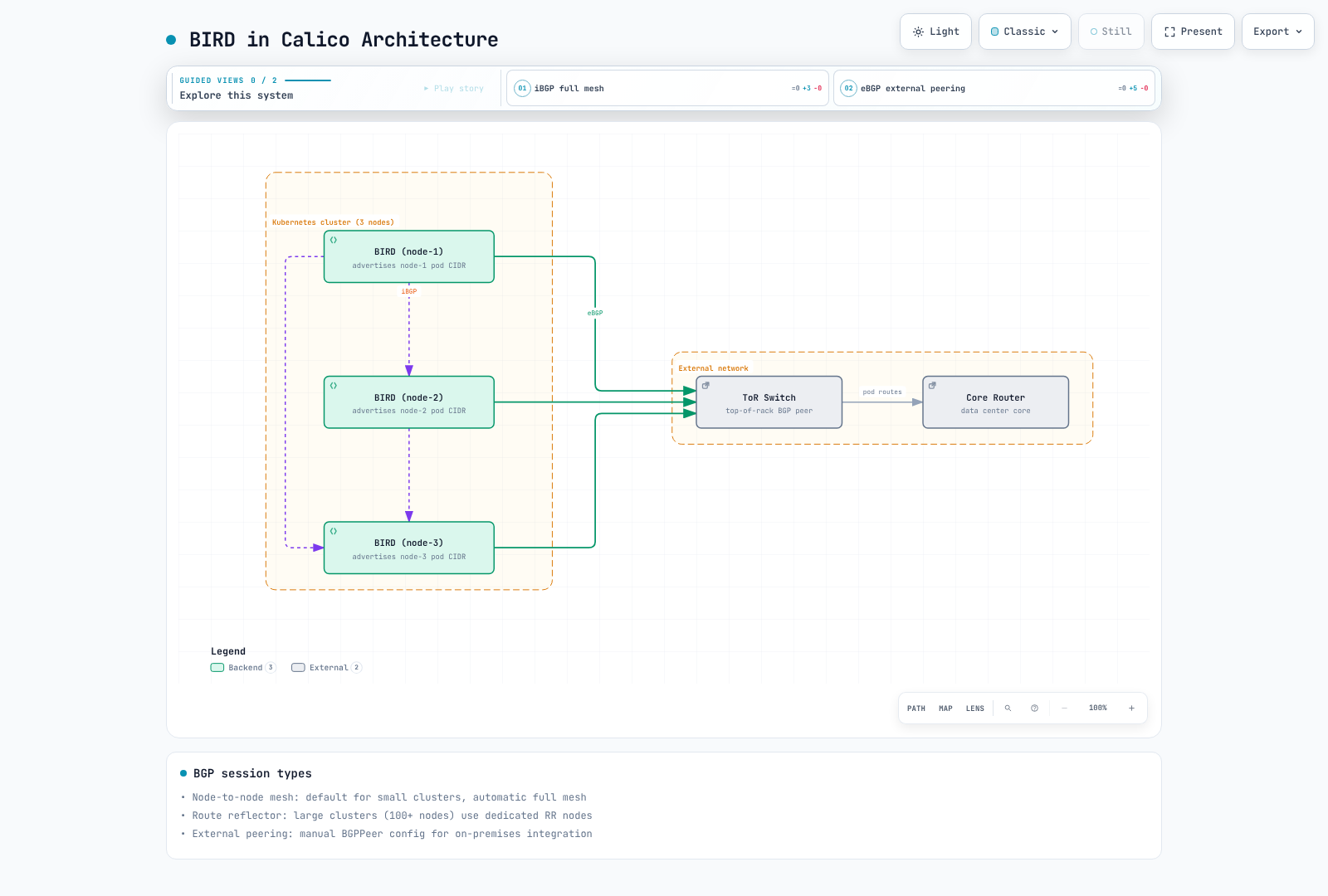
The lines represent BGP sessions, not application-packet transit through BIRD. The size labels are illustrative guidance, not a protocol requirement or a fixed threshold for route reflectors.
BGP Session Types
| Session Type | Use Case | Configuration |
|---|---|---|
| Node-to-Node Mesh | Default for small clusters | Automatic, full mesh |
| Route Reflector | Reduce mesh session count as topology requires | Configure and verify replacement peers first |
| External Peering | On-premises integration | Manual BGP peer config |
BGP Configuration Examples
Node-to-Node Mesh (Default)
apiVersion: projectcalico.org/v3
kind: BGPConfiguration
metadata:
  name: default
spec:
  logSeverityScreen: Info
  nodeToNodeMeshEnabled: true
  asNumber: 64512
Route Reflector Configuration
Use the official BGP transition procedure. Assigning a route-reflector cluster ID immediately removes that node from the existing node mesh and can disrupt workloads. Prepare dedicated nodes without application workloads, or plan an explicit maintenance migration. Do not replace an existing Calico Node with a partial object that omits its other settings.
For the Kubernetes API datastore, the documented node annotation preserves the existing Node fields. Replace these example names with the prepared nodes:
# Existing, prepared RR nodes with no application workloads.
kubectl get nodes rr-1 rr-2 -o yaml > rr-nodes-before.yaml
kubectl get bgpconfiguration.projectcalico.org default -o yaml > bgp-before.yaml
kubectl annotate node rr-1 projectcalico.org/RouteReflectorClusterID=244.0.0.1 --overwrite
kubectl annotate node rr-2 projectcalico.org/RouteReflectorClusterID=244.0.0.2 --overwrite
kubectl label nodes rr-1 rr-2 route-reflector=true --overwrite
kubectl apply -f - <<'YAML'
apiVersion: projectcalico.org/v3
kind: BGPPeer
metadata:
  name: nodes-to-route-reflectors
spec:
  nodeSelector: all()
  peerSelector: route-reflector == 'true'
YAML
all() to the RR selector covers clients and RR-to-RR peering; verify both reflectors and the client routes. Wait for established sessions and confirm actual reachability before disabling the old node mesh. An Established session alone does not prove that the required routes were accepted.
# Only after replacement sessions, routes and test traffic have been verified.
kubectl patch bgpconfiguration.projectcalico.org default --type merge \
  -p '{"spec":{"nodeToNodeMeshEnabled":false}}'
This is an ordered transition, not an instruction to apply every block at once or a guarantee of no disruption. Keep the saved configuration and a tested recovery path. Addresses, ASNs and any reused AS numbers in external-fabric examples require deliberate route-policy and AS-loop handling.
External BGP Peering
Replace the example peer address, ASNs and rack selector with the planned topology. The password reference requires a matching Secret/key in the Calico node component's namespace and matching router configuration. It authenticates the BGP session, not the workload payload.
apiVersion: projectcalico.org/v3
kind: BGPPeer
metadata:
  name: tor-switch-peer
spec:
  peerIP: 10.0.0.1
  asNumber: 65001
  nodeSelector: rack == 'rack-1'
  password:
    secretKeyRef:
      name: bgp-passwords
      key: tor-password
  sourceAddress: UseNodeIP
  keepOriginalNextHop: false
Route Propagation Process
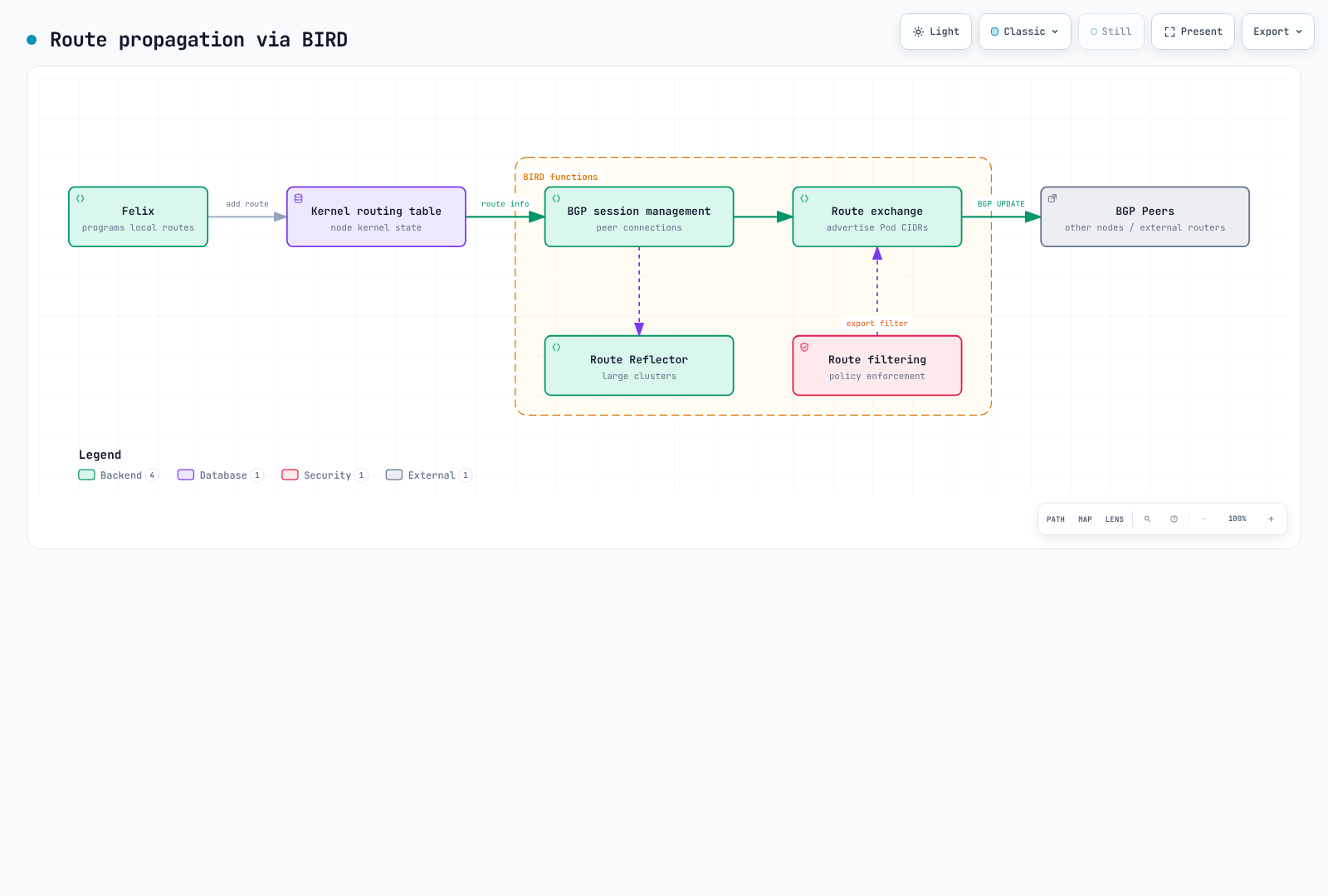
This shows one route-information path. BIRD's kernel protocol can also install learned routes, while confd/IPAM data contributes to generated routing configuration. BGP route filters are routing policy, not Kubernetes NetworkPolicy enforcement.
BIRD Status Commands
Select a node where BIRD is running. The released startup script sets the IPv4 control socket below. A manifest-managed installation may use another namespace.
CALICO_NODE=worker-node-name
CALICO_POD=$(kubectl -n calico-system get pods -l k8s-app=calico-node \
  --field-selector "spec.nodeName=$CALICO_NODE" -o jsonpath='{.items[0].metadata.name}')
: "${CALICO_POD:?No Calico Pod on the selected node}"
kubectl -n calico-system exec "$CALICO_POD" -c calico-node -- \
  birdcl -s /var/run/calico/bird.ctl show protocols
kubectl -n calico-system exec "$CALICO_POD" -c calico-node -- \
  birdcl -s /var/run/calico/bird.ctl show route
Use the actual protocol names and prefixes from the output for more detailed queries. Commands and sample console output are different things; the former birdcl> prompts were not Bash commands. These read-only checks do not configure routing.
confd: Configuration Management
confd is a lightweight configuration management tool that watches the Calico datastore and generates BIRD configuration files.
confd Workflow
confd watches the relevant BGP configuration, renders its template, checks the candidate and signals BIRD to reload.
confd Template Processing
Use the released template, not an invented .NodeIP / .BGPPeers data structure. This excerpt illustrates kernel synchronization; its filter and surrounding configuration are defined elsewhere, so it is not a complete bird.cfg.
protocol kernel {
  learn;
  persist;
  scan time 2;
  import all;
  export filter calico_kernel_programming;
  graceful restart;
  merge paths on;
}
The confd template definition writes /etc/calico/confd/config/bird.cfg, validates the candidate with bird -p -c {{.src}}, and uses sv hup bird || true as its configured reload action. This establishes that BIRD can export selected learned routes to the kernel; it is not merely receiving every route from Felix. Reload and graceful-restart behavior still need status and traffic checks. Manage BGP settings through their API owner rather than editing the generated file.
Typha: Scaling Component
Typha is a fan-out proxy that sits between the Kubernetes API server and Felix agents. It reduces load on the API server by caching and distributing datastore updates.
Why Typha?
Typha reduces repeated datastore update processing by caching state and streaming changes to multiple clients. Installation ownership, TLS and actual scaling logic matter as well as node count.
Typha scaling in operator 1.42.6
The operator deploys and scales Typha; there is no universal “only above 50 nodes” rule. The pinned autoscaler implementation counts nodes that are not marked unschedulable, excludes AKS virtual nodes, and separately checks for enough Linux nodes to place the desired replicas. Taints and other placement constraints still matter.
The actual scale function, rather than its abbreviated comment, returns:
- 1 replica for 1–2 counted nodes.
- 2 replicas for 3–4 counted nodes.
max(3, floor(N / 200) + 2)for 5 or more counted nodes.
| Counted nodes | Desired replicas in this version |
|---|---|
| 50 | 3 |
| 200 | 3 |
| 500 | 4 |
| 1,000 | 7 |
| 2,000 | 12 |
This is a version-specific desired count, not a per-replica capacity guarantee or a recommendation for every installation. Non-cluster-host mode uses a separate eligible HostEndpoint count. The former max(3, ceil(N / 200)) table did not describe this operator.
Operator-managed Typha configuration
Keep the operator's Deployment, ServiceAccount/RBAC, Service, disruption budget and TLS configuration together. The hand-written Deployment formerly shown here omitted essential dependencies and could overwrite operator-managed settings. Felix-to-Typha TLS uses a trusted CA, Typha server certificate/key and the expected Felix client identity. Port 5473 is the default sync port, not a user-traffic proxy.
# Change the operator's supported setting through its API.
kubectl patch installation.operator.tigera.io default --type merge \
  -p '{"spec":{"typhaMetricsPort":9093}}'
kubectl -n calico-system get deployment calico-typha -o yaml
kubectl -n calico-system get service calico-typha -o yaml
kubectl -n calico-system get pdb
Typha's health endpoint defaults to localhost:9098. This operator derives the health port as the configured Felix health port minus one and configures probes accordingly. A Pod-network Deployment whose probe targets the Pod IP will not reach a listener bound only to localhost; copying probes without their network/bind settings is unsafe. The operator source supplies TLS mounts and client-identity settings that are absent from the old standalone example.
Typha Fan-out Architecture
Each Typha maintains cached state for its client streams. Client grouping in a diagram is not a fixed per-instance capacity specification.
kube-controllers: Kubernetes Integration
calico-kube-controllers runs selected reconciliation functions. Which controllers run depends on the datastore, edition and installation configuration. Policy/namespace/service-account projection into an etcd datastore is different from Kubernetes API datastore handling.
Available controller roles
| Controller | Purpose |
|---|---|
| Node Controller | Syncs Kubernetes nodes with Calico node resources |
| Policy Controller | Syncs Kubernetes NetworkPolicy with Calico policy |
| Namespace Controller | Syncs namespace labels for profile management |
| ServiceAccount Controller | Projects service-account labels into Calico profiles; does not grant Kubernetes RBAC |
| WorkloadEndpoint Controller | Updates workload endpoint metadata such as Pod labels on the applicable datastore path |
Controller Reconciliation Loop
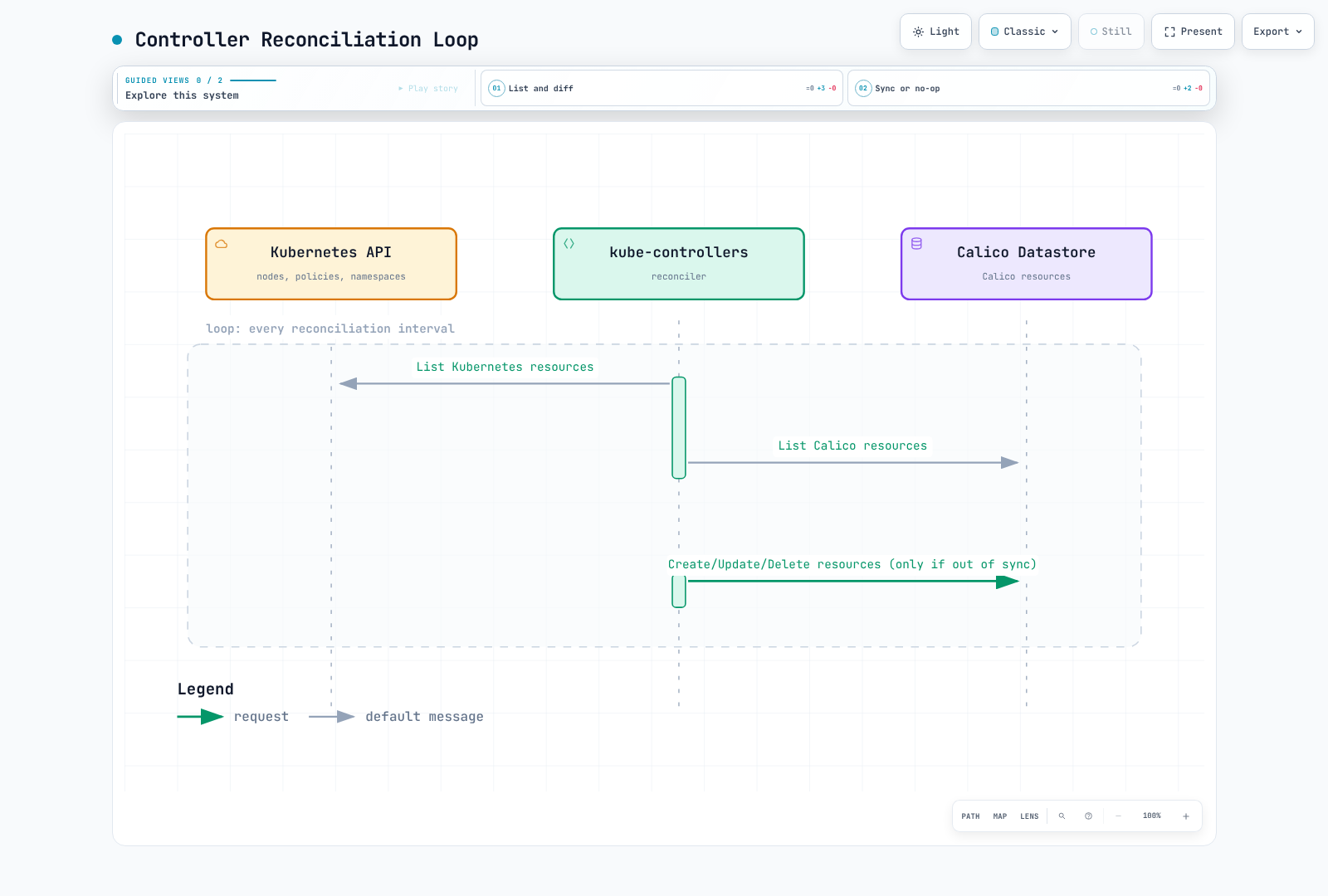
This is a logical desired-versus-observed reconciliation sketch, not a trace proving two remote LIST calls every interval. Real controllers use watches/caches, and their enabled roles depend on the datastore and installation.
kube-controllers Configuration
For the operator installation, configure the real KubeControllersConfiguration API. An arbitrary ConfigMap named calico-kube-controllers-config is not consumed by the Deployment shown in this guide.
kubectl get kubecontrollersconfiguration.projectcalico.org default -o yaml
kubectl patch kubecontrollersconfiguration.projectcalico.org default --type merge \
  -p '{"spec":{"logSeverityScreen":"Info","healthChecks":"Enabled","prometheusMetricsPort":9094}}'
This merge patch preserves the existing controllers configuration. If GitOps manages the resource, make the equivalent change in its desired state instead. A replacement manifest with empty controller objects can alter existing reconciliation or allocation settings.
Operator 1.42.6 selects ENABLED_CONTROLLERS=node,loadbalancer for its standard Open Source deployment. The broader list above describes available controller roles, not five controllers necessarily running with every datastore. Its renderer specifies one replica and a Recreate strategy; the previous leader-election claim was not supported by that configuration. Keep this workload under the installation owner rather than replacing or manually scaling it.
Datastore Options
The operator examples here use the Kubernetes API datastore. Calico state can involve Calico CRDs and native Kubernetes objects; not every logical Calico resource is a separate CRD. The usual aggregated API server exposes projectcalico.org/v3 over the internal representation. Native v3 CRDs are a separate Calico 3.32 tech preview and have their own migration procedure.
Typha distributes read/watch updates; it is not a general write proxy for Felix. Components that update status or resources use their own datastore access. Kubernetes persists its API state in its backing store, but Calico users do not need a separate Calico etcd cluster for this mode.
Direct etcdv3 access is a different installation choice with explicit support and feature constraints. Do not infer that it is faster, unlimited, or required above 5,000 nodes. The eBPF data plane requires the Kubernetes datastore. A direct-etcd deployment also needs its own TLS trust, credentials, availability and consistent backup/restore design.
| Concern | Kubernetes API datastore | Direct etcdv3 |
|---|---|---|
| Access control | Kubernetes authentication/RBAC plus the appropriate Calico API path | etcd authentication/TLS and access controls |
| Operations | Reuse the cluster API; follow provider-specific backup procedures | Operate and back up the selected etcd deployment |
| Host/VM support | Check the specific installation and edition | Check the specific installation and edition |
| Selection | Used by this operator guide | A separately validated design, not a node-count shortcut |
On managed Kubernetes, “Kubernetes backup” does not mean users can take direct control-plane etcd snapshots. Back up supported resources using the platform's procedure.
Component Interaction Sequence
Kubelet requests sandbox creation through the container runtime, which invokes CNI/IPAM. Endpoint and policy data reaches Felix through the selected datastore/watch path. In BGP mode, confd and BIRD handle routing configuration separately. These components converge asynchronously; verify actual connectivity and enforcement.
Packet Flow Analysis
Ingress Packet Flow (Pod-to-Pod, Same Node)
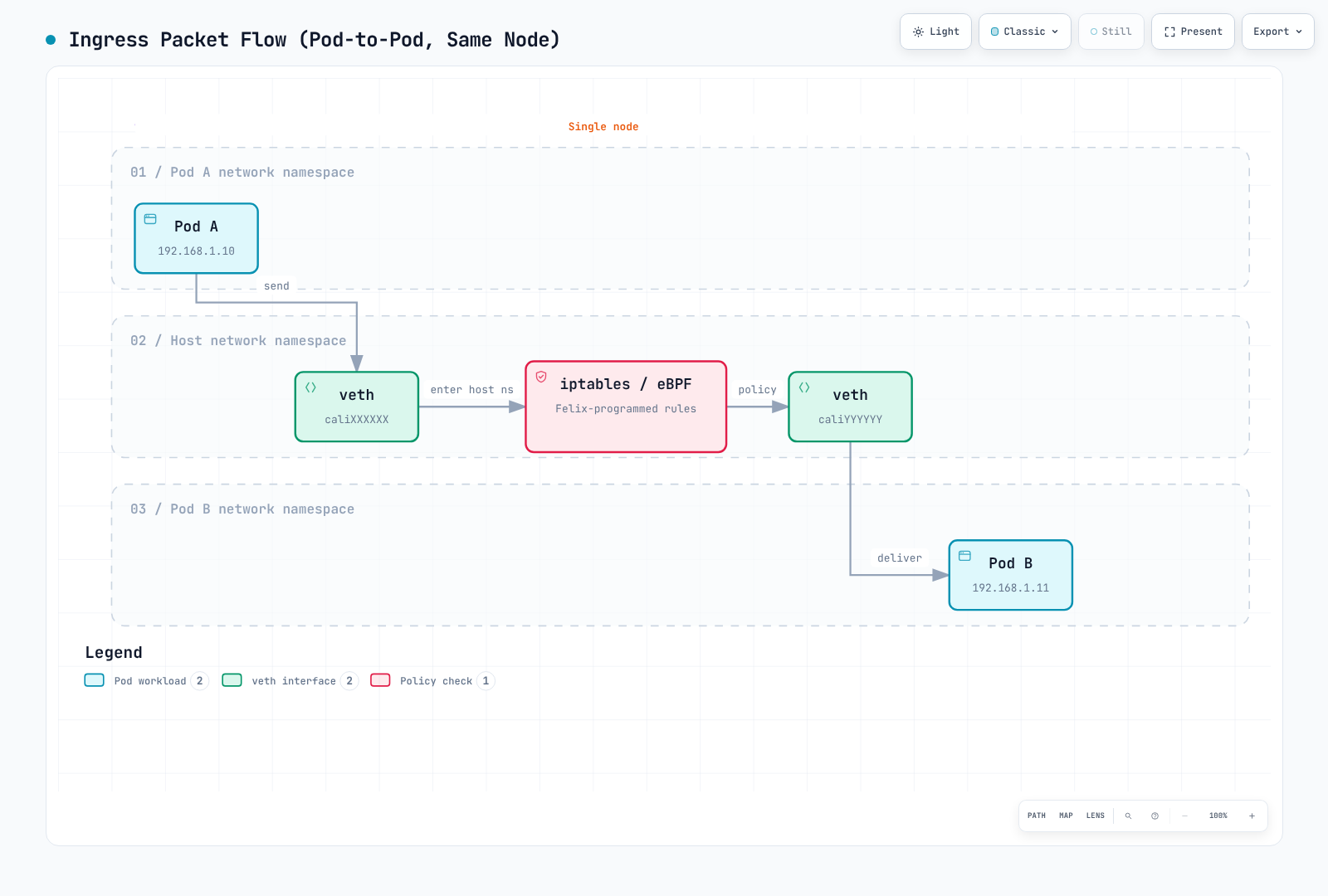
The policy box summarizes the applicable source-egress and destination-ingress kernel checks. The veth interfaces belong to the two Pods' network paths; packets are not sent through the Felix process.
Egress Packet Flow (Pod-to-Pod, Different Nodes with IPIP)
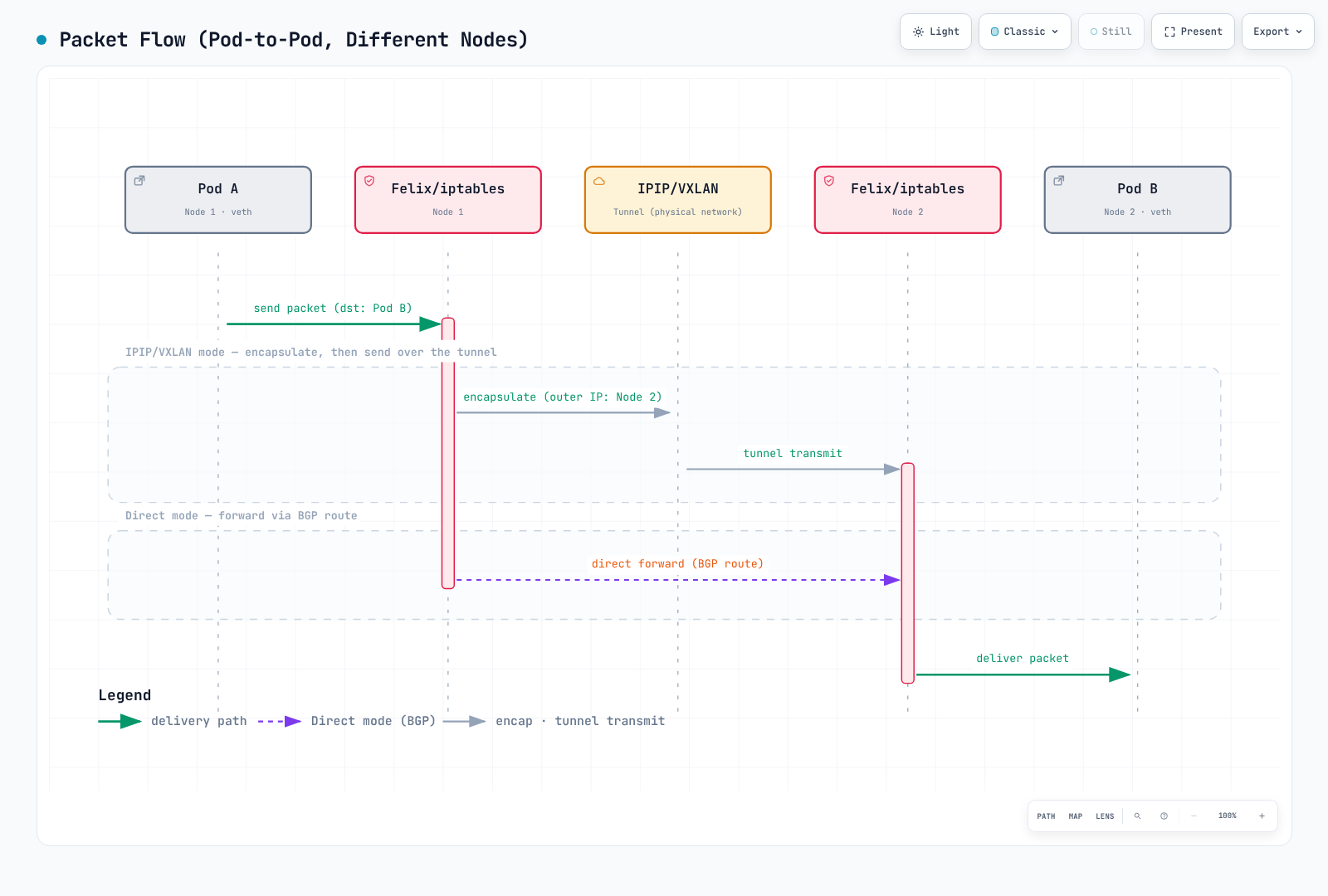
Read the two paths as alternatives. “Felix/iptables” means kernel rules programmed by Felix, not daemon packet forwarding. BIRD supplies routing control information in BGP mode; it does not carry application packets.
Packet Structure Comparison
Original Pod-to-Pod Packet:
┌─────────────────────────────────────────────────────────────┐
│ Ethernet │   IP Header    │   TCP/UDP   │     Payload      │
│  Header  │ Src: 192.168.1.10 │   Header    │                  │
│          │ Dst: 192.168.2.10 │             │                  │
└─────────────────────────────────────────────────────────────┘

IPIP Encapsulated Packet:
┌───────────────────────────────────────────────────────────────────────────────┐
│ Ethernet │   Outer IP     │   Inner IP     │   TCP/UDP   │     Payload      │
│  Header  │ Src: 10.0.1.10 │ Src: 192.168.1.10 │   Header    │                  │
│          │ Dst: 10.0.1.11 │ Dst: 192.168.2.10 │             │                  │
│          │ Proto: 4 (IPIP)│                │             │                  │
└───────────────────────────────────────────────────────────────────────────────┘
Summary
Calico's architecture is designed for scalability, performance, and operational simplicity:
- Felix: The workhorse agent on every node, programming routes and ACLs
- BIRD: Distributes routes via BGP, enabling native routing integration
- confd: Bridges the datastore to BIRD configuration
- Typha: Scales the system by reducing API server load
- kube-controllers: Keeps Kubernetes and Calico in sync
- Datastore: Kubernetes API (recommended) or etcd for configuration storage
Understanding these components and their interactions is essential for:
- Troubleshooting connectivity issues
- Optimizing performance at scale
- Planning capacity and architecture
- Integrating with existing network infrastructure
Previous: Part 1 - Introduction to Calico
Next: Part 3 - Networking Modes
Quiz
To test what you've learned in this chapter, try the Architecture Quiz.