Part 4: Performance and Cost Tuning
Review baseline: September 12, 2026 · upstream Spark 4.2.0 · Karpenter 1.14
Scope and measurement
This chapter uses Part 1's direct spark-submit path. Spark 4.2 requires Kubernetes 1.34+; also check EKS, kubectl and Karpenter compatibility. Part 2's operators and Part 3's EMR have different submission and pod-customization paths. Do not copy all settings across them without review. Values below are small starting points, not measured performance optima.
metrics-server is not required for Karpenter's pending-pod provisioning. Karpenter uses pod requests and scheduling constraints. metrics-server helps with usage observation and consumers such as kubectl top/HPA; it does not supply Spark task backlog or directly provision EC2.
Measure stage/task time, spill, shuffle fetch wait, skew, GC and executor loss in Spark UI/event logs alongside node CPU, memory, disk and network limits. Confirm the bottleneck before assuming R-series or NVMe is always faster. Review AQE, partitioning, join strategy and data format, changing one factor at a time.
1. Choose nodes and instance storage
Older R5d/R5ad/R5dn examples are a subset of available choices. Compare M/C/R/I families according to CPU, memory, disk and network demands, current AZ capacity and total cost. R-series is not universally best for shuffle, and C-series is not inherently unsuitable for Spark.
Graviton is a valid Spark evaluation option. A tested multi-architecture image may already be available; building your own image is not always necessary. Check arm64 support for JNI, codecs, BLAS, Python wheels and custom plugins. The example below selects amd64 for one consistent path, without claiming it is faster.
Nitro/NVMe does not identify a disk as instance store. EBS is also exposed as NVMe on Nitro. An unmounted disk is not necessarily empty or safe to format. The old loop that formatted unmounted NVMe devices could misidentify EBS/root devices and has been removed.
2. Managed scratch storage on AL2023
Before this lab, have an administrator prepare two EC2NodeClasses:
spark-general: a reviewed general node configuration for drivers.spark-nvme: a new executor-specific class with a pinned AL2023 AMI matching the Kubernetes release/architecture, and appropriate IAM/subnet/security-group settings.
Include this field in the complete spark-nvme configuration. It is a fragment, not a standalone kubectl apply resource. Changing an existing NodeClass can cause drift and node replacement; do not improvise disk formatting on running nodes.
spec:
  instanceStorePolicy: RAID0
For AL2023, Karpenter configures instance-store RAID0 through NodeConfig and uses it for kubelet/containerd ephemeral storage, including node allocatable capacity. This avoids pinning /dev/nvme1n1 or requiring hostPath. Follow the documented procedure for other AMI families or custom bootstrap.
Instance store is transient scratch that can be lost on stop, termination or failure. RAID0 is not replication or backup. Although there is no separate EBS volume charge, instance pricing, idle capacity and recomputation still cost money. Properly sized EBS is also an option; consider both volume and instance throughput limits. Do not assume every EKS node has a 20GB root volume or the same backing filesystem.
3. Place drivers on On-Demand and executors on Spot
On-Demand reduces driver exposure to Spot reclamation, but not failures, maintenance or Karpenter drift/expiration. Driver SparkContext/coordination state matters in both cluster and client modes. Design job reruns and data recovery separately.
Save the following as nodepools.yaml, referencing the two prepared NodeClasses. Executors require instance-store capacity. This is Spot-only: insufficient Spot capacity can leave pods Pending, with no automatic On-Demand fallback. Design an explicit fallback policy and cost bounds if needed.
apiVersion: karpenter.sh/v1
kind: NodePool
metadata:
  name: spark-driver
spec:
  template:
    metadata:
      labels:
        workload-pool: spark-driver
    spec:
      requirements:
      - key: kubernetes.io/arch
        operator: In
        values:
        - amd64
      - key: kubernetes.io/os
        operator: In
        values:
        - linux
      - key: karpenter.sh/capacity-type
        operator: In
        values:
        - on-demand
      - key: karpenter.k8s.aws/instance-category
        operator: In
        values:
        - m
        - r
      - key: karpenter.k8s.aws/instance-generation
        operator: Gt
        values:
        - '5'
      taints:
      - key: spark-role
        value: driver
        effect: NoSchedule
      nodeClassRef:
        group: karpenter.k8s.aws
        kind: EC2NodeClass
        name: spark-general
  limits:
    cpu: '64'
    memory: 512Gi
  disruption:
    consolidationPolicy: WhenEmpty
    consolidateAfter: 120s
---
apiVersion: karpenter.sh/v1
kind: NodePool
metadata:
  name: spark-executor
spec:
  template:
    metadata:
      labels:
        workload-pool: spark-executor
    spec:
      requirements:
      - key: kubernetes.io/arch
        operator: In
        values:
        - amd64
      - key: kubernetes.io/os
        operator: In
        values:
        - linux
      - key: karpenter.sh/capacity-type
        operator: In
        values:
        - spot
      - key: karpenter.k8s.aws/instance-category
        operator: In
        values:
        - m
        - r
        - i
      - key: karpenter.k8s.aws/instance-generation
        operator: Gt
        values:
        - '5'
      - key: karpenter.k8s.aws/instance-local-nvme
        operator: Gt
        values:
        - '0'
      taints:
      - key: spark-role
        value: executor
        effect: NoSchedule
      nodeClassRef:
        group: karpenter.k8s.aws
        kind: EC2NodeClass
        name: spark-nvme
  limits:
    cpu: '256'
    memory: 2048Gi
  disruption:
    consolidationPolicy: WhenEmpty
    consolidateAfter: 120s
Pool labels/selectors choose a target; tolerations allow its taints. A toleration does not force placement, and other pods may also have it. NoSchedule does not evict already-running pods. NodePool limits are eventually consistent capacity guardrails that may briefly overrun during concurrent scale-out, not exact spending caps.
Save as driver-template.yaml. It is a Spark pod template, completed by Spark, not a standalone pod deployment.
apiVersion: v1
kind: Pod
spec:
  securityContext:
    runAsNonRoot: true
    runAsUser: 185
    fsGroup: 185
  tolerations:
  - key: spark-role
    operator: Equal
    value: driver
    effect: NoSchedule
  containers:
  - name: spark-kubernetes-driver
    securityContext:
      allowPrivilegeEscalation: false
      capabilities:
        drop:
        - ALL
      seccompProfile:
        type: RuntimeDefault
    resources:
      requests:
        ephemeral-storage: 2Gi
      limits:
        ephemeral-storage: 4Gi
Save as executor-template.yaml.
apiVersion: v1
kind: Pod
spec:
  securityContext:
    runAsNonRoot: true
    runAsUser: 185
    fsGroup: 185
  tolerations:
  - key: spark-role
    operator: Equal
    value: executor
    effect: NoSchedule
  containers:
  - name: spark-kubernetes-executor
    securityContext:
      allowPrivilegeEscalation: false
      capabilities:
        drop:
        - ALL
      seccompProfile:
        type: RuntimeDefault
    resources:
      requests:
        ephemeral-storage: 10Gi
      limits:
        ephemeral-storage: 20Gi
    volumeMounts:
    - name: spark-local-dir-scratch
      mountPath: /var/data/spark-local
  automountServiceAccountToken: false
  volumes:
  - name: spark-local-dir-scratch
    emptyDir:
      sizeLimit: 16Gi
This emptyDir uses the prepared NVMe-backed kubelet filesystem; another node configuration could back it differently. The volume name must start with spark-local-dir-, including the final hyphen and a suffix. The old name spark-local-dir is not recognized and can cause an additional emptyDir mount at the same path.
Setting only spark.local.dir can make Kubernetes Spark create an emptyDir there; hostPath is not required. Recognized scratch mounts populate SPARK_LOCAL_DIRS. sizeLimit is not reserved capacity: node disk exhaustion may occur first. Observe requests/limits, logs, writable layers and disk pressure together. tmpfs consumes RAM and needs memory budgeting.
4. Two scaling loops and termination
Save as performance.properties, reusing Part 1's namespace and RBAC.
spark.kubernetes.namespace=spark-jobs
spark.kubernetes.container.image=spark:4.2.0-scala2.13-java21-ubuntu
spark.kubernetes.authenticate.driver.serviceAccountName=spark-driver
spark.kubernetes.authenticate.executor.serviceAccountName=spark-executor
spark.kubernetes.driver.podTemplateFile=driver-template.yaml
spark.kubernetes.executor.podTemplateFile=executor-template.yaml
spark.kubernetes.driver.node.selector.workload-pool=spark-driver
spark.kubernetes.executor.node.selector.workload-pool=spark-executor
spark.kubernetes.driver.node.selector.karpenter.sh/capacity-type=on-demand
spark.kubernetes.executor.node.selector.karpenter.sh/capacity-type=spot
spark.driver.cores=1
spark.driver.memory=1g
spark.kubernetes.driver.limit.cores=1
spark.executor.cores=2
spark.executor.memory=4g
spark.kubernetes.executor.limit.cores=2
spark.executor.instances=2
spark.dynamicAllocation.enabled=true
spark.dynamicAllocation.shuffleTracking.enabled=true
spark.dynamicAllocation.minExecutors=1
spark.dynamicAllocation.initialExecutors=2
spark.dynamicAllocation.maxExecutors=10
spark.dynamicAllocation.executorIdleTimeout=60s
spark.kubernetes.allocation.batch.size=5
spark.kubernetes.allocation.batch.delay=1s
spark.decommission.enabled=true
spark.storage.decommission.enabled=true
spark.kubernetes.executor.terminationGracePeriodSeconds=120s# Prerequisite: Part 1's spark-jobs namespace and driver/executor RBAC.
# All template/property files below must be present in the submitter's working directory.
K8S_API_SERVER="$(kubectl config view --minify -o jsonpath='{.clusters[0].cluster.server}')"
: "${K8S_API_SERVER:?Select the intended Kubernetes context first}"
spark-submit \
--master "k8s://${K8S_API_SERVER}" --deploy-mode cluster \
--name spark-performance-smoke \
--properties-file performance.properties \
--class org.apache.spark.examples.SparkPi \
local:///opt/spark/examples/jars/spark-examples.jar 10Spark DRA adjusts executor count from task backlog and idle/cache/shuffle state. spark.kubernetes.allocation.batch.size and batch.delay control Kubernetes allocator pod creation rate; they are not exclusive to DRA. Karpenter supplies capacity from unschedulable pod requests and constraints. Image pulls, IP/quota/AZ shortages and taint mismatches can also delay pods.
WhenEmpty with 120s is a conservative starting consolidation policy for ordinary running Spark pods. Karpenter's definition of empty can include remaining pods with no disruption cost, such as DaemonSets. Also inspect other ordinary workloads before treating an executor-only node as empty.
consolidateAfter > executorIdleTimeout does not guarantee DRA releases first. The timers start from different events, and cached data/shuffle tracking can keep executors longer. Drift, expiration and Spot interruption are separate from consolidation. PDBs, do-not-disrupt and disruption budgets do not prevent Spot reclamation.
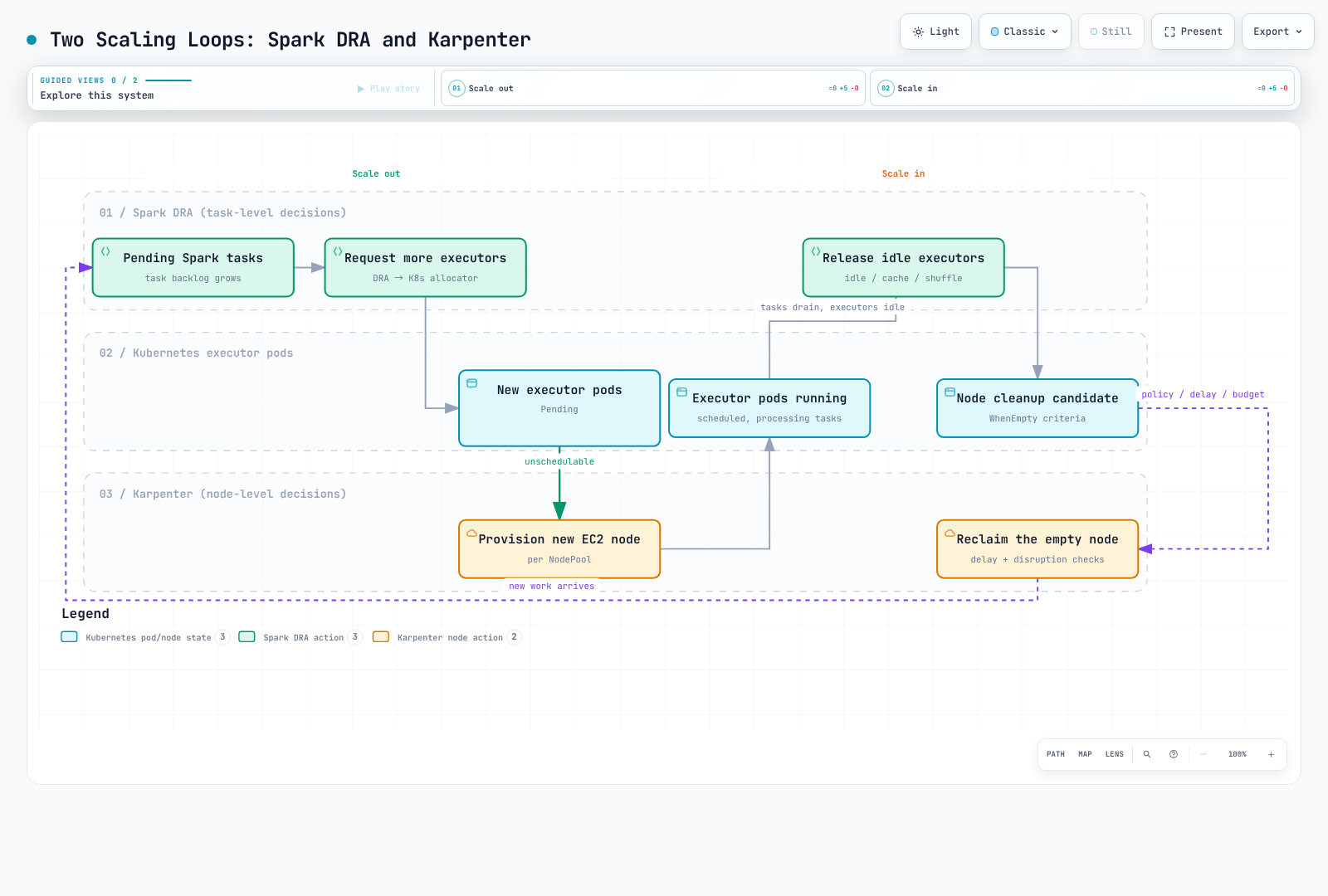
Actual decommission limits
Spot stop/terminate warnings normally arrive two minutes ahead, on a best-effort basis. Hibernation starts immediately without that two-minute warning. Karpenter's Spot handling needs EventBridge-to-SQS wiring, an interruption queue and permissions. Spark flags alone do not receive AWS interruption notices.
As verified in Part 1, Spark 4.2's decommission flag injects the official image's /opt/decom.sh preStop. Check the actual script, signal, pod grace and node drain path. spark.kubernetes.executor.terminationGracePeriodSeconds=120s requests grace; it does not guarantee remaining cloud lifetime or completed block migration. Overriding lifecycle hooks can change that behavior.
Migration depends on peer capacity, network and time. Shuffle fallback requires an explicit spark.storage.decommission.fallbackStorage.path plus working filesystem and permissions. Arbitrary remote storage or a History Server is not automatic fallback. RDD-cache and shuffle recovery also differ. Recomputation, repeated losses, fetch/task retry limits or unreadable source data can fail the job; executor loss is not guaranteed harmless.
5. Validate resources and cost
| Setting | Kubernetes effect |
|---|---|
| Driver/executor memory | Heap plus applicable overhead/other memory in request and limit |
| Driver/executor cores | Default CPU request and Spark role-specific concurrency; not an automatic CPU limit |
| spark.kubernetes.*.request.cores | Explicit CPU request, distinct from task-slot count |
| spark.kubernetes.*.limit.cores | Explicit CPU limit |
| Template ephemeral-storage | Scratch/log temporary-storage budget; backing storage depends on node setup |
A JVM executor with 4g heap and default 10% overhead adds 409MiB after integer conversion, totaling 4505MiB. Account separately for PySpark, off-heap and explicit overhead settings; 4g is not the entire pod memory. A driver need not always be larger than an executor, and smaller executors are not universally better.
Compare cost per successful job and p95 completion time, including retries, idle capacity, storage/network and logs, rather than only instance hourly price. EMR runtime behavior such as executor preallocation can differ from upstream; inspect the selected release's configuration.
Examples are checked against CRDs and native Spark feature-step construction. This does not constitute EC2 provisioning, disk initialization, a Spot-interruption test or a large shuffle-performance benchmark.
- Karpenter instanceStorePolicy and AMI behavior
- Karpenter disruption and interruption handling
- Karpenter scheduling
- EKS AL2023 instance-store setup implementation
- Spark 4.2 Kubernetes configuration
- Spark local-directory feature implementation
- Spark 4.2 configuration
- Spot interruption notice limitations
- EMR-specific performance and storage guidance