Session Affinity
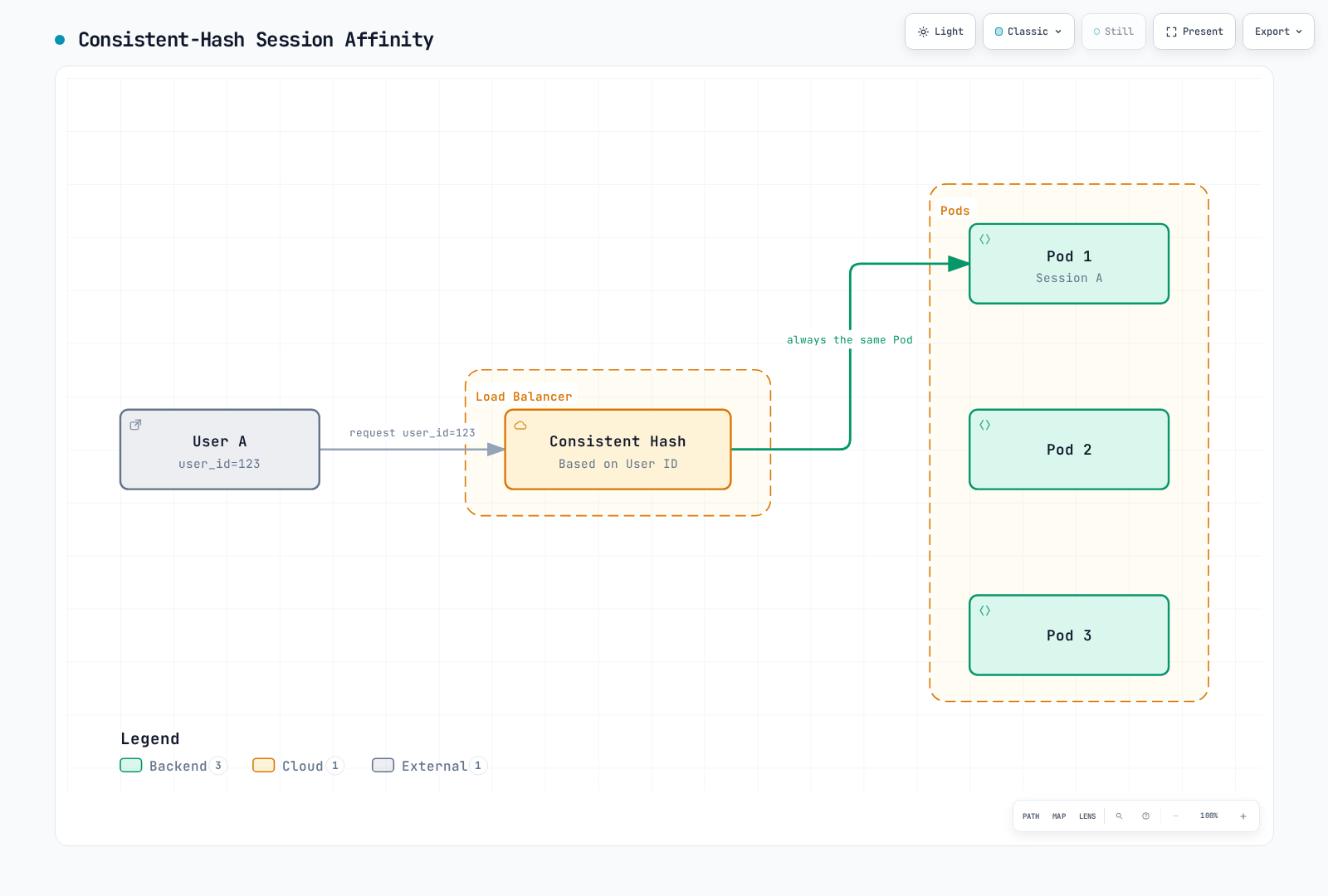
Session Affinity (or Sticky Session) is a technique that provides soft affinity for requests sharing the same hash key; it does not guarantee a permanent pod assignment.
Table of Contents
- Session Affinity Overview
- Consistent Hash Based
- Cookie Based
- HTTP Header Based
- Source IP Based
- Operational Considerations
Session Affinity Overview
Consistent Hash Based
HTTP Header Based
apiVersion: networking.istio.io/v1
kind: DestinationRule
metadata:
  name: reviews-session-affinity
spec:
  host: reviews
  trafficPolicy:
    loadBalancer:
      consistentHash:
        httpHeaderName: "x-user-id"
Cookie Based
apiVersion: networking.istio.io/v1
kind: DestinationRule
metadata:
  name: reviews-cookie-affinity
spec:
  host: reviews
  trafficPolicy:
    loadBalancer:
      consistentHash:
        httpCookie:
          name: "session-id"
          ttl: 0s  # Cookie expiration time (0s = session cookie)
Source IP Based
apiVersion: networking.istio.io/v1
kind: DestinationRule
metadata:
  name: reviews-ip-affinity
spec:
  host: reviews
  trafficPolicy:
    loadBalancer:
      consistentHash:
        useSourceIp: true
Operational Considerations
The diagram assumes an unchanged endpoint set and identical endpoint views at each proxy. Adding/removing pods or locality-based endpoint differences can remap requests. Store session state so that a remap or pod failure remains safe.
Choose one of these DestinationRules for the same host. HTTP header/cookie hashing requires HTTP processing; a missing header cannot identify a user. ttl: 0s creates a session cookie when it is absent, but the browser must return it. Cookie attributes and lifetime should match the application’s requirements.
Source-IP hashing uses the source address visible to the proxy. NAT and intervening load balancers can collapse multiple clients onto one address; check trusted proxy/client-IP handling before relying on it. These DestinationRule examples describe sidecar behavior; verify waypoint feature support separately.