Part 3: DAG Patterns and KubernetesPodOperator
Review baseline: Airflow 3.3.1 / cncf-kubernetes provider 10.21.0 Latest upstream patch checked: Airflow 3.3.2; examples remain on 3.3.1 · October 12, 2026
1. Executors, KPO and physical pod count
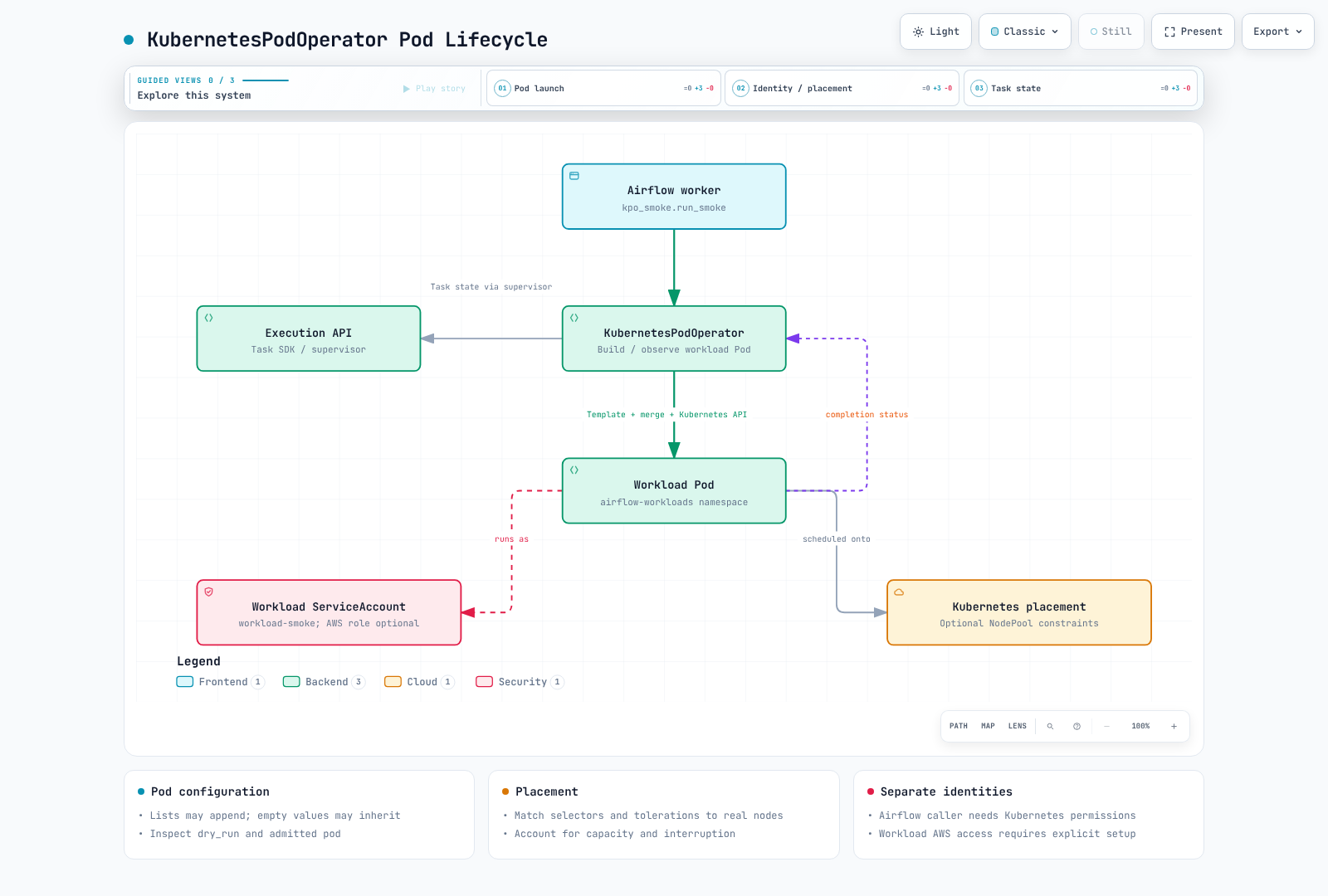
KubernetesPodOperator (KPO) lets an Airflow task create and observe a separate workload pod. It can run through CeleryExecutor, KubernetesExecutor or another compatible executor. The Airflow task environment needs the provider, but the workload pod does not inherently need Airflow installed.
| Typical new execution | Newly created pods and shared resources |
|---|---|
| CeleryExecutor + KPO | An existing worker process runs KPO and creates a workload pod; multiple tasks can share the worker pod |
| KubernetesExecutor + KPO | Creates an Airflow task-runner pod and a separate KPO workload pod |
Changing the executor can therefore change physical pod count. Two logical execution roles do not imply an unchanged number of pods. Retries/reattachment can reuse pods or create further attempts; deferrable mode can release a worker slot while a triggerer continues observation. Exactly two live pods is not a guarantee.
2. Precedence includes merge behavior
Provider 10.21.0 constructs the pod as follows:
- Select pod_template_file when present. It does not additionally merge pod_template_dict from the same call.
- Otherwise select pod_template_dict, or start from full_pod_spec/an empty pod.
- Merge the chosen template with full_pod_spec, then with KPO's constructed pod.
- Airflow labels, secret/XCom handling, pod_mutation_hook and server-side admission/defaulting can further affect the result.
Specified nonempty values such as image/namespace generally override the template, but not every field is a simple replacement. Running the released merge methods confirms:
| Input | Result |
|---|---|
| Nonempty image | Overrides template image |
| Empty command or tolerations | Can retain template values |
| False automount overriding a true template value | Falsy override can retain True; inspect the final pod |
| Lists such as env/volume_mounts | Can concatenate; an empty list need not erase the base |
| container_resources with only limits | Does not preserve the previous requests |
| Nonempty node_selector | Can replace the whole previous selector |
| Metadata labels | Merge by key |
| Init containers | Merge matching names and append others |
Use container_resources=V1ResourceRequirements(...) for Kubernetes container resources. Do not confuse generic resources arguments with that setting. Inspect dry_run output and actual admitted pods, not merely the original template.
3. Prepare a small runnable DAG
First prepare Part 2's Airflow and DAG-distribution path. This example prints a run ID and does not access S3, so it needs no AWS data role. Real workloads need their own image, packages and data permissions.
In workload-access.yaml, set the RoleBinding subject to the Airflow worker service account that actually runs KPO. The example uses airflow-worker in the airflow namespace. This differs from the workload pod's service account.
apiVersion: v1
kind: Namespace
metadata:
  name: airflow-workloads
---
apiVersion: v1
kind: ServiceAccount
metadata:
  name: workload-smoke
  namespace: airflow-workloads
automountServiceAccountToken: false
---
apiVersion: rbac.authorization.k8s.io/v1
kind: Role
metadata:
  name: airflow-kpo
  namespace: airflow-workloads
rules:
- apiGroups:
  - ''
  resources:
  - pods
  verbs:
  - create
  - get
  - list
  - watch
  - patch
  - delete
- apiGroups:
  - ''
  resources:
  - pods/log
  verbs:
  - get
---
apiVersion: rbac.authorization.k8s.io/v1
kind: RoleBinding
metadata:
  name: airflow-kpo-worker
  namespace: airflow-workloads
subjects:
- kind: ServiceAccount
  name: airflow-worker
  namespace: airflow
roleRef:
  apiGroup: rbac.authorization.k8s.io
  kind: Role
  name: airflow-kpo
The Role is scoped to the workload namespace, but can affect all matching pod resources there. Use trust boundaries and admission controls to restrict untrusted DAG authors from selecting privileged identities or dangerous pod specs. This synchronous example needs no XCom exec permission. Adding an XCom sidecar or deferral requires review of pods/exec and triggerer observation rights.
Distribute these files together in the DAG bundle:
dags/
  kpo_smoke.py
  templates/
    base-pod-template.yaml
templates/base-pod-template.yaml is completed by KPO, not a standalone pod deployment. Its resources, filesystem and UID settings fit this example workload.
apiVersion: v1
kind: Pod
metadata:
  labels:
    app: airflow-kpo-smoke
spec:
  serviceAccountName: workload-smoke
  automountServiceAccountToken: false
  restartPolicy: Never
  securityContext:
    runAsNonRoot: true
    runAsUser: 65532
    seccompProfile:
      type: RuntimeDefault
  containers:
  - name: base
    image: python:3.12-slim
    resources:
      requests:
        cpu: 100m
        memory: 64Mi
      limits:
        cpu: 500m
        memory: 128Mi
    securityContext:
      allowPrivilegeEscalation: false
      readOnlyRootFilesystem: true
      capabilities:
        drop:
        - ALL
kpo_smoke.py defines an actual discoverable DAG. It resolves the template relative to the bundle file on the worker rather than assuming a universal /opt/airflow/dags path.
from datetime import datetime, timedelta, timezone
from pathlib import Path

from airflow.sdk import Asset, DAG
from airflow.providers.cncf.kubernetes.operators.pod import KubernetesPodOperator
from kubernetes.client import models as k8s

TEMPLATES = Path(__file__).parent / "templates"
smoke_completed = Asset("demo://kpo-smoke-completed")

with DAG(
    dag_id="kpo_smoke",
    schedule=None,
    start_date=datetime(2026, 9, 1, tzinfo=timezone.utc),
    catchup=False,
) as dag:
    run_smoke = KubernetesPodOperator(
        task_id="run_smoke",
        name="kpo-smoke",
        namespace="airflow-workloads",
        in_cluster=True,
        pod_template_file=str(TEMPLATES / "base-pod-template.yaml"),
        service_account_name="workload-smoke",
        image="python:3.12-slim",
        cmds=["python", "-B", "-c"],
        arguments=["import sys; print('KPO_SMOKE_OK run_id=' + sys.argv[1])", "{{ run_id }}"],
        container_resources=k8s.V1ResourceRequirements(
            requests={"cpu": "250m", "memory": "128Mi"},
            limits={"cpu": "500m", "memory": "256Mi"},
        ),
        random_name_suffix=True,
        reattach_on_restart=True,
        deferrable=False,
        get_logs=True,
        do_xcom_push=False,
        startup_timeout_seconds=120,
        active_deadline_seconds=180,
        execution_timeout=timedelta(minutes=5),
        on_finish_action="delete_pod",
        on_kill_action="delete_pod",
        outlets=[smoke_completed],
    )

if __name__ == "__main__":
    run_smoke.dry_run()
In an Airflow environment with the provider installed, python kpo_smoke.py prints the pod configuration. With explicit namespace and XCom disabled, this example avoids live Kubernetes-client initialization in 10.21.0's dry_run path. Jinja arguments and task-instance labels still need the real execution context; dry_run is not final admission or successful execution.
run_id is passed as a separate command argument. Asset-triggered DAG runs can lack time context such as logical_date/ds, so do not assume {{ ds }} exists for every task.
Apply the namespace/RBAC, verify DAG delivery/parsing, then trigger kpo_smoke through the UI or CLI. Inspect task status, KPO_SMOKE_OK logs and the actual pod's image, service account and resources. Post-success deletion is configured behavior; durable logs need Part 5's remote-logging setup.
Deletion, killing and restart
Provider 10.21.0 accepts is_delete_operator_pod but does not use that argument in its constructor. False does not reliably request retention. Configure on_finish_action and on_kill_action for their respective paths. Reattachment resumes observation of an existing pod after restart; it does not guarantee exactly-once external writes.
4. Dedicated nodes and AWS access
When required, add selectors/required affinity and tolerations matching a prepared NodePool. Tolerations permit taints rather than force placement. Dedicated pools do not prevent Spot reclamation, node failure, disk pressure or disruption, and other workloads may tolerate the same taint.
For actual S3 work, prepare IRSA OIDC trust or Pod Identity associations/Agent, IAM permissions and compatible SDKs/providers for the workload service account. An annotation or service_account_name string alone does not complete S3 access. Inspect other credential sources such as environment variables, IMDS and the SDK's default chain. Pod lifetime also need not equal temporary-credential expiry. Separate Kubernetes RBAC from AWS data permissions and test allowed/denied access.
5. DAG bundles and rerun code versions
Bundles supply DAG code and related files to processors and workers. LocalDagBundle and S3DagBundle/GCSDagBundle currently do not version bundles. This does not guarantee a parser-time snapshot matches the code later read by a worker. GitDagBundle supports versioning; git-sync also remains supported.
Even a versioned bundle does not force every rerun onto the original commit. In 3.3.1 the selection order is:
- Explicit run_on_latest_version in the API request.
- The DAG's rerun_with_latest_version value.
- Global [core] rerun_with_latest_version.
- When unset, per-call fallback: False for clear/rerun, True for backfill.
disable_bundle_versioning separately disables tracking on runs; rerun defaults cannot preserve a version that was not tracked. Retaining a Git commit also does not reproduce results when images, packages, external data or configuration change. Preserve repository history/access and pin execution dependencies as needed.
Bundle kwargs can be exposed through the Config API. Reference Airflow Connections or suitable credential mechanisms instead of embedding tokens in repo_url.
6. Spark, dbt and Asset integration
KPO can run packaged dbt or other CLI workloads. Spark has several integration paths:
| Path | What to verify |
|---|---|
| SparkKubernetesOperator | SparkApplication API/CRD and provider compatibility, caller RBAC, driver observation/cleanup |
| SparkSubmitOperator or a KPO submitter image | spark-submit runtime/authentication, driver/executor roles and completion/failure handling |
| CustomObjects client or submission service | Explicit namespace, unique execution identity and state/retry/cleanup contracts |
The old fixed-name SparkApplication apply followed only by waiting for COMPLETED can mistake a previous COMPLETED state for a new successful run. It can also wait in the wrong namespace and fails to handle terminal failure promptly. That combination is not used as a runnable baseline here.
A native operator is not automatically compatible with every release combination. The reviewed 10.21.0 SparkKubernetesOperator adds spec.labels in its reattachment setup, but the Spark chapter's Kubeflow 2.5.2 CRD lacks that field. Server field validation/pruning can affect behavior: validate the final generated CR. That version's kill path deletes the Spark CR; delete_on_termination=False does not preserve it across that path. Validating only input YAML is not an integration test.
The basic DAG's demo://kpo-smoke-completed is a demo Asset event emitted on success. It does not automatically detect S3 objects or validate data. A downstream DAG can use schedule=[smoke_completed], but real pipelines should emit their outlet event only after the intended data is committed.
Validation scope
Merge behavior was checked by executing the unchanged released merge functions with real Kubernetes Python models. Constructor checks are source/AST checks. This is not a completed Airflow task, Kubernetes API, IAM/S3 or Spark-cluster execution/recovery test.