Advanced Topics and Real-World Cases
Review baseline: Cilium 1.20.2, Cilium CLI 0.20.1 and Hubble CLI 1.20.2. Last reviewed: October 15, 2026. Cilium 1.20's Kubernetes compatibility range is 1.33–1.36; historical measurements below retain their original environment.
Lab Environment Setup
Use the installation prerequisites and a disposable test cluster with at least two schedulable Linux nodes. Keep the OS, kernel, Cilium settings, topology, MTU, policies, encryption and test workload in the result record. Use kubectl within its supported API-server version skew. Helm, jq and the Cilium/Hubble CLIs are needed for the commands below; kubectl top additionally needs a metrics API.
Performance Testing Environment Setup
Record the existing deployment before changing it:
cilium version
cilium status --verbose
kubectl version
kubectl get nodes -o wide
kubectl -n kube-system get pods -l k8s-app=cilium -o wide
helm get values cilium --namespace kube-system -o yaml > cilium-current-values.yaml
The current CLI can create its own matching test workloads. Run this only when generating network load and creating test resources are acceptable:
cilium connectivity perf --test-namespace cilium-advanced-perf \
  --namespace-labels docs-audit-lab=cilium-advanced-07 \
  --duration 10s --samples 2 --crr --udp \
  --host-net=false --pod-net=true --same-node=true --other-node=true \
  --report-dir ./cilium-advanced-perf-results
The default single-concurrency run uses cilium-advanced-perf-1, even though the argument lacks that suffix. Ensure that namespace is unused before the test. --duration applies to each scenario/sample, not to the complete run; scheduling, setup and the combination of cases add time. The command is an active workload test, not a read-only diagnostic.
Compare same-node and cross-node results, TCP request/response and UDP, and the actual CPU/memory/packet-loss behavior. Repeat with one planned change at a time. A successful run does not prove application SLOs, a production capacity limit or every policy path. The audit validated these command contracts without running the test or provisioning a cluster.
Performance Tuning and Troubleshooting
Performance Tuning Architecture
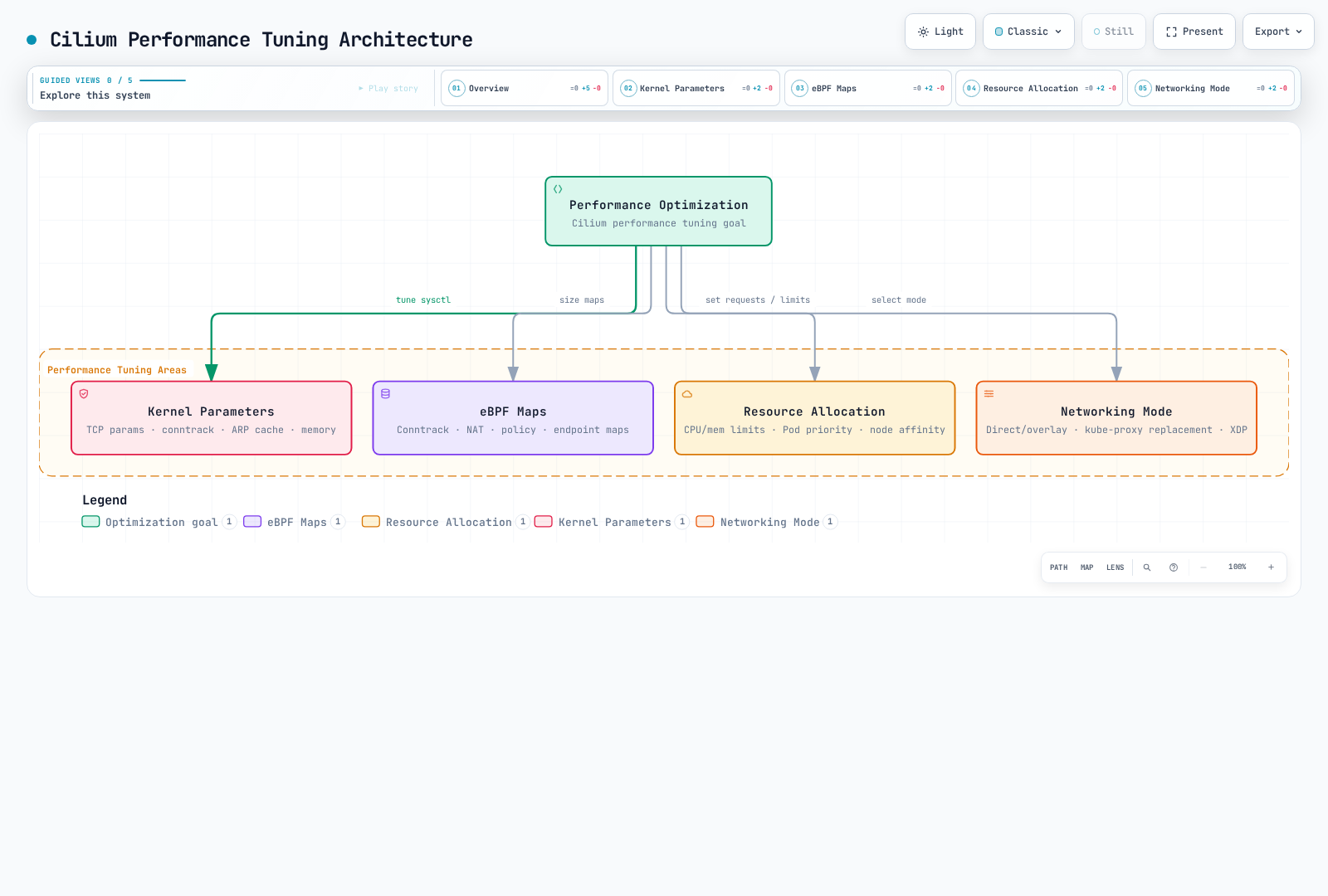
The figure groups investigation areas; it does not prescribe increasing every setting or disabling security controls.
Performance Tuning Areas
| Area | What to measure and what the setting controls |
|---|---|
| Socket backlogs | net.core.somaxconn limits the socket listen backlog; net.ipv4.tcp_max_syn_backlog concerns pending SYN_RECV requests per listener. Check the server's accept behavior and the relevant network namespace. |
| Neighbor entries | net.ipv4.neigh.default.gc_thresh1, gc_thresh2 and gc_thresh3 are distinct garbage-collection thresholds. There is no single gc_thresh setting. |
| Connection tracking | Netfilter's nf_conntrack_max and Cilium's BPF CT maps are separate mechanisms. Increasing the former does not resize the latter. |
| BPF maps | Inspect map pressure, insertion failures, churn and memory. CT, NAT, LB and per-endpoint policy maps have different scopes and sizing rules. |
| CPU and memory | Measure agent, operator, Envoy and Hubble separately. Requests affect scheduling; CPU limits can throttle and memory limits can cause OOM termination. Raising all limits is not a diagnosis. |
| Network path | Identify native/tunnel routing, MTU, masquerading, encryption and service forwarding. XDP acceleration applies to supported paths and drivers; it is not required for kube-proxy replacement. |
Keep security and routing requirements constant when comparing performance. A faster result obtained by removing required encryption or policy is not an equivalent configuration.
Map Sizing
Save the following only as a candidate change after measuring pressure. Merge it into the complete, versioned release values; do not replace the whole Cilium ConfigMap with a small snippet.
# map-sizing-values.yaml
bpf:
  mapDynamicSizeRatio: 0.005
0.005 is a nominal 0.5% of node memory input to dynamic sizing, not 5% and not a hard limit on all Cilium memory. For example, 32 GiB × 0.005 is 163.84 MiB before map limits, rounding and other allocations. The affected large maps include CT, NAT, neighbor and socket reverse-NAT maps; other maps and userspace memory remain separate.
Explicit bpf.ctTcpMax, bpf.ctAnyMax or bpf.natMax values override dynamic sizing for those maps. Keep NAT capacity compatible with CT capacity and verify the resolved startup sizes. Increasing maps can consume more memory; replacing maps can disrupt existing connections.
Distributed LRU (bpf.distributedLRU.enabled) uses per-CPU pools to reduce contention, with memory/eviction tradeoffs. It requires dynamic sizing and recreates maps when enabled. The official high-performance profile is not a universal live toggle: introduce such datapath changes on prepared new nodes or use the documented migration procedure.
The old proxy-max-memory-percentage, proxy-max-threads, enable-xdp, tunnel: disabled and kube-proxy-replacement: strict examples are not current configuration recipes. Use supported chart settings such as envoy.resources, routingMode, boolean kubeProxyReplacement and loadBalancer.acceleration, with their prerequisites.
Hubble Cost and Event Loss
A larger event queue can absorb a burst, but it uses memory and does not solve a sustained processing deficit or reduce CPU consumption:
# hubble-queue-values.yaml
hubble:
  eventQueueSize: 32768
If repeated trace events dominate processing, separately evaluate a longer aggregation interval:
# hubble-aggregation-values.yaml
bpf:
  monitorAggregation: medium
  monitorInterval: 10s
The actual chart field is bpf.monitorInterval, not bpf.events.monitorInterval. Inspect the rendered monitor-aggregation-interval before deployment. Increased aggregation, event-rate limits and disabled event classes all reduce observations available to monitor, Hubble metrics and export. A lost Hubble event is not itself a dropped application packet; check both observability loss and datapath drops.
Advanced Datapath Prerequisites
| Feature | Prerequisites and limits to check |
|---|---|
| netkit | Beta in this baseline; Linux 6.8+ and BPF host routing. Existing veth Pods cannot simply switch device type on agent restart. |
| BIG TCP | Family-specific kernel/NIC requirements; the combined tuning profile requires Linux 6.8+ and supported NICs. It is not a generic MTU increase. |
| BPF host routing | Requires compatible kube-proxy replacement and BPF masquerading. Bypasses host netfilter hooks; check Istio and other integrations that rely on those hooks. |
| XDP service acceleration | Native XDP-capable devices and a supported external service-forwarding path. Use the driver/platform guidance and verify the running status. |
| Bandwidth Manager | Per-Pod egress uses EDT; ingress uses an eBPF token bucket. 10M in the bandwidth annotation means 10 Mbit/s, not 10 MB/s. |
| BBR for Pods | Bandwidth Manager, Linux 5.18+ and BPF host routing; newly created Pods adopt the setting. Host-only BBR is a separate option. |
Bandwidth enforcement has documented limitations with egress L7 Cilium policies and nested network namespaces such as kind. These conditions differ from ordinary Cilium installation requirements. Do not use one tuning profile as evidence that all service-mesh, cloud or kernel combinations work.
Targeted Troubleshooting Commands
Use the standalone cilium CLI for cluster operations and cilium-dbg inside the relevant agent for local endpoints, policies and maps. Select the node being investigated instead of arbitrarily querying the first agent:
set -euo pipefail
: "${NODE_NAME:?Set NODE_NAME to the node being investigated}"
CILIUM_POD=$(kubectl -n kube-system get pods -l k8s-app=cilium \
  --field-selector "spec.nodeName=$NODE_NAME,status.phase=Running" -o json |
  jq -er 'if (.items | length) == 1
then .items[0].metadata.name
else error("expected exactly one running Cilium Pod on the selected node")
end')
kubectl -n kube-system exec "$CILIUM_POD" -c cilium-agent -- cilium-dbg status --verbose
kubectl -n kube-system exec "$CILIUM_POD" -c cilium-agent -- cilium-dbg endpoint list
kubectl -n kube-system exec "$CILIUM_POD" -c cilium-agent -- cilium-dbg policy get
kubectl -n kube-system exec "$CILIUM_POD" -c cilium-agent -- cilium-dbg policy selectors
kubectl -n kube-system exec "$CILIUM_POD" -c cilium-agent -- cilium-dbg map list
kubectl -n kube-system exec "$CILIUM_POD" -c cilium-agent -- cilium-dbg bpf metrics list
kubectl -n kube-system logs "$CILIUM_POD" -c cilium-agent --since=10m --tail=200
Endpoint IDs are local to that agent. Use an ID from its endpoint list:
: "${CILIUM_POD:?Select the owning Cilium Pod first}"
: "${ENDPOINT_ID:?Read the endpoint ID from the selected agent endpoint list}"
kubectl -n kube-system exec "$CILIUM_POD" -c cilium-agent -- \
  cilium-dbg endpoint get "$ENDPOINT_ID"
# Stream local BPF drop events; stop with Ctrl-C.
kubectl -n kube-system exec "$CILIUM_POD" -c cilium-agent -- \
  cilium-dbg monitor --type drop
cilium-dbg map list lists open maps known to the agent's map manager; it is not an inventory of every kernel BPF map. cilium-dbg monitor displays emitted BPF events and optional captured traces, not a lossless tcpdump of every packet. Large CT-map dumps can be expensive; inspect metrics and the affected node before running cilium-dbg bpf ct list global.
For Hubble, first establish the local Relay connection described in Security and Visibility:
hubble status
hubble observe --protocol tcp --verdict DROPPED --since 1h
hubble observe --protocol dns --from-label k8s:app=frontend --last 100
hubble observe --http-status '5+' --from-namespace production --last 100
--type selects event types, not DNS record type A. Use the DNS flow fields if you need to distinguish query types. HTTP status filters use 5+, not 5xx. Retained history and event availability bound --since 1h; it cannot recover an hour of overwritten events.
Common Troubleshooting Scenarios
| Symptom | Evidence to gather | Next decision |
|---|---|---|
| CT/NAT pressure | Map pressure, insertion/drop reasons, connection churn, actual configured sizes | Investigate churn/timeouts and memory headroom before resizing. |
| OOM or CPU saturation | Container termination reason, memory/CPU history, throttling, proxy and Hubble load | Identify the responsible component and change its budget or workload. |
| Unexpected policy result | Correct namespace/labels, endpoint policy revision, proxy errors and Hubble verdict | Check direction, additive allow rules and deny precedence; ordinary allows are not a priority-ordered firewall list. |
| Cross-node failure | DNS, node/pod routes, MTU, tunnel/encryption ports and platform firewall | Verify forward and return paths; a BGP session alone does not prove datapath reachability. |
| Upgrade regression | Old/new values, version notes, all component versions, proxy reconnections | Use the prepared supported rollback path and investigate feature compatibility. |
Large-Scale Deployment Strategies
Capacity planning must include node/Pod density, Services and backends, identities, policy expansion, API watch traffic, IPAM allocation and flow volume. A policy's object count alone does not determine its per-endpoint map cost.
Large-Scale Deployment Architecture
Management / GitOps / shared monitoring
          | config and collected telemetry
          +-----------------------+
          v                       v
  Workload cluster A       Workload cluster B
  - Cilium Operator        - Cilium Operator
  - agent on each node     - agent on each node
  - local Hubble servers   - local Hubble servers
  - Relay/export setup     - Relay/export setup
          |                       |
          +--- optional ClusterMesh metadata/data paths
A central management cluster does not replace the operator in every managed cluster. Size each cluster's operator and agents; the chart's operator replicas and anti-affinity need enough eligible nodes. Aggregate metrics/logs through configured collectors. ClusterMesh requires its own addressing, identity, trust and reachability design; it does not automatically replicate every policy resource.
ciliumEndpointSlice.enabled is an opt-in Cilium feature, distinct from Kubernetes EndpointSlice. It is not the old enable-endpoint-slice ConfigMap flag. Evaluate version and feature compatibility before enabling it; Egress Gateway currently cannot be combined with CiliumEndpointSlice or ClusterMesh.
Egress Gateway SNATs selected traffic to a predictable gateway address; it does not preserve the original Pod source address. Gateway interfaces/IPs and routing must already be provisioned, including platform-specific requirements on AWS. It needs BPF masquerading, kube-proxy replacement and CRD identity allocation. Newly started Pods can briefly send traffic before the egress policy takes effect; do not treat it as an immediate fail-closed source-IP guarantee.
Rollout and Recovery
Keep desired values, policies, address-pool definitions and necessary trust/key material under appropriate versioning and backup controls. Rehearse recovery; a ConfigMap backup is not a complete IPAM or cryptographic recovery plan.
For minor upgrades, first reach the current minor's latest patch, run the required preflight, then move one minor at a time. Preserve initial upgradeCompatibility as instructed by the upgrade guide and migrate renamed/removed values. Do not use --reuse-values across minor versions. Agents, operator and other Cilium components should converge on the same version.
Traffic through userspace proxies can reconnect during upgrades; buffered monitoring events can be lost. New features/resources may need removal or migration before a rollback is valid. A generic application blue/green deployment or Helm rollback is not a guarantee of a reversible, zero-downtime CNI migration.
Real-World Use Case Studies
A Documented Historical Scalability Experiment
The official scalability report describes 1,000 worker nodes, three controller nodes and kernel 5.4.0-1009-gcp on Google Cloud. Its setup does not identify a Cilium version, so these results must not be relabeled as a Cilium 1.20.2 benchmark. The report discusses resource consumption and convergence under its own workload; it is not a current support matrix or a capacity promise.
Its health-check changes and large rollout concurrency were experiment choices. Preserve the actual test conditions when citing it and validate an operational configuration separately.
Design Scenario 1: Large-Scale E-commerce
For many services and high request volume, evaluate eBPF service forwarding, identity/L7 policy, Hubble and optional ClusterMesh. Measure p95/p99 latency, throughput, errors, CPU per request and policy convergence under the same topology and protection requirements. No named implementation or reproducible measurements support a universal percentage improvement here.
Design Scenario 2: Financial Services
Combine least-privilege policy, appropriately scoped transport/application encryption and controlled flow export with application/API audit records. Test key rotation, event loss, retention and cross-cluster trust. Hubble flows alone do not constitute complete regulatory audit evidence or guarantee a shorter audit.
Design Scenario 3: Telecommunications and Edge
Assess NIC/driver support, CPU scheduling, service-forwarding paths, packet sizes, loss and latency under realistic traffic. XDP may benefit a qualifying forwarding path. It does not by itself implement a 5G user-plane function or prove a fixed packets-per-second rate on arbitrary hardware. Remote sites still require an underlay and explicit failure/recovery testing.
Future Roadmap and Development Direction
The community roadmap explicitly makes no date commitments. Track release notes, accepted designs and issues for a specific capability rather than treating a list of desired integrations as a delivery promise.
| Area | Questions to investigate |
|---|---|
| eBPF and kernels | Which kernel feature, backport, NIC and architecture does the proposed path require? CO-RE does not supply missing kernel capabilities. |
| Networking and IPv6 | Which IPAM, routing, policy and external-integration combinations are supported by the selected release? |
| Security and observability | Is this Cilium network policy, Beta workload authentication/encryption, Tetragon runtime enforcement, or an external detector/storage system? |
| Cloud, mesh and serverless | Does the managed platform permit the intended CNI/host hooks? Are mesh interception and authentication preserved? |
| Edge, IoT, 5G and AI/ML | What extra device, transport, runtime or accelerator integration is required? A Kubernetes CNI does not establish all application-specific capabilities. |
Participate through project issues, design proposals, documentation and community discussions. Commercial support and managed distributions have their own feature/support contracts.
Current BGP Configuration
The former CiliumBGPPeeringPolicy example is obsolete for this baseline. Current configuration separates cluster/node selection, peer settings and advertised prefixes into three cilium.io/v2 resources. For the BGP Control Plane, LoadBalancer IP advertisement, Egress Gateway and edge patterns in depth, see BGP, LB, egress and edge; for multi-cluster, see ClusterMesh install and upgrade.
This is a configuration model for an isolated routing lab, not a complete cloud-router setup. It assumes cluster-pool or Kubernetes host-scope IPAM for PodCIDR advertisements, a reachable peer router, the corresponding router configuration, and nodes intentionally labeled cilium-bgp=lab. 192.0.2.1 is a documentation address; replace it with the real peer IP, without /32. Multi-pool IPAM uses a different advertisement type and pool selection.
# bgp-values.yaml
bgpControlPlane:
enabled: true# bgp-lab.yaml
apiVersion: cilium.io/v2
kind: CiliumBGPClusterConfig
metadata:
name: lab-bgp
spec:
nodeSelector:
matchLabels:
cilium-bgp: lab
bgpInstances:
- name: asn-64512
localASN: 64512
peers:
- name: router-64513
peerASN: 64513
peerAddress: 192.0.2.1
peerConfigRef:
name: lab-peer
---
apiVersion: cilium.io/v2
kind: CiliumBGPPeerConfig
metadata:
name: lab-peer
spec:
timers:
connectRetryTimeSeconds: 120
holdTimeSeconds: 90
keepAliveTimeSeconds: 30
gracefulRestart:
enabled: true
restartTimeSeconds: 120
families:
- afi: ipv4
safi: unicast
advertisements:
matchLabels:
advertise: lab
---
apiVersion: cilium.io/v2
kind: CiliumBGPAdvertisement
metadata:
name: lab-pod-cidrs
labels:
advertise: lab
spec:
advertisements:
- advertisementType: PodCIDRThe peer's advertisement selector matches advertise: lab, and peerConfigRef resolves to lab-peer. Graceful Restart requires compatible peer behavior and appropriate timers; it cannot retain a failed datapath or guarantee application availability. BGP advertises reachability but does not install the local datapath routes or create DNS records.
After preparing and applying an appropriate configuration in your routing lab, inspect both Cilium's state and the external router's received routes:
kubectl get ciliumbgpclusterconfigs,ciliumbgppeerconfigs,ciliumbgpadvertisements
cilium bgp peers
cilium bgp routes advertised ipv4 unicast
Test actual forward/return traffic separately. Do not describe long-existing HTTP policy or arbitrary percentage gains as new features of an old release. Consult the exact release notes when migrating from Cilium 1.18 or another earlier minor.
Next Steps
Use the IPAM and policy, L2–L7 networking and security/visibility chapters to validate individual paths. Keep benchmark conditions and limitations with each result, then rehearse a staged rollout and recovery.
After reviewing the exact namespace created by the performance test, remove its resources:
set -eu
PERF_NS=cilium-advanced-perf-1
LAB_OWNER=$(kubectl get namespace "$PERF_NS" -o jsonpath='{.metadata.labels.docs-audit-lab}')
test "$LAB_OWNER" = cilium-advanced-07
kubectl delete namespace "$PERF_NS"
Primary References
- Tuning guide
- Chart values
- Chart ConfigMap template
- Map sizing
- Map sizing implementation
- Upgrade guide
- Upgrade limitations
- BGP configuration
- BGP operation
- Bandwidth Manager
- Egress Gateway
- Historical scalability report
- Community roadmap
- Linux IP sysctls
Quiz
Review the operational boundaries and diagnostic commands in the topic quiz.