FinOps Cost Visibility Platform
Last Updated: September 12, 2026. OpenCost 1.121.2 / chart 2.5.31, Kubecost 3.2.4, Kyverno 1.19.1. Validation: Helm rendering, Kubernetes schemas, Terraform mock providers, local cost calculations and policy evaluation. This does not represent an installation on a production cluster or reconciliation against an actual AWS invoice.
< Previous: Event Capacity Planning | Contents | Next: Tekton Pipelines >
Overview
FinOps brings engineering, finance, product and business teams together to manage the value of technology spending. Cost reduction alone is not the success criterion: service levels, growth, unit economics and reliable attribution matter too.
This chapter distinguishes the Kubernetes allocation model, AWS billing data and team budgets, then connects them. Replace example cluster names, namespaces, buckets and IAM roles before deployment. Installation commands create real resources; the validation reported here was local.
1. FinOps Operating Model
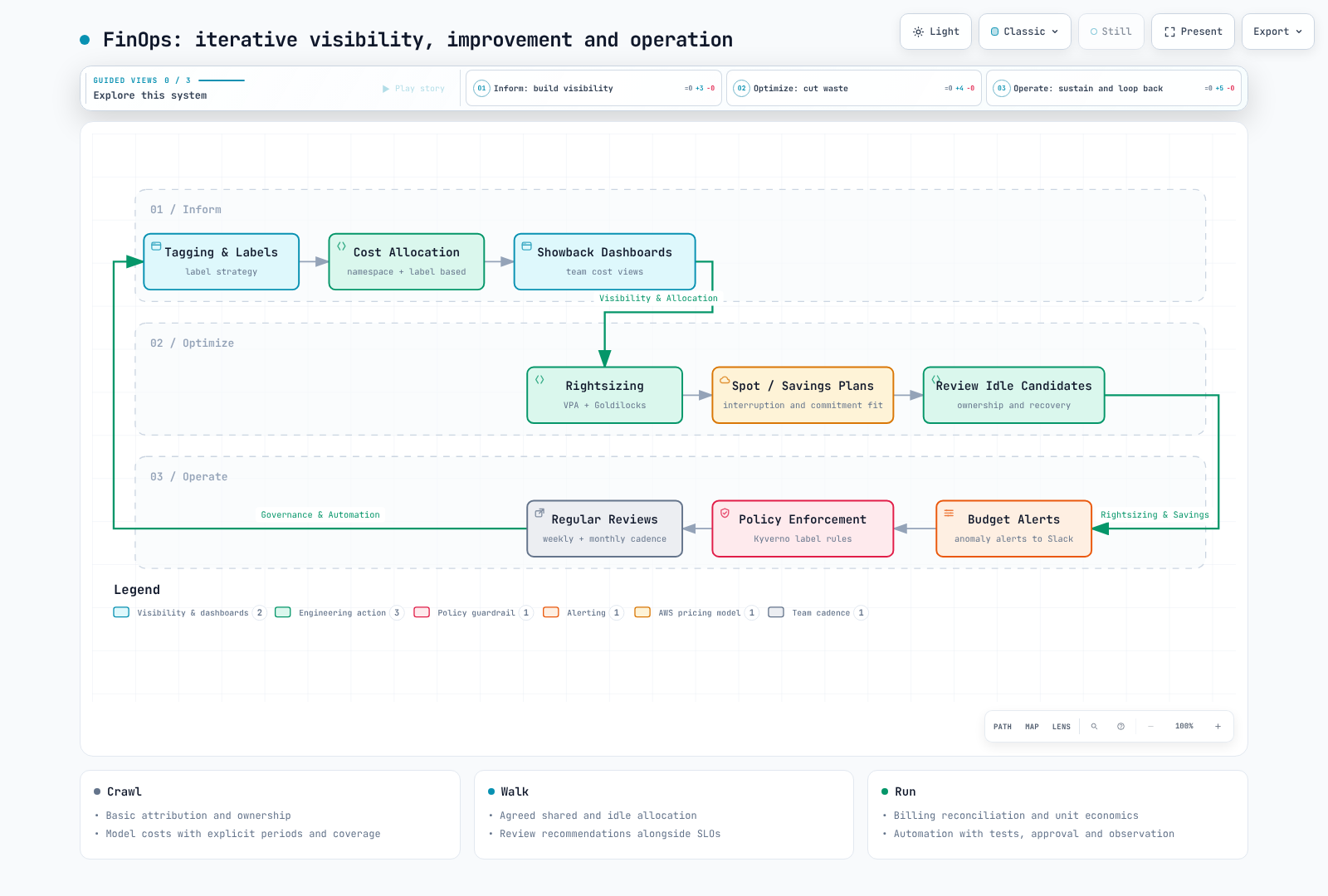
Inform covers data collection, allocation and visibility. Optimize turns measurements into improvements. Operate sustains ownership, budgets and reviews. These phases repeat.
| Role | Responsibility |
|---|---|
| Platform | Reliable collection, cost-data access control, upgrades |
| Service teams | Labels, resource requests, performance tests, change review |
| Finance / FinOps | Billing reconciliation, shared-cost rules, budgets and forecasts |
| Product / business | Unit economics, value and investment priorities |
Crawl/Walk/Run describe capabilities in particular areas. They are not universal 1–3 or 6–12 month schedules. Establish data quality and ownership before automated chargeback or deletion.
2. Cost Data and Installation
2.1 Distinguish the measurements
| Measurement | Meaning | Limitation |
|---|---|---|
| Current allocation rate, USD/hour | Current allocation and pricing model | Not actual monthly spending |
| Windowed allocation model cost | Kubernetes attribution over an explicit period | Depends on coverage, retention and model |
| CUR 2.0 / Cost Explorer | AWS billing-based costs | Refresh lag, discounts, credits, taxes and amortization choices |
| Linear month-end estimate | Cost to date / completed days × days in that month | Does not model seasonality or changing demand |
EC2 CPU and memory are generally not separately billed products. OpenCost's per-core and per-GiB prices allocate instance cost. Do not present arbitrary CPU/RAM prices or a second blanket contract discount as an invoice. Adding Cloud Cost totals to Allocation totals for the same infrastructure can double count spending.
2.2 Install OpenCost
This assumes the Prometheus Operator and ServiceMonitor CRD from the observability stack, plus an appropriate gp3 StorageClass. EKS storage may use the EBS CSI driver or Auto Mode's StorageClass configuration. The example release: prometheus must match the actual Prometheus ServiceMonitor selector.
The earlier seven-day Prometheus retention cannot reconstruct a full month. Monthly analysis requires sufficient retention and storage. Increasing retention does not recover deleted data. The exporter PVC below does not replace Prometheus storage.
opencost-values.yaml
serviceAccount:
  create: true
  name: opencost
opencost:
  mcp:
    enabled: false
  exporter:
    defaultClusterId: eks-production
    resources:
      requests:
        cpu: 100m
        memory: 256Mi
      limits:
        memory: 2Gi
    persistence:
      enabled: true
      accessMode: ReadWriteOnce
      storageClass: gp3
      size: 10Gi
  prometheus:
    internal:
      enabled: true
      serviceName: prometheus-kube-prometheus-prometheus
      namespaceName: observability
      port: 9090
    external:
      enabled: false
  metrics:
    serviceMonitor:
      enabled: true
      namespace: opencost
      additionalLabels:
        release: prometheus
      honorLabels: true
  customPricing:
    enabled: false
  cloudCost:
    enabled: false
  ui:
    enabled: true
    ingress:
enabled: falsehelm repo add opencost https://opencost.github.io/opencost-helm-chart
helm repo update opencost
helm upgrade --install opencost opencost/opencost \
--version 2.5.31 --namespace opencost --create-namespace \
-f opencost-values.yaml --wait --timeout 10m
kubectl -n opencost get pods,pvc,svc,servicemonitor
kubectl -n opencost port-forward service/opencost 9090:9090 9003:9003The local UI uses port 9090; the API uses 9003. opencost.prometheus and opencost.cloudCost are not children of exporter. Chart 2.5.31 enables MCP by default, so this baseline explicitly disables it. Design authentication and access scope separately if exposing cost tools through MCP; cost-data MCP is distinct from documentation-search MCP.
2.3 Choosing Kubecost 3.x
Kubecost is a separate product and deployment choice. Version 3.x uses ClickHouse storage and finops-agent collection. Do not copy 2.x kubecostModel, Prometheus or ETL settings unchanged. Existing 2.x installations need the official migration procedure, including intermediate agents, re-ingestion and feature constraints.
The current chart repository is https://kubecost.github.io/kubecost/. This is a limited-feature installation baseline. It explicitly disables Cluster Controller, Admission Controller and forecasting. Do not use it as an in-place replacement command for existing installations and storage.
kubecost-values.yaml
global:
  clusterId: eks-production
  defaultStorageClass: gp3
frontend:
  enabled: true
  service:
    type: ClusterIP
localStore:
  enabled: true
  persistentVolume:
    enabled: true
    size: 32Gi
    storageClass: gp3
finopsagent:
  enabled: true
aggregator:
  enabled: true
cloudCost:
  enabled: false
networkCosts:
  enabled: false
clusterController:
  enabled: false
kubecostAdmissionController:
  enabled: false
forecasting:
  enabled: false
ingress:
  enabled: false
telemetry:
enabled: falsehelm repo add kubecost https://kubecost.github.io/kubecost/
helm repo update kubecost
helm template kubecost kubecost/kubecost --version 3.2.4 \
--namespace kubecost -f kubecost-values.yaml > kubecost-rendered.yaml
# Review storage, RBAC, images and product entitlements before installation.
helm install kubecost kubecost/kubecost --version 3.2.4 \
--namespace kubecost --create-namespace -f kubecost-values.yamlCheck product entitlements for SSO, fine-grained RBAC and multi-cluster features. The presence of SAML/OIDC values does not enable those features for every deployment. global.acknowledged concerns Enterprise major-upgrade acknowledgement, not general license acceptance. An internal ALB does not authenticate users.
2.4 CUR 2.0, Athena and OpenCost Cloud Cost
The following Terraform defines a new CUR 2.0 export, two S3 buckets, an Athena workgroup and an OpenCost IRSA role. Check ownership and import before managing existing resources. Organization-wide billing data requires appropriate management-account permissions.
Glue crawler and table creation are not included. Follow the Data Exports Athena-processing procedure: wait for initial delivery, then create and refresh the Glue table and partitions using the export's data directory. Do not combine manifests and metadata with the data table. Supply the resulting database and table names. Lake Formation protection requires additional grants.
COST_AND_USAGE_REPORT is the Data Exports SQL source, not a universal Athena Glue table name. Inspect the resulting schema: CUR 2.0 uses a billing_period partition rather than assuming the legacy CUR year/month layout.
Data Exports delivers using SSE-S3. Do not copy a configuration requiring direct KMS-encrypted delivery. If KMS is required, design the documented post-delivery encryption process and consumer permissions together. Archival storage requiring restoration can break queries over active data.
cur.tf
terraform {
  required_version = ">= 1.12.0"
  required_providers {
    aws = {
      source  = "hashicorp/aws"
      version = "= 6.64.0"
    }
  }
}

provider "aws" {
  region = var.region
}

provider "aws" {
  alias  = "billing"
  region = "us-east-1"
}

variable "region" {
  type    = string
  default = "ap-northeast-2"
}

variable "cur_bucket" {
  type = string
}

variable "results_bucket" {
  type = string
  validation {
    condition     = var.results_bucket != var.cur_bucket
    error_message = "Use separate CUR source and Athena result buckets."
  }
}

variable "oidc_provider_arn" {
  type = string
}

variable "oidc_issuer" {
  type = string
}

variable "glue_database" {
  type = string
}

variable "glue_table" {
  type = string
}

data "aws_caller_identity" "current" {}
data "aws_partition" "current" {}

locals {
  account = data.aws_caller_identity.current.account_id
  arn     = "arn:${data.aws_partition.current.partition}"
  issuer  = trimprefix(trimsuffix(var.oidc_issuer, "/"), "https://")
  buckets = { cur = var.cur_bucket, results = var.results_bucket }
}

resource "aws_s3_bucket" "cost" {
  for_each      = local.buckets
  bucket        = each.value
  force_destroy = false
}

resource "aws_s3_bucket_public_access_block" "cost" {
  for_each                = aws_s3_bucket.cost
  bucket                  = each.value.id
  block_public_acls       = true
  block_public_policy     = true
  ignore_public_acls      = true
  restrict_public_buckets = true
}

resource "aws_s3_bucket_ownership_controls" "cost" {
  for_each = aws_s3_bucket.cost
  bucket   = each.value.id
  rule {
    object_ownership = "BucketOwnerEnforced"
  }
}

resource "aws_s3_bucket_server_side_encryption_configuration" "cost" {
  for_each = aws_s3_bucket.cost
  bucket   = each.value.id
  rule {
    apply_server_side_encryption_by_default {
      sse_algorithm = "AES256"
    }
  }
}

resource "aws_s3_bucket_policy" "delivery" {
  bucket = aws_s3_bucket.cost["cur"].id
  policy = jsonencode({
    Version = "2012-10-17"
    Statement = [{
      Sid       = "AllowDataExports"
      Effect    = "Allow"
      Principal = { Service = "bcm-data-exports.amazonaws.com" }
      Action    = "s3:PutObject"
      Resource  = "${aws_s3_bucket.cost["cur"].arn}/cur/*"
      Condition = {
        StringEquals = { "aws:SourceAccount" = local.account }
        ArnLike = {
          "aws:SourceArn" = "${local.arn}:bcm-data-exports:us-east-1:${local.account}:export/*"
        }
      }
    }]
  })
}

resource "aws_bcmdataexports_export" "cur" {
  provider = aws.billing
  depends_on = [
    aws_s3_bucket_policy.delivery,
    aws_s3_bucket_public_access_block.cost,
    aws_s3_bucket_server_side_encryption_configuration.cost
  ]
  export {
    name = "opencost-cur"
    data_query {
      query_statement = "SELECT * FROM COST_AND_USAGE_REPORT"
      table_configurations = {
        COST_AND_USAGE_REPORT = {
          BILLING_VIEW_ARN                      = "${local.arn}:billing::${local.account}:billingview/primary"
          TIME_GRANULARITY                      = "HOURLY"
          INCLUDE_RESOURCES                     = "TRUE"
          INCLUDE_MANUAL_DISCOUNT_COMPATIBILITY = "FALSE"
          INCLUDE_SPLIT_COST_ALLOCATION_DATA    = "FALSE"
        }
      }
    }
    destination_configurations {
      s3_destination {
        s3_bucket = aws_s3_bucket.cost["cur"].bucket
        s3_prefix = "cur"
        s3_region = var.region
        s3_output_configurations {
          overwrite   = "OVERWRITE_REPORT"
          format      = "PARQUET"
          compression = "PARQUET"
          output_type = "CUSTOM"
        }
      }
    }
    refresh_cadence {
      frequency = "SYNCHRONOUS"
    }
  }
}

resource "aws_athena_workgroup" "opencost" {
  name          = "opencost-cur"
  force_destroy = false
  configuration {
    enforce_workgroup_configuration    = true
    publish_cloudwatch_metrics_enabled = true
    bytes_scanned_cutoff_per_query     = 10737418240
    result_configuration {
      output_location       = "s3://${aws_s3_bucket.cost["results"].bucket}/opencost/"
      expected_bucket_owner = local.account
      encryption_configuration {
        encryption_option = "SSE_S3"
      }
    }
  }
}

resource "aws_iam_role" "opencost" {
  name = "opencost-cur-reader"
  assume_role_policy = jsonencode({
    Version = "2012-10-17"
    Statement = [{
      Effect    = "Allow"
      Principal = { Federated = var.oidc_provider_arn }
      Action    = "sts:AssumeRoleWithWebIdentity"
      Condition = {
        StringEquals = {
          "${local.issuer}:aud" = "sts.amazonaws.com"
          "${local.issuer}:sub" = "system:serviceaccount:opencost:opencost"
        }
      }
    }]
  })
}

resource "aws_iam_role_policy" "opencost" {
  role = aws_iam_role.opencost.id
  policy = jsonencode({
    Version = "2012-10-17"
    Statement = [
      {
        Effect = "Allow"
        Action = ["athena:StartQueryExecution", "athena:StopQueryExecution",
        "athena:GetQueryExecution", "athena:GetQueryResults", "athena:GetWorkGroup"]
        Resource = aws_athena_workgroup.opencost.arn
      },
      {
        Effect = "Allow"
        Action = ["glue:GetDatabase", "glue:GetDatabases", "glue:GetTable",
        "glue:GetTables", "glue:GetPartitions"]
        Resource = [
          "${local.arn}:glue:${var.region}:${local.account}:catalog",
          "${local.arn}:glue:${var.region}:${local.account}:database/${var.glue_database}",
          "${local.arn}:glue:${var.region}:${local.account}:table/${var.glue_database}/${var.glue_table}"
        ]
      },
      {
        Effect   = "Allow"
        Action   = "s3:GetBucketLocation"
        Resource = [for b in aws_s3_bucket.cost : b.arn]
      },
      {
        Effect    = "Allow"
        Action    = "s3:ListBucket"
        Resource  = aws_s3_bucket.cost["cur"].arn
        Condition = { StringLike = { "s3:prefix" = ["cur", "cur/*"] } }
      },
      {
        Effect    = "Allow"
        Action    = "s3:ListBucket"
        Resource  = aws_s3_bucket.cost["results"].arn
        Condition = { StringLike = { "s3:prefix" = ["opencost", "opencost/*"] } }
      },
      {
        Effect   = "Allow"
        Action   = "s3:GetObject"
        Resource = "${aws_s3_bucket.cost["cur"].arn}/cur/*"
      },
      {
        Effect   = "Allow"
        Action   = ["s3:GetObject", "s3:PutObject", "s3:AbortMultipartUpload"]
        Resource = "${aws_s3_bucket.cost["results"].arn}/opencost/*"
      }
    ]
  })
}

output "opencost_role_arn" {
  value = aws_iam_role.opencost.arn
}

output "cur_export_arn" {
  value = aws_bcmdataexports_export.cur.arn
}

output "athena_results" {
  value = "s3://${aws_s3_bucket.cost["results"].bucket}/opencost/"
}
glue_database and glue_table identify the query target; they do not create it. The example Athena scan limit is 10 GiB per query: investigate failures and size it for the dataset. Hourly records do not imply hourly report delivery.
This example uses IRSA. Supply the existing OIDC provider ARN and issuer, and match the trust policy sub to the actual opencost/opencost ServiceAccount. EKS Pod Identity uses a different trust policy and association instead of the IRSA annotation.
cloud-integration.json
{
  "aws": {
    "athena": [
      {
        "bucket": "s3://REPLACE_QUERY_RESULTS_BUCKET/opencost/",
        "region": "ap-northeast-2",
        "database": "REPLACE_GLUE_DATABASE",
        "catalog": "AwsDataCatalog",
        "table": "REPLACE_GLUE_TABLE",
        "workgroup": "opencost-cur",
        "account": "123456789012",
        "authorizer": {
          "authorizerType": "AWSServiceAccount"
        }
      }
    ]
  }
}
opencost-cloud-values.yaml
serviceAccount:
  create: true
  name: opencost
  annotations:
    eks.amazonaws.com/role-arn: arn:aws:iam::123456789012:role/opencost-cur-reader
opencost:
  cloudIntegrationSecret: opencost-cloud-integrations
  cloudCost:
enabled: true# Replace all placeholders and account IDs in the files first.
kubectl -n opencost create secret generic opencost-cloud-integrations \
--from-file=cloud-integration.json=cloud-integration.json \
--dry-run=client -o yaml | kubectl apply -f -
helm upgrade opencost opencost/opencost --version 2.5.31 \
--namespace opencost -f opencost-values.yaml -f opencost-cloud-values.yamlThe JSON bucket is the Athena query-results bucket, not the CUR source bucket. AWSServiceAccount uses the AWS SDK default credential chain rather than static access keys. Verify source reads, result writes, the Secret mount and importer freshness before claiming billing integration works.
Cost allocation tag keys may be absent before activation. AWS currently supports management-account backfill for up to 12 months, subject to tags actually existing on resources during that period and processing delay. Applying a tag now does not manufacture historical tagging.
3. Showback and Chargeback
Showback makes spending visible to consuming teams. Chargeback allocates and bills it under agreed accounting rules. A model value is not automatically an internal invoice. Define the period, currency, direct/shared/idle/unallocated categories, taxes, credits, refunds and rounding first.
3.1 Labels and policies
Use namespace team labels for team aggregation and Pod-template team / cost-center labels for finer attribution. Kubernetes labels and AWS cost allocation tags are separate data. Namespace allocation can still work without team labels, but team mapping is not guaranteed.
Kyverno 1.19.1 warns that ClusterPolicy is deprecated. New examples use CEL ValidatingPolicy from policies.kyverno.io/v1, requiring the corresponding CRD and controller version. They target namespaces labeled finops.example.com/enabled=true and generate checks for Pod-controller templates.
cost-labels.yaml
apiVersion: policies.kyverno.io/v1
kind: ValidatingPolicy
metadata:
  name: finops-pod-labels
spec:
  validationActions: [Audit]
  evaluation:
    admission:
      enabled: true
    background:
      enabled: true
  autogen:
    podControllers:
      controllers: [deployments, statefulsets, daemonsets, jobs, cronjobs]
  matchConstraints:
    namespaceSelector:
      matchLabels:
        finops.example.com/enabled: "true"
    resourceRules:
      - apiGroups: [""]
        apiVersions: [v1]
        operations: [CREATE, UPDATE]
        resources: [pods]
  validations:
    - expression: >-
        ['team', 'cost-center'].all(label,
          object.metadata.?labels[label].orValue('') != '')
      message: "Add team and cost-center labels to the Pod template."
resource-requests.yaml
apiVersion: policies.kyverno.io/v1
kind: ValidatingPolicy
metadata:
  name: finops-container-requests
spec:
  validationActions: [Audit]
  evaluation:
    admission:
      enabled: true
    background:
      enabled: true
  autogen:
    podControllers:
      controllers: [deployments, statefulsets, daemonsets, jobs, cronjobs]
  matchConstraints:
    namespaceSelector:
      matchLabels:
        finops.example.com/enabled: "true"
    resourceRules:
      - apiGroups: [""]
        apiVersions: [v1]
        operations: [CREATE, UPDATE]
        resources: [pods]
  validations:
    - expression: >-
        object.spec.containers.all(c,
          has(c.resources) && has(c.resources.requests) &&
          ['cpu', 'memory'].all(r,
            r in c.resources.requests &&
            quantity(c.resources.requests[r]).isGreaterThan(quantity('0'))))
      message: "Set positive CPU and memory requests for each regular container."
Audit does not block violations. Review background reports and scope, resolve issues with owners, then switch selected policies to Deny. Choose Warn separately if user-facing warnings are wanted. The local CLI can return a failed test for an Audit policy; that is not proof that admission would be denied.
The request policy checks positive CPU and memory requests for every regular container. Init-container and Pod-level budgets and limit strategies need separate policies. Universal four-core / 8 GiB limits do not establish that applications are correctly sized.
apiVersion: v1
kind: Namespace
metadata:
  name: team-backend
  labels:
    team: backend
    finops.example.com/enabled: "true"
---
apiVersion: v1
kind: ResourceQuota
metadata:
  name: team-capacity
  namespace: team-backend
spec:
  hard:
    requests.cpu: "20"
    requests.memory: 40Gi
    requests.storage: 200Gi
    persistentvolumeclaims: "20"
    pods: "100"
This quota is an example resource ceiling, not a dollar budget or a cap on all cloud spending. Size it against current usage and autoscaling maxima, and plan for rejected creation requests.
3.2 Windowed allocation API
This uses OpenCost 1.121.2's /allocation/compute. Verify the period, aggregation and response structure for the product and version. includeIdle and shareIdle are booleans; shareIdle=weighted is not the documented boolean form.
curl --fail --silent --show-error --get \
  'http://127.0.0.1:9003/allocation/compute' \
  --data-urlencode 'window=2026-09-01T00:00:00Z,2026-09-12T00:00:00Z' \
  --data-urlencode 'aggregate=namespace' \
  --data-urlencode 'includeIdle=true' \
  --data-urlencode 'shareIdle=false'
3.3 Shared-cost allocation and conservation
These are synthetic USD inputs for calculation validation, not an actual bill. Non-overlapping pools contain 6,500 direct, 2,500 shared and 1,000 idle cost. Shared cost is weighted by direct cost; idle cost is divided equally. Fractional cents use the largest-remainder method with lexical team-name tie-breaking.
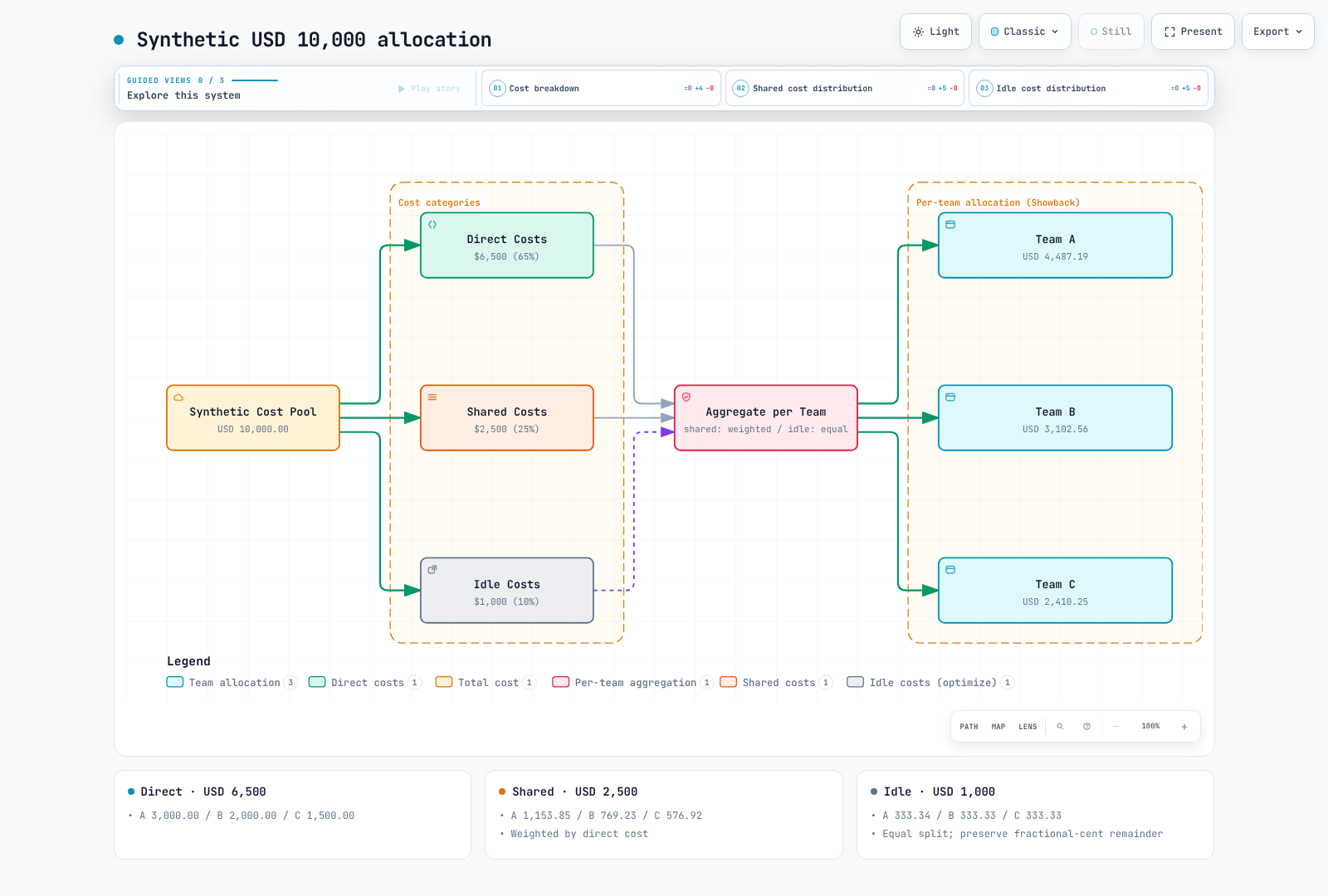
Team     Direct    Shared     Idle      Total
A        3000.00   1153.85    333.34     4487.19
B        2000.00    769.23    333.33     3102.56
C        1500.00    576.92    333.33     2410.25
Total    6500.00   2500.00   1000.00    10000.00
allocation-example.json
{
  "description": "Synthetic reconciled expense pool, not an actual account bill.",
  "currency": "USD",
  "direct": {
    "team-a": "3000.00",
    "team-b": "2000.00",
    "team-c": "1500.00"
  },
  "shared": "2500.00",
  "idle": "1000.00",
  "unallocated": "0.00"
}
allocate_costs.py
"""Allocate one reconciled USD expense pool using explicit, conserved cent amounts."""
import argparse
import json
from decimal import Decimal
from fractions import Fraction


def cents(value):
    if isinstance(value, bool):
        raise ValueError("Money cannot be boolean")
    value=Decimal(str(value))
    if not value.is_finite() or value < 0:
        raise ValueError("Use finite nonnegative expense amounts; handle refunds explicitly")
    scaled=value*100
    if scaled != scaled.to_integral_value():
        raise ValueError("Settle source amounts to cents under an approved rounding policy first")
    return int(scaled)


def money(value):
    return f"{Decimal(value)/100:.2f}"


def distribute(total, weights):
    if not weights:
        raise ValueError("At least one allocation target is required")
    rational={}
    for name, weight in weights.items():
        value=Decimal(str(weight))
        if not value.is_finite() or value < 0:
            raise ValueError("Weights must be finite and nonnegative")
        rational[name]=Fraction(value)
    denominator=sum(rational.values(),Fraction(0))
    if denominator==0:
        if total:
            raise ValueError("A positive pool cannot be allocated with zero total weight")
        return {name:0 for name in weights}
    exact={name:Fraction(total)*weight/denominator for name,weight in rational.items()}
    result={name:value.numerator//value.denominator for name,value in exact.items()}
    remainder=total-sum(result.values())
    # Largest remainder; ties resolved by stable target name.
    order=sorted(exact,key=lambda name:(-(exact[name]-result[name]),name))
    for name in order[:remainder]:
        result[name]+=1
    assert sum(result.values())==total
    return result


def allocate(config):
    if config.get("currency")!="USD":
        raise ValueError("This example accepts a single USD ledger; do not mix currencies")
    direct={name:cents(value) for name,value in config["direct"].items()}
    if not direct:
        raise ValueError("No teams supplied")
    shared=cents(config["shared"])
    idle=cents(config["idle"])
    unallocated=cents(config.get("unallocated","0"))
    shared_alloc=distribute(shared,direct)
    idle_alloc=distribute(idle,{name:1 for name in direct})
    teams={name:{"direct":money(value),"shared":money(shared_alloc[name]),"idle":money(idle_alloc[name]),
                 "total":money(value+shared_alloc[name]+idle_alloc[name])} for name,value in sorted(direct.items())}
    source_total=sum(direct.values())+shared+idle+unallocated
    allocated_total=sum(cents(value["total"]) for value in teams.values())+unallocated
    assert source_total==allocated_total
    return {"currency":"USD","policy":"Shared weighted by direct cost; idle split equally; unallocated retained",
            "rounding":"Exact cents; largest remainder with lexical tie-break",
            "teams":teams,"unallocated":money(unallocated),"source_total":money(source_total),
            "allocated_total":money(allocated_total),
            "limits":["Use one reconciled pool; do not add overlapping Allocation and Cloud Cost totals.",
                      "This policy is an example, not an inherently fair or mandatory chargeback rule.",
                      "Refunds, credits, taxes and currency conversion require explicit separate policies."]}


if __name__=="__main__":
    parser=argparse.ArgumentParser()
    parser.add_argument("input")
    args=parser.parse_args()
    try:
        with open(args.input,encoding="utf-8") as stream:
            result=allocate(json.load(stream))
    except (ValueError,KeyError,ArithmeticError) as error:
        parser.error(str(error))
print(json.dumps(result,ensure_ascii=False,indent=2))python3 allocate_costs.py allocation-example.jsonRetain unattributed amounts as unallocated. This calculator does not automatically redistribute negative costs or refunds. Real accounting needs separate credit, refund and currency-conversion rules. The example policy is not inherently the fairest choice for every organization.
3.4 Prometheus and Grafana
These rules assume one cluster's Prometheus. Central Prometheus/Thanos queries must retain a real cluster identifier in every aggregation and join. Joining multiple clusters on node name alone can mix costs.
node_cpu_hourly_cost is per core and node_ram_hourly_cost per GiB per hour. Multiply by allocation metrics and deduplicate repeated scrapes with max. Do not invent metrics such as kubecost_container_cpu_cost. Merge this kube-state-metrics setting into the existing observability chart values before joining labels.
kube-state-metrics:
  metricLabelsAllowlist:
    - namespaces=[team]
cost-rules.yaml
groups:
  - name: finops-current-rates
    rules:
      - record: finops:node_cpu_hourly_cost
        expr: max by (node) (node_cpu_hourly_cost)
      - record: finops:node_ram_hourly_cost
        expr: max by (node) (node_ram_hourly_cost)
      - record: finops:namespace_cpu_cost_per_hour
        expr: |
          sum by (namespace) (
            max by (namespace, pod, container, node) (container_cpu_allocation{container!=""})
            * on (node) group_left finops:node_cpu_hourly_cost
          )
      - record: finops:namespace_ram_cost_per_hour
        expr: |
          sum by (namespace) (
            max by (namespace, pod, container, node) (container_memory_allocation_bytes{container!=""}) / 1073741824
            * on (node) group_left finops:node_ram_hourly_cost
          )
      - record: finops:namespace_compute_cost_per_hour
        expr: finops:namespace_cpu_cost_per_hour + finops:namespace_ram_cost_per_hour
      - record: finops:team_compute_cost_per_hour
        expr: |
          sum by (label_team) (
            finops:namespace_compute_cost_per_hour
            * on (namespace) group_left (label_team)
              max by (namespace, label_team) (kube_namespace_labels{label_team!=""})
          )
      - alert: OpenCostMetricsUnavailable
        expr: absent(node_cpu_hourly_cost)
        for: 15m
        labels:
          severity: warning
        annotations:
          summary: "OpenCost CPU pricing metrics are absent"
      - alert: KubernetesComputeRateAboveReviewThreshold
        expr: sum(finops:namespace_compute_cost_per_hour) > 20
        for: 30m
        labels:
          severity: warning
        annotations:
          summary: "Allocated compute model exceeds the example USD 20/hour threshold"
The file is in Prometheus rule-file format. With the Operator, put it under PrometheusRule.spec and set metadata labels to match the actual rule selector. USD 20/hour for 30 minutes is an example review threshold over model data. for requires a condition to persist; it does not eliminate false positives.
Grafana panels can use finops:namespace_compute_cost_per_hour and finops:team_compute_cost_per_hour, labeled USD/hour. These are allocated CPU/RAM rates, not a bill including all storage, networking, control-plane and idle costs. Label any * 730 panel as a fixed 730-hour estimate. Missing prices must appear as missing data, not zero cost.
Namespaces without team labels can disappear from team aggregation. Compare the full namespace total with the team total. Dashboard variables and folders do not enforce datasource authorization. Use server-side datasource permissions or separate tenants for team isolation, and test that cross-team queries are denied.
4. Billing-Based Anomaly Detection
A DIMENSIONAL / SERVICE Cost Anomaly Detection monitor covers AWS service spending. Naming it “EKS” does not scope it to EKS. For CUSTOM monitors using tags, linked accounts or Cost Categories, verify supported scope and data availability. Reuse an existing monitor ARN where appropriate.
This optional configuration belongs beside the earlier Terraform file. Separate DAILY EMAIL summaries from IMMEDIATE SNS notifications. SNS delivery still follows billing updates and anomaly detection; it is not an instantaneous spending stop. The topic needs separately approved subscribers. This example does not create a Slack subscription.
anomaly.tf
# Optional: supply an existing monitor ARN to avoid duplicating a SERVICE monitor.
variable "cost_monitor_arn" {
  type = string
}

variable "notification_email" {
  type = string
}

resource "aws_ce_anomaly_subscription" "daily" {
  provider         = aws.billing
  name             = "daily-cost-anomalies"
  frequency        = "DAILY"
  monitor_arn_list = [var.cost_monitor_arn]
  threshold_expression {
    dimension {
      key           = "ANOMALY_TOTAL_IMPACT_ABSOLUTE"
      match_options = ["GREATER_THAN_OR_EQUAL"]
      values        = ["100"]
    }
  }
  subscriber {
    type    = "EMAIL"
    address = var.notification_email
  }
}

resource "aws_sns_topic" "anomalies" {
  provider = aws.billing
  name     = "cost-anomalies"
}

resource "aws_sns_topic_policy" "anomalies" {
  provider = aws.billing
  arn      = aws_sns_topic.anomalies.arn
  policy = jsonencode({
    Version = "2012-10-17"
    Statement = [{
      Effect    = "Allow"
      Principal = { Service = "costalerts.amazonaws.com" }
      Action    = "sns:Publish"
      Resource  = aws_sns_topic.anomalies.arn
      Condition = {
        StringEquals = { "aws:SourceAccount" = local.account }
        ArnLike = {
          "aws:SourceArn" = "${local.arn}:ce::${local.account}:anomalysubscription/*"
        }
      }
    }]
  })
}

resource "aws_ce_anomaly_subscription" "immediate" {
  provider         = aws.billing
  depends_on       = [aws_sns_topic_policy.anomalies]
  name             = "immediate-cost-anomalies"
  frequency        = "IMMEDIATE"
  monitor_arn_list = [var.cost_monitor_arn]
  threshold_expression {
    dimension {
      key           = "ANOMALY_TOTAL_IMPACT_ABSOLUTE"
      match_options = ["GREATER_THAN_OR_EQUAL"]
      values        = ["100"]
    }
  }
  subscriber {
    type    = "SNS"
    address = aws_sns_topic.anomalies.arn
  }
}
Creating resources and subscriptions has real cost and notification effects. For KMS-encrypted SNS, also configure the necessary key permissions for costalerts.amazonaws.com and constrain SourceAccount/SourceArn. Adjust the example USD 100 threshold to the organization.
AWS Budgets Actions can perform supported EC2/RDS actions as well as IAM/SCP actions. Update delays and action scope still apply; this is not a hard cap that immediately stops all spending.
5. Team Budgets and Scheduled Reports
5.1 Explicit numeric budgets
label_replace does not turn a namespace-annotation string into a numeric time series. This example parses explicit USD budgets from JSON. A missing budget produces a null ratio; zero, negative and invalid numeric budgets are rejected.
budgets.json
{
  "currency": "USD",
  "namespaces": {
    "backend-production": "3000.00",
    "frontend-production": "2000.00"
  }
}
5.2 Monthly model report and optional Slack delivery
This script uses only the Python 3.12 standard library. It queries completed UTC dates; --as-of is the exclusive end date. On the first day of a month it reports the previous completed month. Empty data or multiple time steps fail instead of becoming a false USD 0 result. The script cannot prove complete historical coverage: inspect API warnings and importer freshness.
By default it creates JSON files and does not send Slack messages. Delivery requires both --send and --webhook-file. Different channels need separate incoming webhooks; a payload channel override is not used.
report_costs.py
"""Read-only OpenCost monthly model-cost report and optional reviewed Slack delivery."""
import argparse
import calendar
import json
from datetime import date, datetime, timedelta, timezone
from decimal import Decimal, ROUND_HALF_UP
from pathlib import Path
from urllib.parse import urlencode, urlsplit
from urllib.request import Request, build_opener, HTTPRedirectHandler


class NoRedirect(HTTPRedirectHandler):
    def redirect_request(self, req, fp, code, msg, headers, newurl):
        return None


def decimal_value(value, name, positive=False):
    if value is None or isinstance(value, bool):
        raise ValueError(f"{name}: missing/invalid number")
    amount=Decimal(str(value))
    if not amount.is_finite() or (positive and amount <= 0):
        raise ValueError(f"{name}: invalid finite range")
    return amount


def usd(value):
    return format(value.quantize(Decimal("0.01"),rounding=ROUND_HALF_UP),"f")


def month_window(as_of):
    end=date.fromisoformat(as_of)
    month_reference=end if end.day>1 else end-timedelta(days=1)
    start=month_reference.replace(day=1)
    completed=(end-start).days
    return start,end,completed,calendar.monthrange(start.year,start.month)[1]


def summarize(payload, budgets, as_of):
    start,end,days,month_days=month_window(as_of)
    if not isinstance(payload,dict) or not isinstance(budgets,dict) or not isinstance(budgets.get("namespaces",{}),dict):
        raise ValueError("Expected API and budget JSON objects")
    if budgets.get("currency")!="USD":
        raise ValueError("This report requires an explicitly configured USD cost source and budgets")
    if payload.get("code",200)!=200 or payload.get("status","success")!="success" or payload.get("errors"):
        raise ValueError("Cost API reported an error")
    sets=payload.get("data")
    if not isinstance(sets,list) or len(sets)!=1 or not isinstance(sets[0],dict) or not sets[0]:
        raise ValueError("Expected one nonempty whole-window allocation set; missing data is not zero cost")
    namespace_costs={}
    for namespace,allocation in sets[0].items():
        if not isinstance(allocation,dict) or "totalCost" not in allocation:
            raise ValueError(f"{namespace}: missing allocation cost")
        namespace_costs[namespace]=decimal_value(allocation["totalCost"],namespace)
    total=sum(namespace_costs.values(),Decimal(0))
    rows=[]
    for namespace,cost in sorted(namespace_costs.items(),key=lambda row:(-row[1],row[0])):
        budget=budgets.get("namespaces",{}).get(namespace)
        budget_value=None if budget is None else decimal_value(budget,"budget",positive=True)
        projected=cost*Decimal(month_days)/Decimal(days)
        rows.append({
            "namespace":namespace,
            "model_cost_to_date_usd":usd(cost),
            "linear_month_estimate_usd":usd(projected),
            "budget_usd":None if budget_value is None else usd(budget_value),
            "model_budget_ratio":None if budget_value is None else str(cost/budget_value),
            "linear_estimate_budget_ratio":None if budget_value is None else str(projected/budget_value),
        })
    return {
        "source":"OpenCost allocation model, not an AWS invoice",
        "currency":"USD","window_start":start.isoformat()+"T00:00:00Z",
        "window_end_exclusive":end.isoformat()+"T00:00:00Z",
        "completed_calendar_days":days,"days_in_month":month_days,
        "total_model_cost_to_date_usd":usd(total),
        "total_linear_month_estimate_usd":usd(total*Decimal(month_days)/Decimal(days)),
        "namespaces":rows,"api_warnings":payload.get("warnings",[]),
        "limits":[
            "Linear estimates assume complete coverage and stable daily cost; inspect retention, gaps and importer freshness.",
            "Idle and unallocated buckets are retained; this is not automatic chargeback.",
            "Calendar-to-date model cost, a linear estimate and actual billed cost are different quantities.",
            "Do not add overlapping cloud-billing and Kubernetes-allocation totals."
        ]
    }


def get_allocation(base_url, as_of):
    start,end,_,_=month_window(as_of)
    parsed=urlsplit(base_url)
    if parsed.scheme not in ("http","https") or not parsed.netloc or parsed.username or parsed.query or parsed.fragment:
        raise ValueError("Use an HTTP(S) API base URL without credentials, query or fragment")
    query=urlencode({
        "window":start.isoformat()+"T00:00:00Z,"+end.isoformat()+"T00:00:00Z",
        "aggregate":"namespace","includeIdle":"true","shareIdle":"false","resolution":"1m"
    })
    request=Request(base_url.rstrip("/")+"/allocation/compute?"+query,
                    headers={"Accept":"application/json"},method="GET")
    with build_opener(NoRedirect).open(request,timeout=30) as response:
        if response.status != 200:
            raise ValueError(f"Cost API status {response.status}")
        body=response.read(10*1024*1024+1)
    if len(body)>10*1024*1024:
        raise ValueError("Cost API response exceeded the configured limit")
    return json.loads(body,parse_float=Decimal)


def slack_payload(report):
    # Dynamic names stay in plain_text blocks to avoid markup/mention interpretation.
    header=f"Calendar-month Kubernetes model costs — {report['window_end_exclusive'][:10]}"
    blocks=[{"type":"header","text":{"type":"plain_text","text":header}},
            {"type":"section","text":{"type":"plain_text","text":
                f"UTC window: {report['window_start']} to {report['window_end_exclusive']} (exclusive)\n"
                f"Model cost: USD {report['total_model_cost_to_date_usd']}\n"
                f"Linear estimate: USD {report['total_linear_month_estimate_usd']}\n"
                "This is an allocation estimate, not an AWS invoice."}}]
    for row in report["namespaces"][:10]:
        text=f"{row['namespace']}: USD {row['model_cost_to_date_usd']}"
        blocks.append({"type":"section","text":{"type":"plain_text","text":text[:2900]}})
    omitted=max(0,len(report["namespaces"])-10)
    if omitted:
        blocks.append({"type":"section","text":{"type":"plain_text","text":
            f"{omitted} additional buckets are included in the total. See the full JSON report."}})
    return {"blocks":blocks}


def send_slack(payload, webhook_file):
    url=Path(webhook_file).read_text().strip()
    parsed=urlsplit(url)
    if parsed.scheme!="https" or parsed.hostname not in ("hooks.slack.com","hooks.slack-gov.com"):
        raise ValueError("Use a trusted HTTPS Slack incoming-webhook URL file")
    body=json.dumps(payload,ensure_ascii=False).encode()
    request=Request(url,data=body,headers={"Content-Type":"application/json"},method="POST")
    with build_opener(NoRedirect).open(request,timeout=15) as response:
        result=response.read(1024).decode().strip()
        if response.status!=200 or result!="ok":
            raise ValueError("Slack did not acknowledge the message")


def main():
    parser=argparse.ArgumentParser()
    source=parser.add_mutually_exclusive_group(required=True)
    source.add_argument("--input")
    source.add_argument("--api-url")
    parser.add_argument("--budgets",required=True)
    parser.add_argument("--as-of",default=datetime.now(timezone.utc).date().isoformat(),
                        help="Exclusive UTC reporting end date")
    parser.add_argument("--report",default="cost-report.json")
    parser.add_argument("--slack-payload",default="slack-payload.json")
    parser.add_argument("--print-report",action="store_true",
                        help="Write model-cost JSON to stdout for controlled log collection")
    parser.add_argument("--send",action="store_true")
    parser.add_argument("--webhook-file")
    args=parser.parse_args()
    try:
        if args.send and not args.webhook_file:
            raise ValueError("--send requires --webhook-file")
        payload=(json.loads(Path(args.input).read_text(),parse_float=Decimal) if args.input
                 else get_allocation(args.api_url,args.as_of))
        budgets=json.loads(Path(args.budgets).read_text(),parse_float=Decimal)
        report=summarize(payload,budgets,args.as_of)
        slack=slack_payload(report)
        Path(args.report).write_text(json.dumps(report,ensure_ascii=False,indent=2)+"\n")
        Path(args.slack_payload).write_text(json.dumps(slack,ensure_ascii=False,indent=2)+"\n")
        if args.print_report:
            print(json.dumps(report,ensure_ascii=False))
        if args.send:
            send_slack(slack,args.webhook_file)
        print(f"Report written: {args.report}; Slack delivery: {'requested' if args.send else 'disabled'}")
    except (ValueError,KeyError,ArithmeticError,OSError) as error:
        parser.exit(1,f"Cost report failed: {error}\n")


if __name__=="__main__":
main()python3 report_costs.py \
--api-url http://127.0.0.1:9003 \
--budgets budgets.json --as-of 2026-09-12 \
--report cost-report.json --slack-payload slack-payload.jsonSynthetic data verified total model cost of USD 1,610.10 and a linear month-end estimate of USD 4,391.18. These are not costs from the reader's account. The estimate uses 11 completed days in a 30-day September, rather than a fixed 730-hour projection.
5.3 Run as a CronJob
Store the script and budgets in a ConfigMap. This CronJob runs daily at 09:00 Asia/Seoul, prints the report to stdout, and does not send Slack messages. Reporting boundaries remain UTC. Logs contain internal cost information, so configure access and retention. Output files in emptyDir disappear when the Pod is deleted.
kubectl -n opencost create configmap finops-report-code \
  --from-file=report_costs.py --from-file=budgets.json \
  --dry-run=client -o yaml | kubectl apply -f -
reporter-cronjob.yaml
apiVersion: batch/v1
kind: CronJob
metadata:
  name: finops-report
  namespace: opencost
spec:
  schedule: "0 9 * * *"
  timeZone: Asia/Seoul
  concurrencyPolicy: Forbid
  startingDeadlineSeconds: 1800
  successfulJobsHistoryLimit: 2
  failedJobsHistoryLimit: 2
  jobTemplate:
    spec:
      backoffLimit: 0
      activeDeadlineSeconds: 180
      template:
        spec:
          automountServiceAccountToken: false
          restartPolicy: Never
          securityContext:
            runAsNonRoot: true
            runAsUser: 10001
            runAsGroup: 10001
            fsGroup: 10001
            seccompProfile:
              type: RuntimeDefault
          containers:
            - name: report
              image: python:3.12.13-slim
              command: [python, /app/report_costs.py]
              args:
                - --print-report
                - --api-url
                - http://opencost.opencost.svc.cluster.local:9003
                - --budgets
                - /app/budgets.json
                - --report
                - /output/cost-report.json
                - --slack-payload
                - /output/slack-payload.json
              resources:
                requests:
                  cpu: 50m
                  memory: 64Mi
                limits:
                  memory: 256Mi
              securityContext:
                readOnlyRootFilesystem: true
                allowPrivilegeEscalation: false
                capabilities:
                  drop: [ALL]
              volumeMounts:
                - name: app
                  mountPath: /app
                  readOnly: true
                - name: output
                  mountPath: /output
          volumes:
            - name: app
              configMap:
                name: finops-report-code
            - name: output
              emptyDir: {}
Verify image digest and platform support before deployment, then pin the digest. The Python version and standard-library code were tested locally; container image pulls and cluster CronJob execution were not performed.
To enable operational Slack delivery, mount the webhook as a Secret file and add --send --webhook-file /secrets/webhook. Never put it in documentation, Git or logs. concurrencyPolicy: Forbid and backoffLimit: 0 reduce duplication risk but do not provide exactly-once delivery. Retrying after a lost acknowledgement can duplicate messages; decide whether a delivery ledger and deduplication are needed.
6. Resource Rightsizing
6.1 Collect VPA recommendations
This assumes the VPA recommender and CRD are already installed. Observe in Off mode and avoid multiple VPAs targeting the same workload. If Goldilocks manages VPAs, do not duplicate them with the manual example. target is a recommended request; upperBound is not a mandatory container limit.
vpa.yaml
apiVersion: autoscaling.k8s.io/v1
kind: VerticalPodAutoscaler
metadata:
  name: backend-api
  namespace: team-backend
spec:
  targetRef:
    apiVersion: apps/v1
    kind: Deployment
    name: backend-api
  updatePolicy:
    updateMode: "Off"
  resourcePolicy:
    containerPolicies:
      - containerName: "*"
        controlledResources: [cpu, memory]
        controlledValues: RequestsOnly
Goldilocks is an optional namespace-opt-in dashboard for VPA recommendations. Check current chart dependencies, controller permissions and dashboard access before installing; do not add a duplicate recommender. Labeling a namespace goldilocks.fairwinds.com/enabled=true does not itself save money or approve changes.
6.2 Generate change proposals
This script does not modify the cluster or create a PR. It reads kubectl JSON snapshots, matches Deployment/StatefulSet containers by name and proposes request reductions of at least 20%. It requires kubernetes==36.0.3, whose quantity parser was tested with the example.
Check whether recommendations cover sufficient traffic, peaks and recovery scenarios, and whether changed CPU requests affect HPA utilization calculations. Init containers and Pod-level resources remain separate review items. Duplicate VPAs, unknown containers and missing requests are not guessed.
python3 -m venv .venv
.venv/bin/python -m pip install 'kubernetes==36.0.3'
kubectl --context YOUR_CONTEXT get deployments,statefulsets -A -o json > workloads.json
kubectl --context YOUR_CONTEXT get vpa -A -o json > vpas.json
.venv/bin/python recommend_resources.py \
  --workloads workloads.json --vpas vpas.json --threshold 0.20 > proposals.json
recommend_resources.py
#!/usr/bin/env python3
"""Build review proposals from kubectl JSON snapshots; never patch workloads."""
import argparse
import json
from collections import Counter
from decimal import Decimal
from pathlib import Path

from kubernetes.utils.quantity import parse_quantity


def quantity(value):
    parsed = parse_quantity(str(value))
    if not parsed.is_finite() or parsed <= 0:
        raise ValueError("resource quantity must be finite and positive")
    return parsed


def propose(workloads, vpas, threshold=Decimal("0.20")):
    if not Decimal(0) < threshold < Decimal(1):
        raise ValueError("threshold must be between zero and one")
    index = {}
    for w in workloads.get("items", []):
        key = (w["metadata"].get("namespace", "default"), w["kind"], w["metadata"]["name"])
        index[key] = w
    results = []
    targets = Counter(
        (v["metadata"].get("namespace", "default"),
         v.get("spec", {}).get("targetRef", {}).get("kind"),
         v.get("spec", {}).get("targetRef", {}).get("name"))
        for v in vpas.get("items", [])
    )
    for v in vpas.get("items", []):
        namespace = v["metadata"].get("namespace", "default")
        target = v.get("spec", {}).get("targetRef", {})
        key = (namespace, target.get("kind"), target.get("name"))
        row = {"vpa": v["metadata"]["name"], "namespace": namespace,
               "kind": key[1], "workload": key[2], "proposals": [], "warnings": []}
        if target.get("apiVersion") != "apps/v1" or key[1] not in ("Deployment", "StatefulSet"):
            row["warnings"].append("unsupported target: only apps/v1 Deployment/StatefulSet")
        elif targets[key] > 1:
            row["warnings"].append("duplicate VPA target: remove overlap before proceeding")
        elif key not in index:
            row["warnings"].append("target missing from workload snapshot")
        else:
            workload = index[key]
            pod = workload["spec"]["template"]["spec"]
            containers = {c["name"]: c for c in pod["containers"]}
            conditions = v.get("status", {}).get("conditions", [])
            if not any(c.get("type") == "RecommendationProvided" and c.get("status") == "True" for c in conditions):
                row["warnings"].append("RecommendationProvided is not True")
            else:
                recommendations = v.get("status", {}).get("recommendation", {}).get("containerRecommendations", [])
                if not recommendations:
                    row["warnings"].append("recommendations missing")
                for rec in recommendations:
                    name = rec.get("containerName")
                    if name not in containers:
                        row["warnings"].append(f"unknown container {name}")
                        continue
                    container = containers[name]
                    for resource in ("cpu", "memory"):
                        current = container.get("resources", {}).get("requests", {}).get(resource)
                        target_value = rec.get("target", {}).get(resource)
                        if current is None or target_value is None:
                            row["warnings"].append(f"{name}/{resource}: missing current request or target")
                            continue
                        try:
                            current_number, target_number = quantity(current), quantity(target_value)
                            reduction = (current_number - target_number) / current_number
                            limit = container.get("resources", {}).get("limits", {}).get(resource)
                            if limit is not None and target_number > quantity(limit):
                                row["warnings"].append(f"{name}/{resource}: target exceeds existing limit")
                                continue
                        except (ValueError, ArithmeticError) as error:
                            row["warnings"].append(f"{name}/{resource}: invalid quantity ({error})")
                            continue
                        if reduction >= threshold:
                            row["proposals"].append({
                                "container": name, "resource": resource,
                                "currentRequest": current, "proposedRequest": target_value,
                                "requestReductionRatio": str(reduction),
                                "estimatedBillingSavings": None
                            })
                if pod.get("initContainers") or pod.get("resources"):
                    row["warnings"].append("init containers and Pod-level resources require separate review")
        results.append(row)
    return {"mode": "proposal-only", "threshold": str(threshold), "workloads": results,
            "limitations": ["No PR, patch, or cluster change is created.",
                            "VPA history, peak load, HPA interaction, and SLOs require human review.",
                            "Lower requests do not guarantee fewer nodes or billing savings."]}


if __name__ == "__main__":
    parser = argparse.ArgumentParser()
    parser.add_argument("--workloads", type=Path, required=True)
    parser.add_argument("--vpas", type=Path, required=True)
    parser.add_argument("--threshold", type=Decimal, default=Decimal("0.20"))
    args = parser.parse_args()
    print(json.dumps(propose(json.loads(args.workloads.read_text()),
                             json.loads(args.vpas.read_text()), args.threshold), indent=2))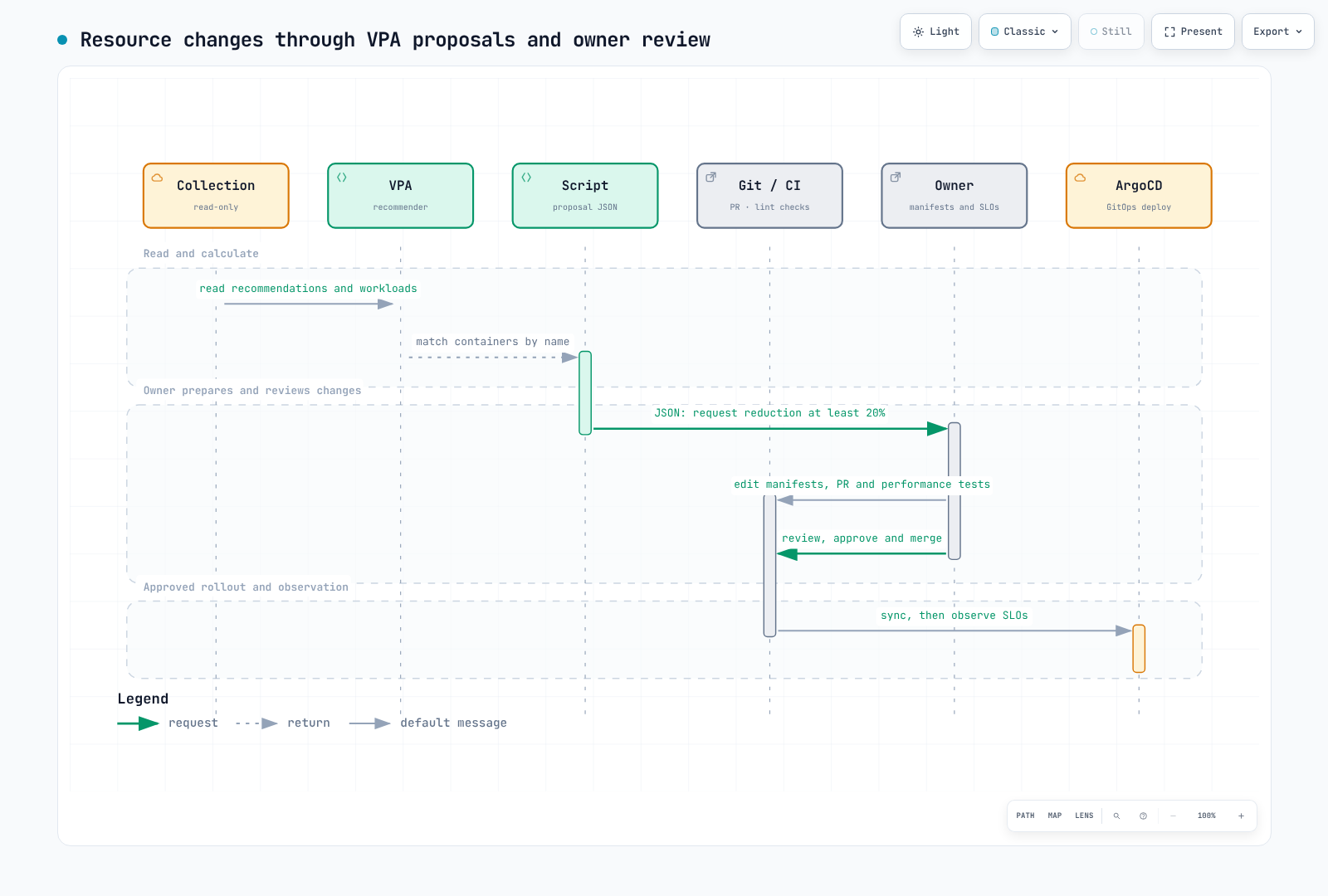
estimatedBillingSavings is null: smaller requests do not guarantee fewer nodes or lower commitment costs. The owner edits the real Git manifests, runs performance tests, reviews the PR and observes SLOs after rollout. Automating that requires repository-file mapping, authentication, duplicate-PR handling, CI and approval rules.
7. Idle Candidates and Governance
7.1 Review lists, not deletion instructions
This single-cluster query finds Bound PVCs with no current Pod volume reference. It compares the gauge to 1 and matches both namespace and claim name.
(kube_persistentvolumeclaim_status_phase{phase="Bound"} == 1)
unless on (namespace, persistentvolumeclaim)
kube_pod_spec_volumes_persistentvolumeclaims_info
This can include data for scaled-to-zero StatefulSets, recovery volumes or paused jobs. Check ownership, recovery requirements, last use, snapshots and retention before deletion. A Deployment created seven days ago does not prove it remained at zero replicas for seven days. Verify continuous history, coverage and gaps.
Low CPU or memory use can be valid for bursty or standby workloads. Aggregating Pods into Deployments requires owner relationships (ReplicaSet → Deployment), namespaces and cluster identifiers. Network receive alone does not identify business traffic or whether a resource is needed.
7.2 Regular reviews
| Cadence | Review |
|---|---|
| Daily | Collection gaps, importer freshness, anomalies, budget estimates |
| Weekly | Idle-candidate ownership, VPA proposals, SLO effects |
| Monthly | Invoice reconciliation, discounts, credits, unattributed costs, shared rules, unit economics |
Record period, currency, model-versus-billing source, refresh time, allocation policy, unattributed amount and approver. Avoid assumptions that complete labels imply perfect accuracy, request reduction equals savings, or dashboard filters enforce team access.