Part 3: Ray Train and Ray Tune
Review baseline: Ray 2.58.0 · 2026-09-12
Lab Environment Setup
Validation used Python 3.12 and ray[train,tune]==2.58.0. These extras install Ray's Train/Tune dependencies; frameworks such as PyTorch are separate. Check the PyTorch, CUDA, and driver pairing for the actual workload.
The checks here cover configuration, callback/checkpoint APIs, and a small CPU scalar Tune example. They are not PyTorch training, GPU, distributed-gradient, or EKS autoscaling tests.
Ray Train V2 and Training-Code Responsibilities
In 2.58.0, V2 is the default when RAY_TRAIN_V2_ENABLED is unset. The ray.train.torch.TorchTrainer import selects its V2 implementation accordingly. Do not assume identical contracts when an environment variable selects the older implementation.
The Trainer coordinates workers and underlying distributed process groups. It does not automatically author models, optimizers, loss/data loops, data partitioning, or state save/restore logic. With PyTorch, use appropriate helpers such as prepare_model and prepare_data_loader for device/DDP/sampler setup, then verify data duplication, gradient synchronization, and evaluation. Framework collectives cannot all be described as Ray object-store transfers.
ScalingConfig and Resource Demand
ScalingConfig specifies worker counts and per-worker logical CPU/GPU resources. Supported elastic configurations also exist, so check the actual mode and its data/recovery requirements. Setting legacy trainer_resources raises a deprecation error in 2.58.0 V2. Distinguish the V2 controller, training workers, and Tune trial-driver resources.
Placement groups and worker bundles need adequate capacity before framework processes can initialize. This neither replaces Kubernetes scheduling nor guarantees atomic scheduling of every Pod. Insufficient GPUs can cause waits, timeouts, or failure; Ray/KubeRay bounds, quotas, image readiness, and EC2 availability matter too.
Checkpoints and Reporting
Checkpoint.from_directory() constructs a checkpoint reference from files you prepare. It does not capture model, optimizer, RNG, scheduler, or dataset position automatically. Save the required state explicitly, then load the checkpoint returned by train.get_checkpoint() inside the worker.
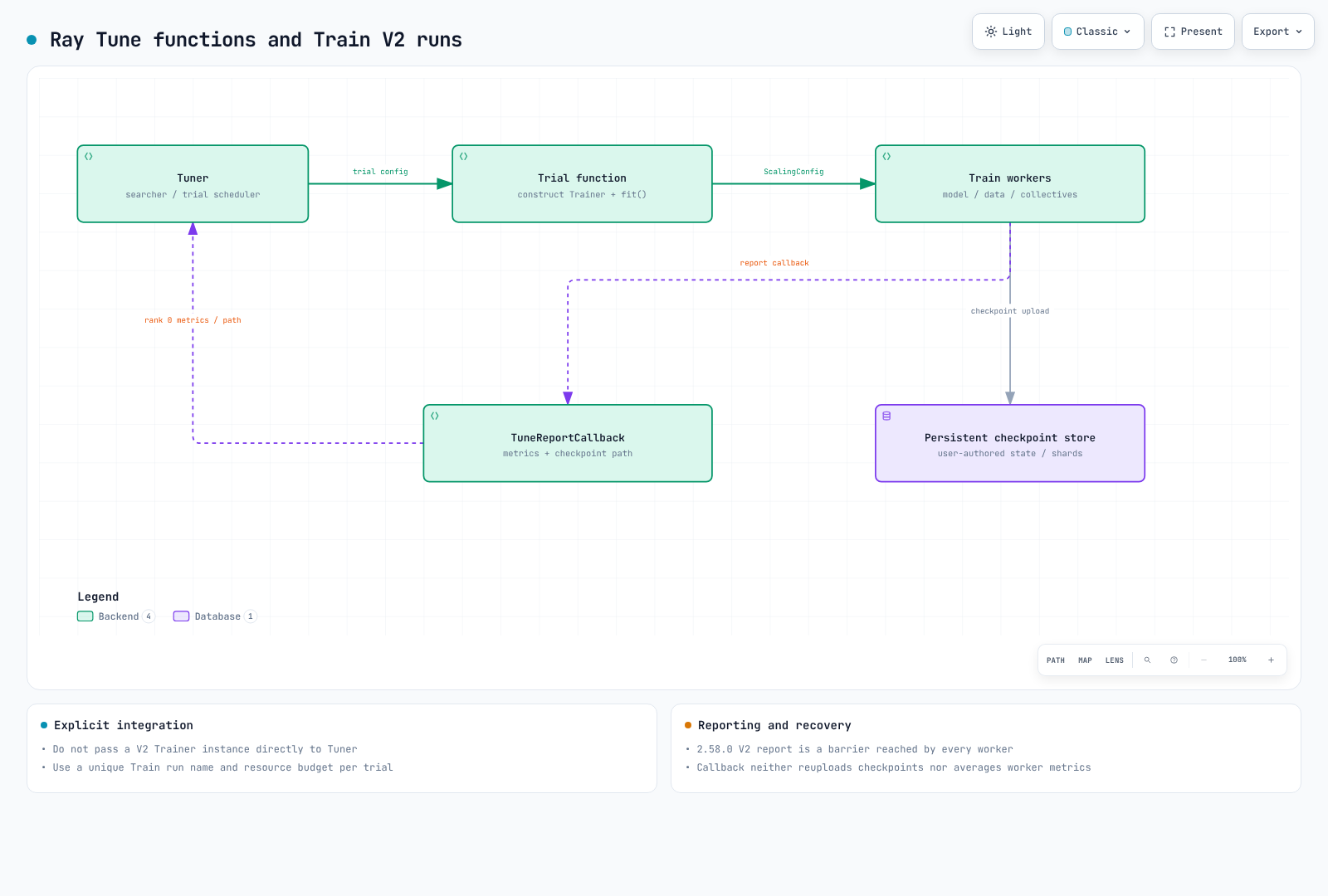
The 2.58.0 V2 train.report call is a barrier that every worker must reach the same number of times. Even if only rank 0 saves files, other ranks participate with checkpoint=None. Skipping reports on some workers can stall training. Metrics are not automatically averaged across workers; compute required aggregates in training code.
Checkpoint upload defaults to synchronous mode. If using asynchronous upload or validation, check completion, temporary-file lifetime, and feature-specific constraints. Avoid filename collisions when several workers save shards.
For multiple nodes, set train.RunConfig(storage_path=...) to persistent storage accessible by all workers. A local Pod directory does not guarantee recovery after node/Pod deletion. S3 paths still need IAM, networking, and retention configuration.
Failure Classes and Retries
The 2.58.0 V2 FailureConfig defaults are max_failures=0 for training-worker errors, controller_failure_limit=-1 for controller errors, and max_preemption_failures=-1 for preemption. Setting only max_failures=0 does not disable every retry class. Configure each limit together with RayJob/operational deadlines. Retries cannot recover progress from a missing or incomplete checkpoint.
Ray Tune: Searchers and Schedulers
Tune manages trial configurations and execution. Searchers select parameter candidates; trial schedulers use intermediate metrics to stop, pause, or continue trials. Grid/random search does not necessarily adapt its next candidate from previous metrics.
Review max_concurrent_trials, trial resources, placement groups, and cluster capacity together. Avoid trial drivers occupying all resources needed by their nested Train workers. Summed CPU/GPU counts alone do not guarantee each worker bundle can be placed.
Small Tune Example
This runs two scalar-objective trials, not model training. The actual check collected both results and selected x=3 with score 0.
from pathlib import Path
import ray
from ray import tune

def objective(config):
    for step in range(2):
        tune.report({"score": -(config["x"] - 3) ** 2, "step": step})

try:
    ray.init(address="local", num_cpus=2, include_dashboard=False,
             object_store_memory=80 * 1024 * 1024)
    tuner = tune.Tuner(
        tune.with_resources(objective, {"cpu": 1}),
        param_space={"x": tune.grid_search([1, 3])},
        tune_config=tune.TuneConfig(
            metric="score", mode="max", max_concurrent_trials=1),
        run_config=tune.RunConfig(
            storage_path=str(Path(".tune-demo").resolve()),
            name="scalar-example", verbose=0),
    )
    results = tuner.fit()
    assert len(results) == 2 and not results.errors
    best = results.get_best_result()
    assert best.config["x"] == 3 and best.metrics["score"] == 0
finally:
    ray.shutdown()
Ray logical resources and object-store size are not OS limits on the whole process. Decide whether you intend a new run or recovery before reusing a result directory.
Current Train/Tune Integration
Do not present passing a V2 Trainer instance directly to Tuner as the current recommended path. The native check raised TuneError for a V2 DataParallelTrainer instance. Distinguish older BaseTrainer compatibility/deprecation handling from V2.
The current documented pattern uses a function trainable that constructs a framework Trainer and calls .fit(). Pass trial parameters through train_loop_config and use unique Train run names and storage paths per trial.
To forward intermediate metrics and checkpoint paths, attach ray.tune.integration.ray_train.TuneReportCallback through the Train RunConfig(callbacks=[...]). Construct it inside a Tune session. The 2.58.0 implementation forwards the first worker metric dictionary, without averaging. It adds an existing checkpoint path to metrics instead of uploading the checkpoint again.
Use tune.RunConfig for Tuner and train.RunConfig for the Trainer. Keep their failure, storage, and callback settings separate. This integration needs explicit wiring and resource planning.
EKS Operational Checks
Inspect Ray resource/placement demand, KubeRay worker-group bounds, Kubernetes Pod placement, and physical node supply separately. Even with capacity available, image pulls, dataset access, framework initialization/communication, and checkpoint permissions can delay startup.
Autoscaling does not provide instant GPUs or an automatic cost/completion bound. Coordinate trial concurrency, workers, max replicas, retry classes, and operational deadlines. Verify result/checkpoint preservation before deleting a RayJob or cluster.