Istio
Last Updated: October 12, 2026
A practical guide for utilizing Istio Service Mesh on Amazon EKS.
October 2026 review: supported releases
Istio 1.31.0 is GA; its release announcement was published on August 31, 2026. The current patch is 1.31.1, published September 21. Its release announcement documents a fix that prevents an unresolved BackendTLSPolicy CA reference from falling back to plaintext backend connections.
New-install commands in this guide use 1.31.1. Istio 1.31's published Kubernetes support range is 1.32–1.37; EKS standard support currently covers 1.34–1.37. Their standard-support overlap is 1.34–1.37; of the EKS extended-support versions (1.31–1.33), 1.32 and 1.33 are also within Istio 1.31's range. Recheck the Istio support matrix and EKS version lifecycle before installation.
Istio 1.30 and 1.29 remain listed as supported in the matrix at this review; 1.29's expected end-of-life date is today, October 12, 2026. Verify its status before installing or upgrading. Existing installations on those branches need at least 1.30.4 or 1.29.7 for ISTIO-SECURITY-2026-006, which covers Envoy vulnerabilities, a BackendTLSPolicy fail-open, and an EnvoyFilter control-plane denial of service. Istio 1.28 is out of support. Istio 1.31 charts use https://blob.istio.io/istio-release/charts; the previous Google-hosted repository no longer receives new releases.
September 2026 update: 1.31.1, 1.30.5 and 1.29.8 patch releases
On September 21, 2026, patch releases shipped for all three supported branches: 1.31.1, 1.30.5 and 1.29.8. 1.31.1 includes the security fix GHSA-qm8v-g4f9-qhjx (CVSS 6.8, Moderate): BackendTLSPolicy fails open to plaintext on sidecar proxies when its CA reference is unresolved. Other fixes include the ambient-mode CNI node agent's auto-detected iptables backend (legacy vs nft) flipping between agent restarts, istiod CPU usage growing with the number of AuthorizationPolicies, and a memory leak in ambient multi-cluster mode when rotating a remote cluster's credentials. New installations and existing 1.31 installations should update to 1.31.1.
Table of Contents
- Do You Really Need a Service Mesh?
- Installation and Initial Setup
- Basic Concepts
- Architecture
- AWS Integration
- Glossary
- Traffic Management
- Security
- Observability
- Resilience
- Advanced
- Troubleshooting
- Best Practices
- Alternative Comparison
What is Istio?
Istio is an open-source service mesh platform for connecting, securing, controlling, and observing microservices. It manages communication between services in complex microservice architectures and provides traffic control, security, and observability.
Service Mesh Concept
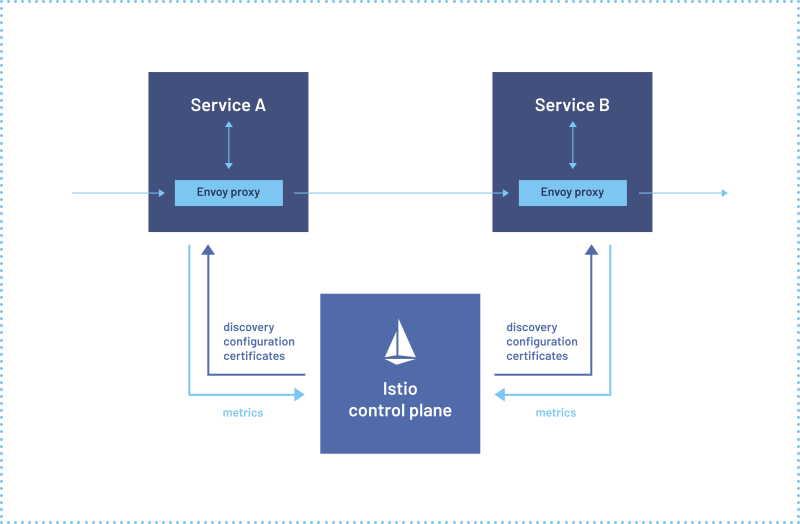
A service mesh is an infrastructure layer that manages communication between microservices. Istio supports Envoy sidecars and ambient mode (node-level ztunnel plus optional L7 waypoints). Proxies handle traffic enrolled in the mesh; excluded traffic and unsupported protocols are outside that coverage. This provides the following capabilities without modifying application code:
- Traffic Routing: Intelligent routing, load balancing, Canary deployments
- Security: Automatic mTLS, authentication, authorization
- Observability: Metrics, logs, distributed tracing
- Resilience: Circuit Breaking, Retry, Timeout
Practical Usage Examples
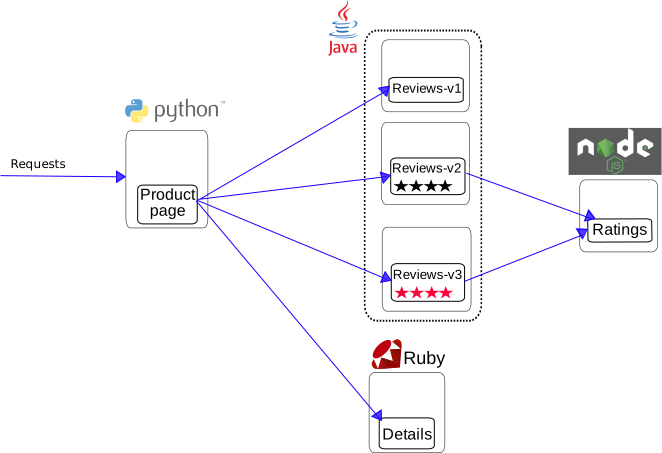
Application without Istio
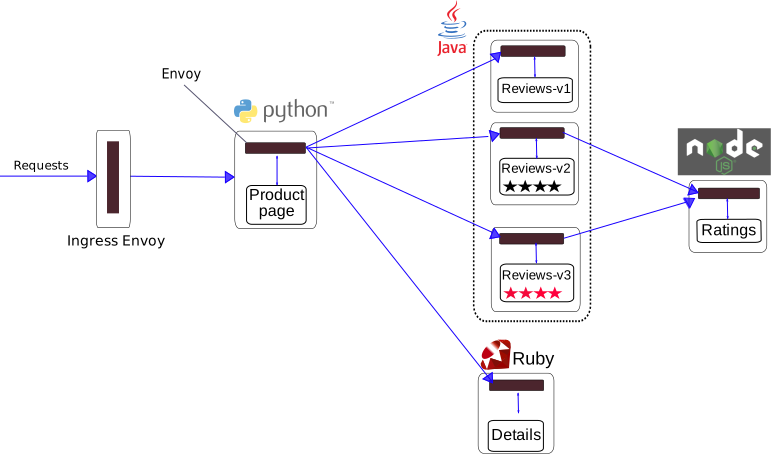
Application with Istio - Envoy Proxy deployed as Sidecar to each service
These Bookinfo diagrams illustrate sidecar mode. Automatic injection adds Envoy only to newly created pods in namespaces or workloads that opt in; ambient mode does not inject a sidecar.
Do You Really Need a Service Mesh?
The service-count thresholds and checklist scores below are discussion prompts, not Istio requirements. A small mesh can still be justified by security needs. The decision diagrams use the same illustrative thresholds.
A service mesh is a powerful tool, but it's not suitable for every situation. Careful consideration is needed before adoption.
Decision Flow
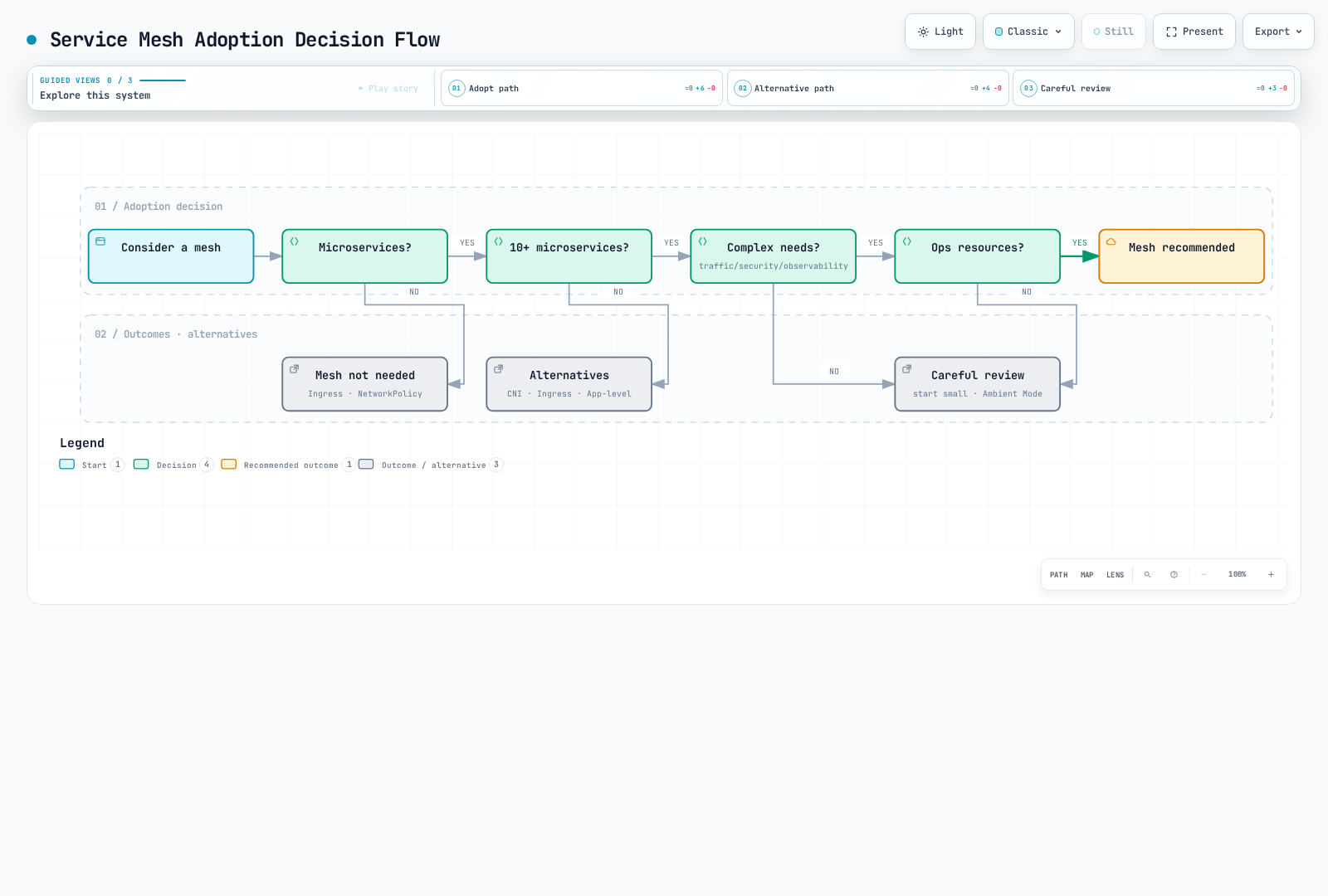
When Service Mesh is Needed ✅
1. Complex Microservices Environment
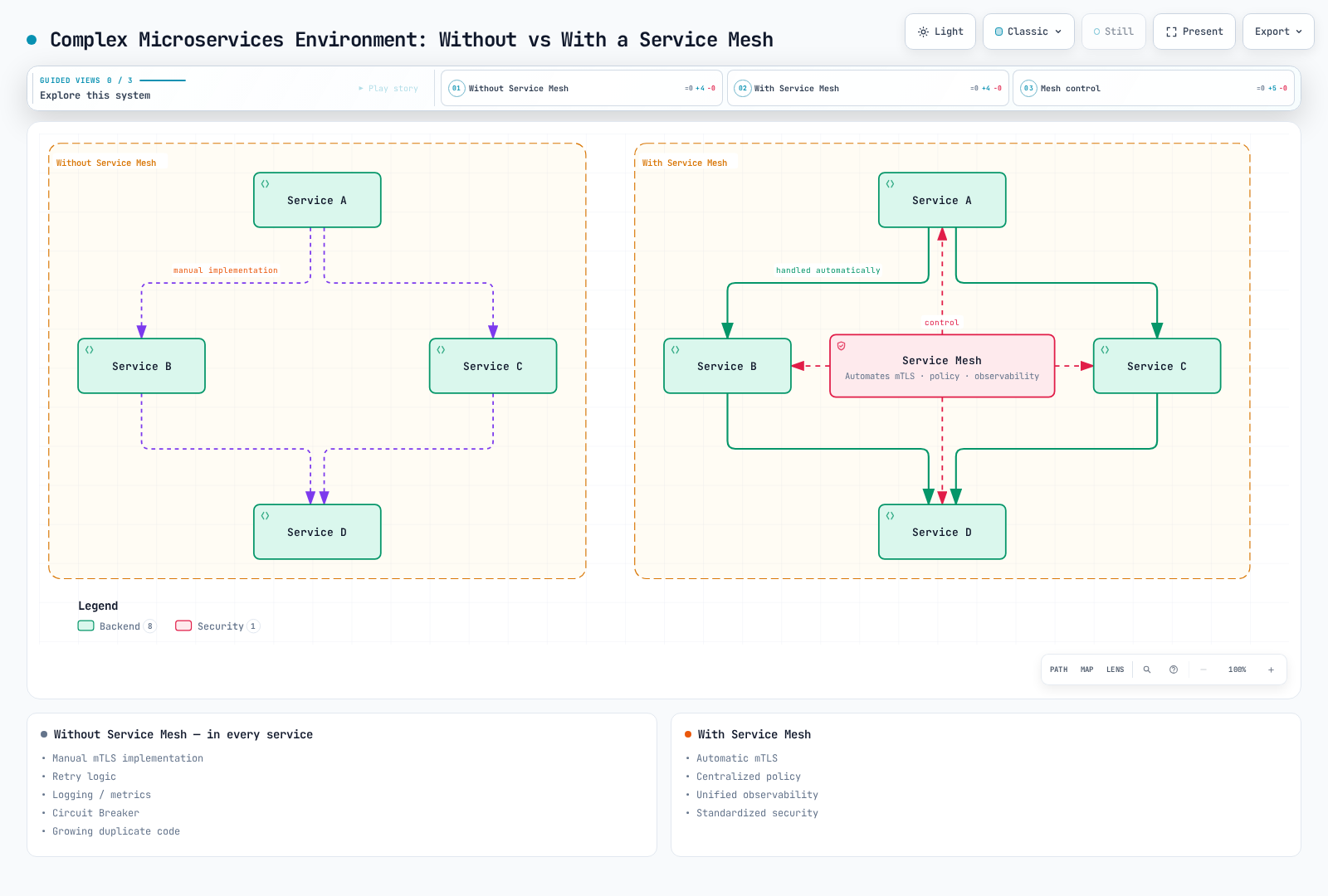
Recommended Criteria:
- ✅ 10 or more microservices
- ✅ Frequent inter-service communication (East-West traffic)
- ✅ Multiple programming languages used (Polyglot)
- ✅ Multiple teams developing services independently
2. Zero Trust Security Requirements
Service Mesh Provides:
- Automatic mTLS encryption between services
- SPIFFE-based Identity management
- Fine-grained authentication/authorization policies
- Encrypted mesh traffic when mTLS is enforced; automatic mTLS alone does not reject plaintext clients
Difficult to Achieve Without Alternatives:
- Duplicate security logic implementation in each service
- Complexity of manual certificate management
- Inconsistent security policies
3. Advanced Traffic Management
# Canary Deployment (Traffic Distribution)
apiVersion: networking.istio.io/v1
kind: VirtualService
metadata:
  name: reviews
spec:
  hosts:
  - reviews
  http:
  - route:
    - destination:
        host: reviews
        subset: v1
      weight: 90
    - destination:
        host: reviews
        subset: v2
      weight: 10  # Only 10% to new version
When Needed:
- Canary deployments, A/B testing
- Header/path-based routing
- Traffic Mirroring (Shadow Testing)
- Fault Injection (Chaos Engineering)
- Circuit Breaking, Retry, Timeout
4. Unified Observability
Service Mesh Advantages:
- Automatic metric collection without application code modification
- Proxy-generated trace spans; applications must propagate trace headers to correlate requests
- Unified logging format
- Service topology visualization (Kiali)
When Service Mesh is Not Needed ❌
1. Simple Architecture
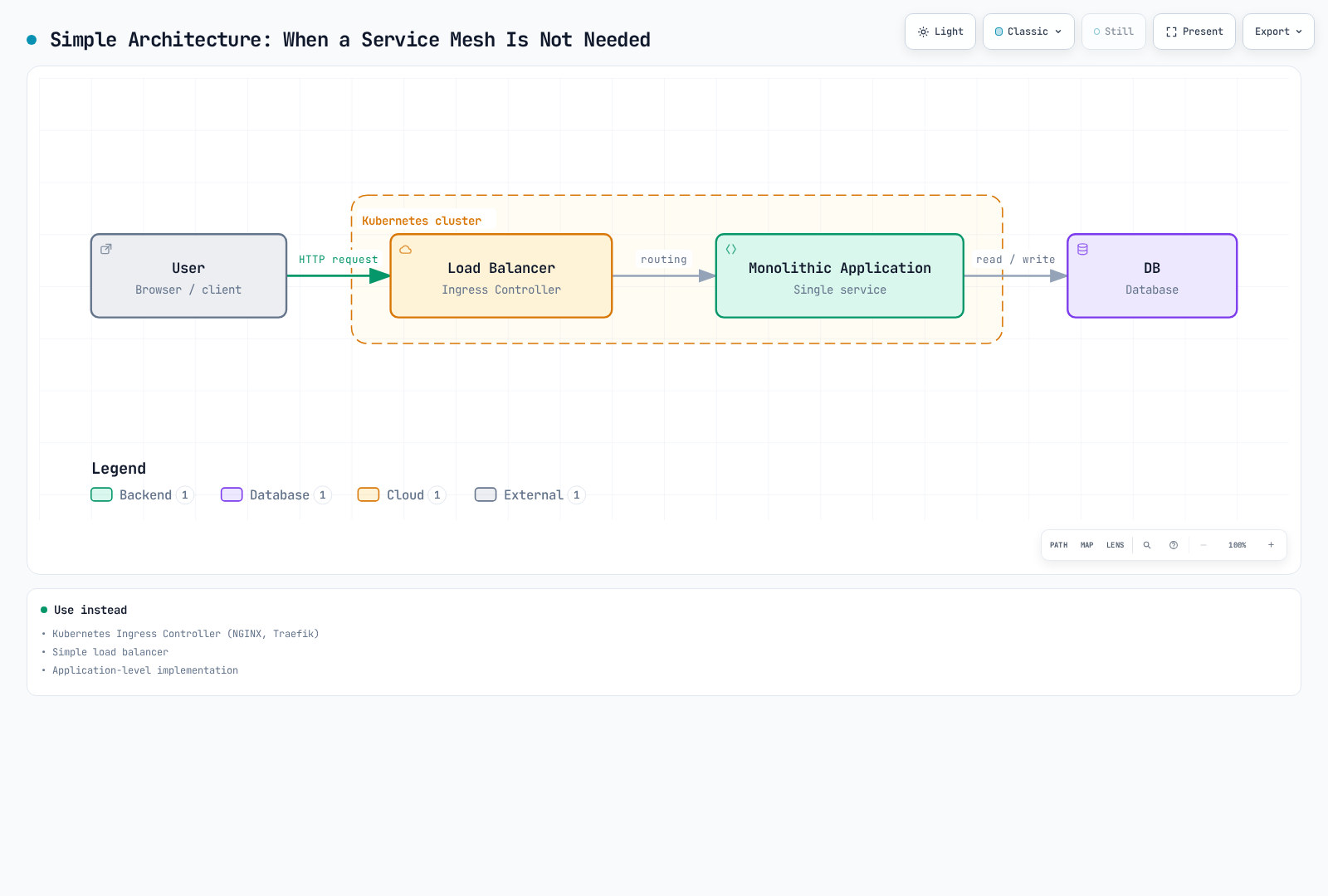
Use Instead:
- A maintained Kubernetes Gateway API or Ingress controller
- Simple load balancer
- Application-level implementation
2. Few Microservices (<10)
Overhead is Greater:
- Service Mesh operational complexity > benefits gained
- 5-10 services can be managed manually
- NetworkPolicy can provide L3/L4 isolation when the CNI enforces it; it does not provide mTLS or HTTP authorization
Alternative:
# L3/L4 ingress isolation; requires a NetworkPolicy-capable CNI
apiVersion: networking.k8s.io/v1
kind: NetworkPolicy
metadata:
  name: allow-frontend-to-backend
spec:
  podSelector:
    matchLabels:
      app: backend
  ingress:
  - from:
    - podSelector:
        matchLabels:
          app: frontend
3. Insufficient Operations Resources
Service Mesh Operations Requirements:
- Istio/Envoy expertise
- Control Plane monitoring and management
- Upgrade and patch management
- Troubleshooting capability (increased debugging complexity)
Team Preparation Needed:
- At least 1-2 Service Mesh experts
- Continuous learning and update tracking
- Sufficient test environment
4. When Performance is Extremely Critical
Service Mesh Overhead:
Measure latency, CPU, and memory with representative traffic, proxy configuration, and telemetry settings. The official performance page records an Istio 1.24 benchmark; those historical results are not guarantees for other versions or workloads.
Consider Alternatives:
- Ambient mode (shared L4 proxies; savings depend on traffic and waypoint deployment)
- CNI-based solutions (Cilium)
- Application-level optimization
Alternative Solutions Comparison
| Feature | Service Mesh | CNI (Cilium) | Ingress Controller | App-level |
|---|---|---|---|---|
| L7 Traffic Management | ✅ Full support | ⚠️ Limited | ⚠️ Ingress only | ✅ Possible |
| mTLS Automation | ✅ Full support | ⚠️ Mutual authentication and encryption are separate | ❌ Not supported | ❌ Manual implementation |
| Distributed Tracing | ⚠️ Requires trace-context propagation | ❌ Not supported | ❌ Not supported | ⚠️ Manual implementation |
| L3/L4 Policies | ✅ Supported | ✅ Full support | ❌ Not supported | ❌ Not supported |
| Operational Complexity | 🔴 High | 🟡 Medium | 🟢 Low | 🟡 Medium |
| Resource Overhead | 🔴 High (Sidecar) | 🟢 Low | 🟢 Low | 🟢 None |
| Suitable Scale | Requirements-dependent | All scales | Small scale | Small scale |
CNI-Based Solution (Cilium)
Cilium provides many features at the network level based on eBPF:
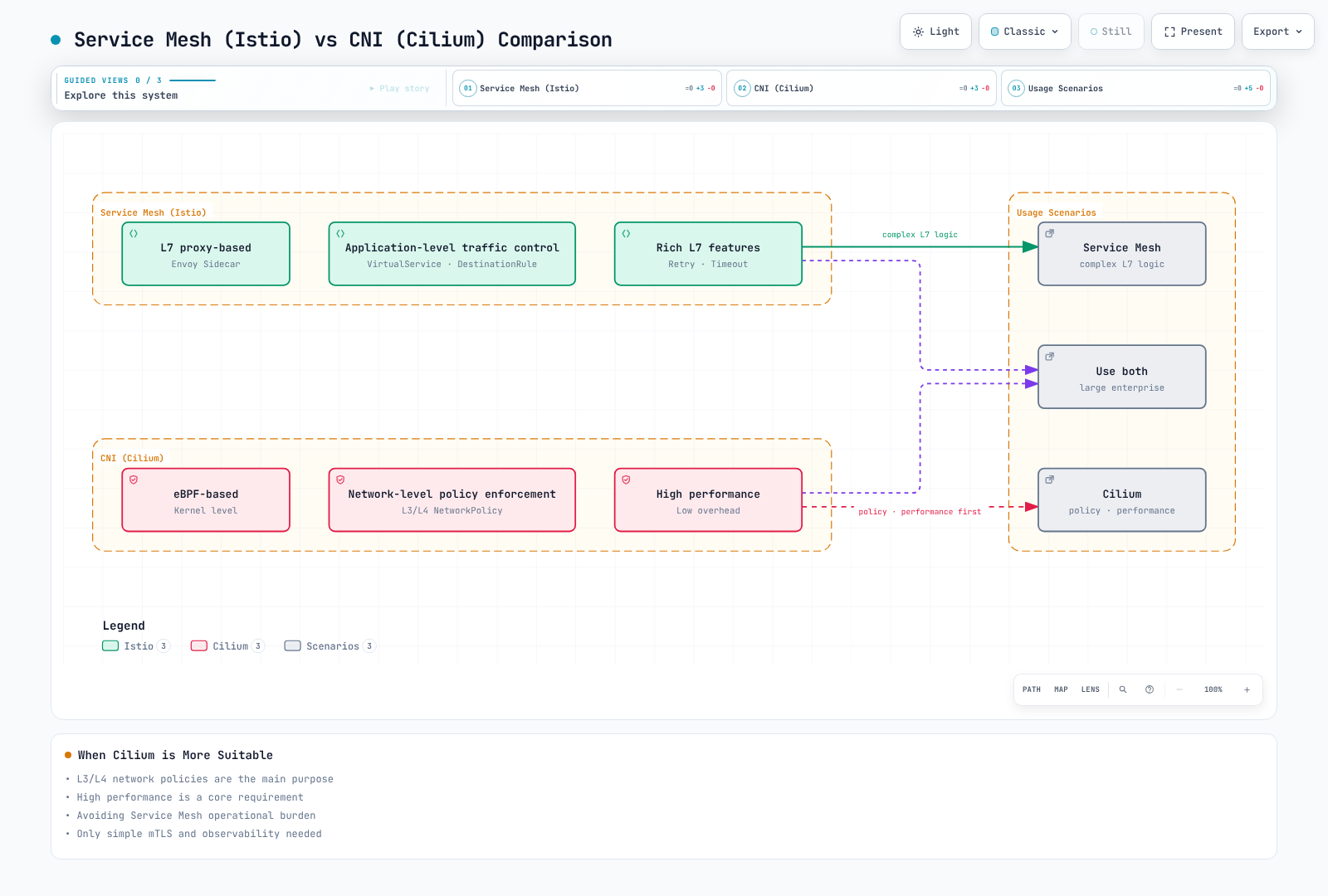
When Cilium is More Suitable:
- L3/L4 network policies are the main purpose
- Measured performance under the required policy/encryption settings meets the workload's needs
- Reusing an existing Cilium deployment whose supported features meet the requirements
- Network policy and observability are primary needs; Cilium out-of-band mutual authentication requires separate WireGuard/IPsec encryption for payload confidentiality
Cilium 1.20.1 also provides a separate ztunnel transparent-encryption beta, selected with encryption.type: ztunnel. It provides TCP workload mTLS with namespace enrollment; both endpoints must be enrolled. It excludes ClusterMesh and host-networked Pods, and the released guide warns that ordinary L4 policies do not work on this path except when targeting HBONE port 15008. This is a distinct deployment choice with its own CA/bootstrap requirements.
The diagram emphasizes the CNI role; Cilium also has L7 Envoy features. Component count and operational cost depend on the selected mode.
Reference: Cilium Documentation
Decision Checklist
Answer the following questions before adoption:
Architecture:
- [ ] Do you have 10 or more microservices?
- [ ] Is inter-service communication complex?
- [ ] Are multiple programming languages used?
Security:
- [ ] Is a Zero Trust security model needed?
- [ ] Is mTLS encryption between services mandatory?
- [ ] Is fine-grained access control needed?
Traffic Management:
- [ ] Are Canary deployments, A/B testing needed?
- [ ] Are advanced routing rules needed?
- [ ] Are Circuit Breaking, Retry needed for many services?
Observability:
- [ ] Is distributed tracing mandatory?
- [ ] Is unified metric collection needed?
- [ ] Is service topology visualization needed?
Operations:
- [ ] Do you have Service Mesh experts?
- [ ] Can you handle the operational complexity?
- [ ] Can you accept the resource overhead?
Results:
- ✅ 10 or more checked: Service Mesh strongly recommended
- 🟡 5-9 checked: Careful evaluation needed, start small (Ambient Mode recommended)
- ❌ 4 or fewer checked: Consider alternative solutions (CNI, Ingress, App-level)
Gradual Adoption Strategy
If you determine that a Service Mesh is needed, adopt it gradually:
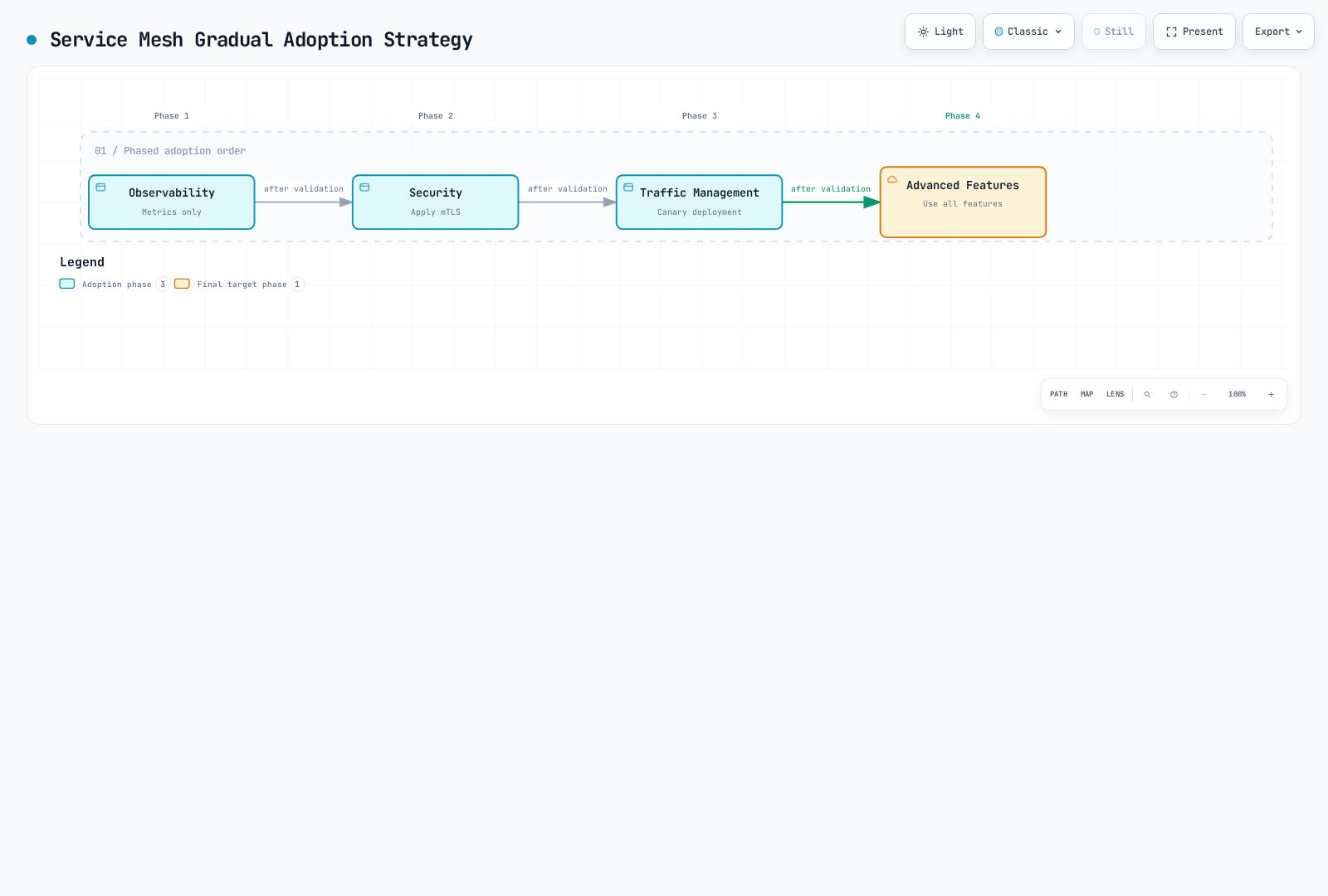
Recommended Order:
- Pilot Project (1-2 namespaces)
- Observability First (metrics, logs, traces)
- Apply Security (mTLS PERMISSIVE → STRICT)
- Traffic Management (VirtualService, DestinationRule)
- Company-wide Expansion
Key Features
Traffic Management
VirtualService selects routes; DestinationRule defines subsets and destination traffic policies.
- Intelligent routing and load balancing
- A/B testing, Canary deployment, Blue/Green deployment
- Circuit Breaking, Retry, Timeout control
- Traffic Mirroring and Fault Injection
Security
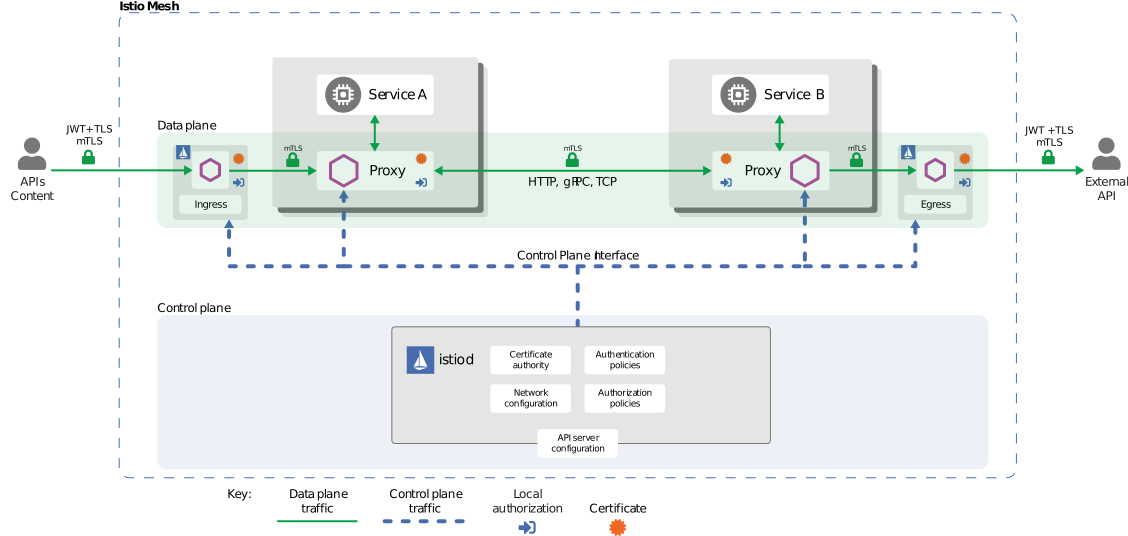
- Automatic mTLS encryption between services
- Strong authentication and authorization
- Fine-grained access control policies
- Network isolation and security policies
Observability
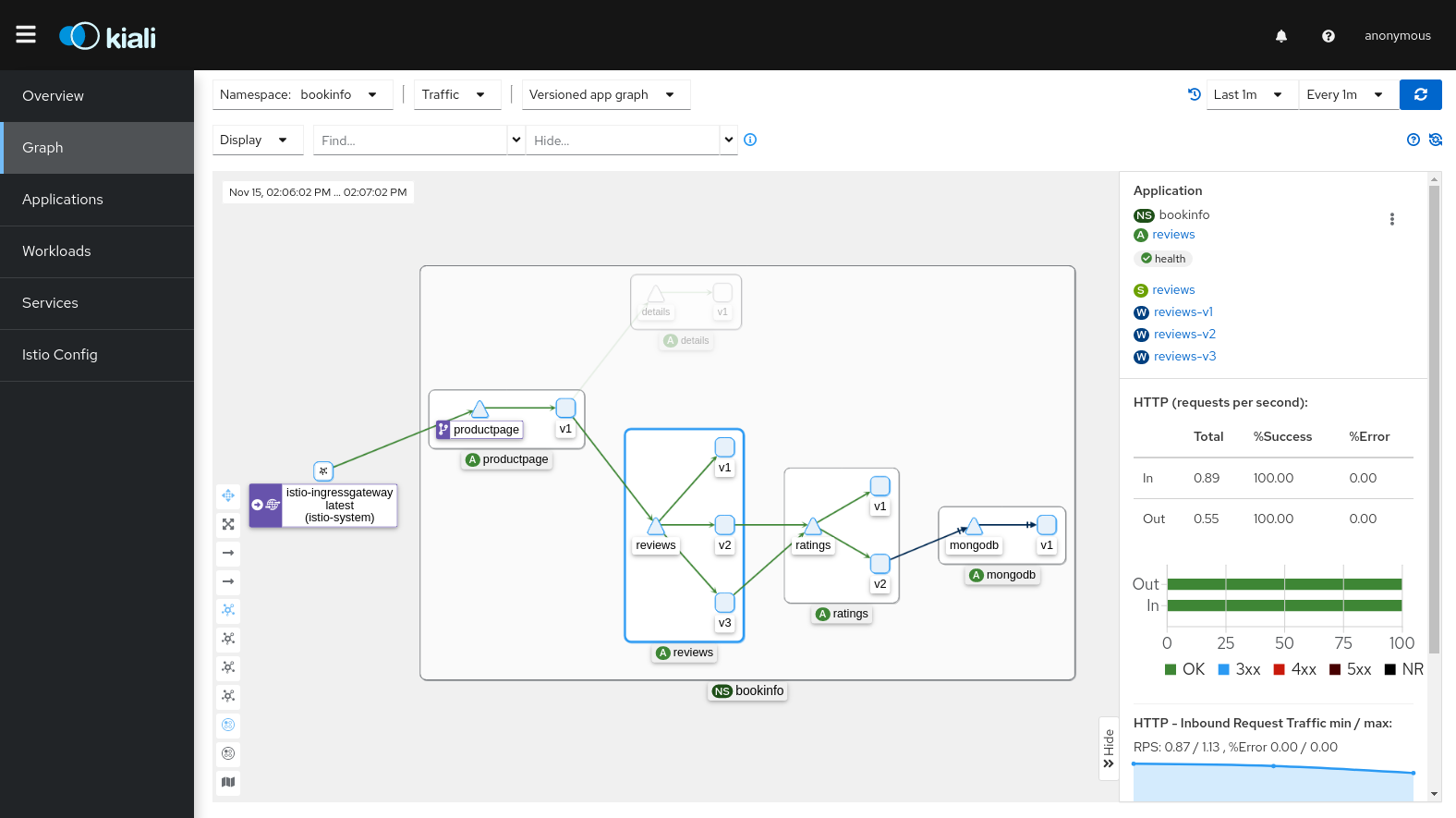
- Proxy metrics and configurable access logs and tracing
- Prometheus, Grafana, Jaeger, Kiali integration
- Service topology visualization
- Real-time traffic monitoring
Resilience
- Circuit Breaker pattern
- Rate Limiting
- Outlier Detection
- Zone Aware Routing
Istio Architecture
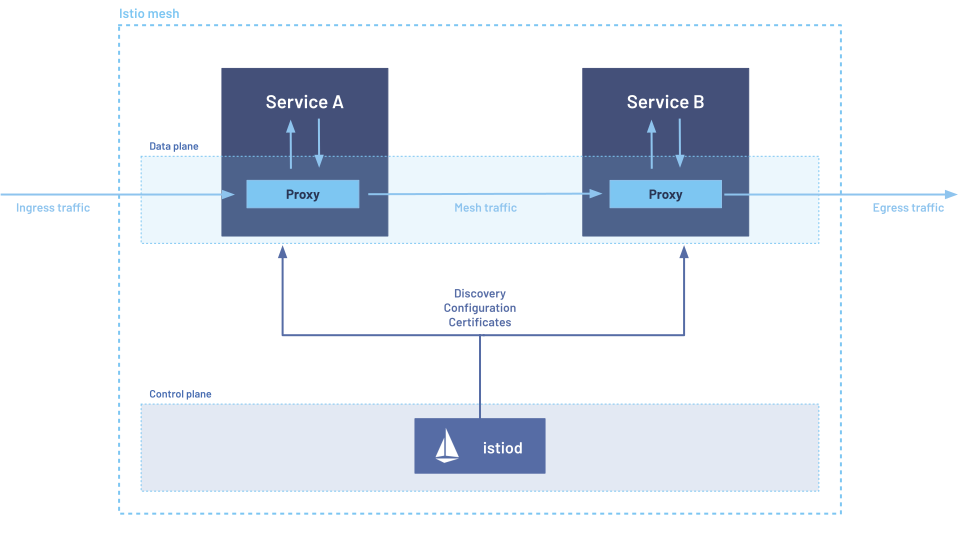
Istio consists of a Control Plane and a Data Plane:
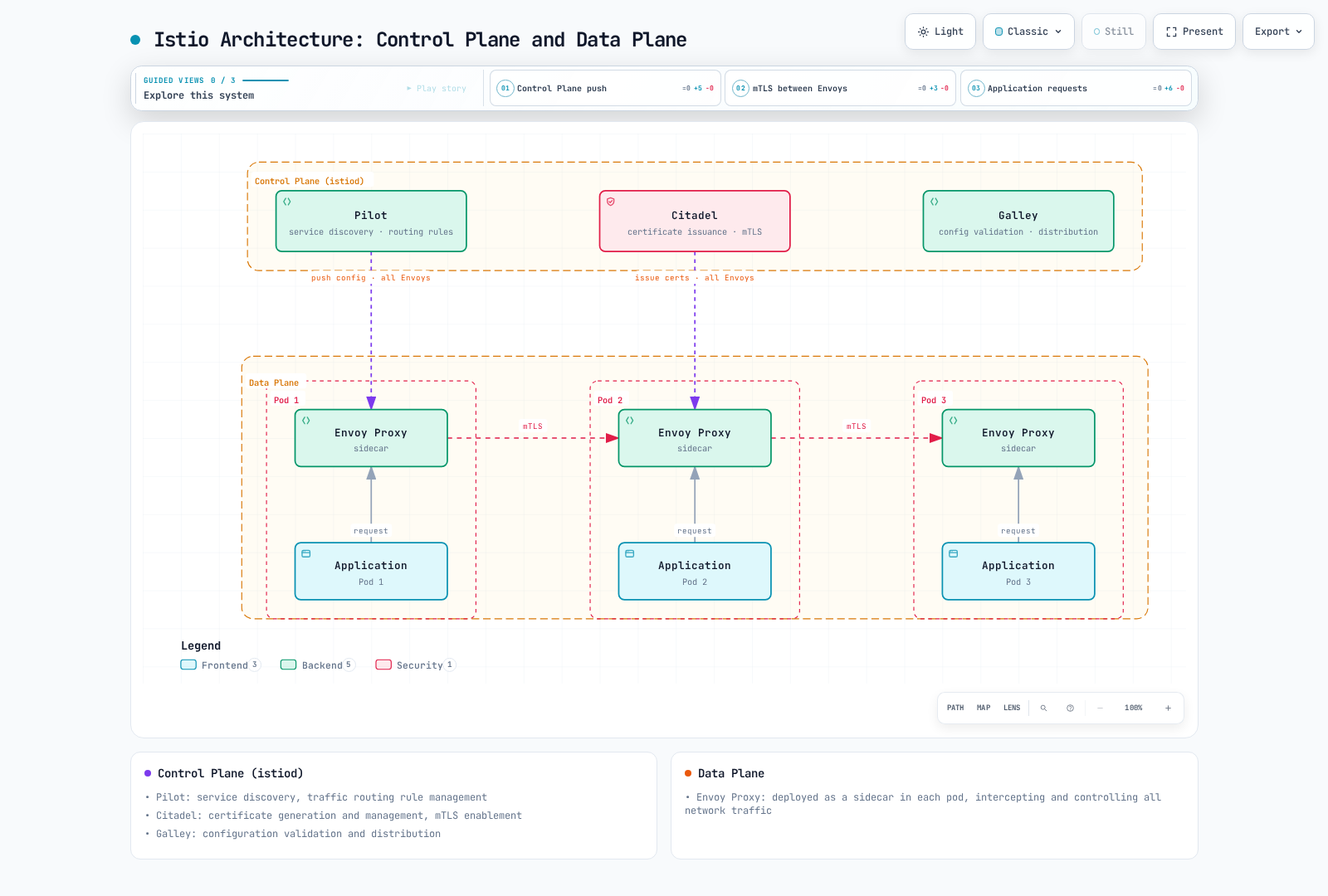
Control Plane (istiod):
- Service discovery and proxy configuration (historically Pilot)
- Certificate authority and identity management (historically Citadel)
- Configuration validation; Galley is a retired standalone component, not a separate current service
Data Plane:
- Sidecar mode: Envoy per enrolled pod
- Ambient mode: ztunnel per node for L4 security and optional waypoint proxies for L7 processing
Benefits of Using Istio on Amazon EKS
- Easy Microservices Management
- Traffic management without application code modification
- Consistent policy application with declarative configuration
- Uses Kubernetes Native API
- Enhanced Security
- Automatic encryption between services
- AWS API access through EKS Pod Identity or IRSA; Istio workload identity remains service-account based
- Fine-grained permission control
- Improved Observability
- Integration with Amazon CloudWatch
- Distributed tracing through AWS X-Ray
- Detailed metrics and logs
- Integration with AWS Services
- Application Load Balancer (ALB) integration
- AWS Certificate Manager (ACM) integration
- Compatible with Amazon EBS CSI Driver
Getting Started
If you're new to Istio, read the documents in the following order:
- Installation and Initial Setup: Install Istio on EKS cluster
- Basic Concepts: Understand Istio core concepts
- Traffic Management: Learn Gateway, VirtualService, DestinationRule
- Security: Configure mTLS, authentication, authorization
- Observability: Collect metrics, logs, traces
- Best Practices: Recommendations for production environments
Hands-on Examples
These routing excerpts require matching Services and DestinationRule subsets (v1/v2); see the traffic-management chapters.
Each section includes working YAML examples. All examples are structured to be click-to-copy:
# Example VirtualService
apiVersion: networking.istio.io/v1
kind: VirtualService
metadata:
  name: reviews
spec:
  hosts:
  - reviews
  http:
  - route:
    - destination:
        host: reviews
        subset: v1
References
Quizzes
To test what you've learned in this chapter, try the following quizzes: