Flink on EKS Deep Dive
Apache Flink is a distributed stateful engine for bounded and unbounded streams. JobManagers coordinate execution/recovery; TaskManagers execute operator tasks and exchange data. Checkpoint consistency and exactly-once behavior at an external sink have separate requirements. Part 3 examines sources, state and sinks together.
Last Updated: September 12, 2026 Integration baseline: Flink 2.2.1 / Java 17 / Operator 1.15.0.
Part 3's Iceberg example separately uses Flink 2.1.3 / Iceberg 1.11.0 to match its runtime. Check each chapter's limits for S3-plugin SDK support and managed-service differences.
The latest stable Flink release is 2.3.0. These examples use 2.2.1 as the baseline to check alongside published Operator and connector compatibility tables. Accepting a version string in a CRD enum does not prove integration compatibility. Choose Kubernetes/kubectl versions using current EKS support and version-skew policies; “Kubernetes 1.21+” is not a current EKS support guarantee.
Who manages what on Kubernetes?
- FlinkDeployment defines an Application or Session cluster.
- FlinkSessionJob defines a job submitted to an existing managed Session cluster.
- The Operator reconciles cluster/job lifecycle and supports both Native and Standalone modes.
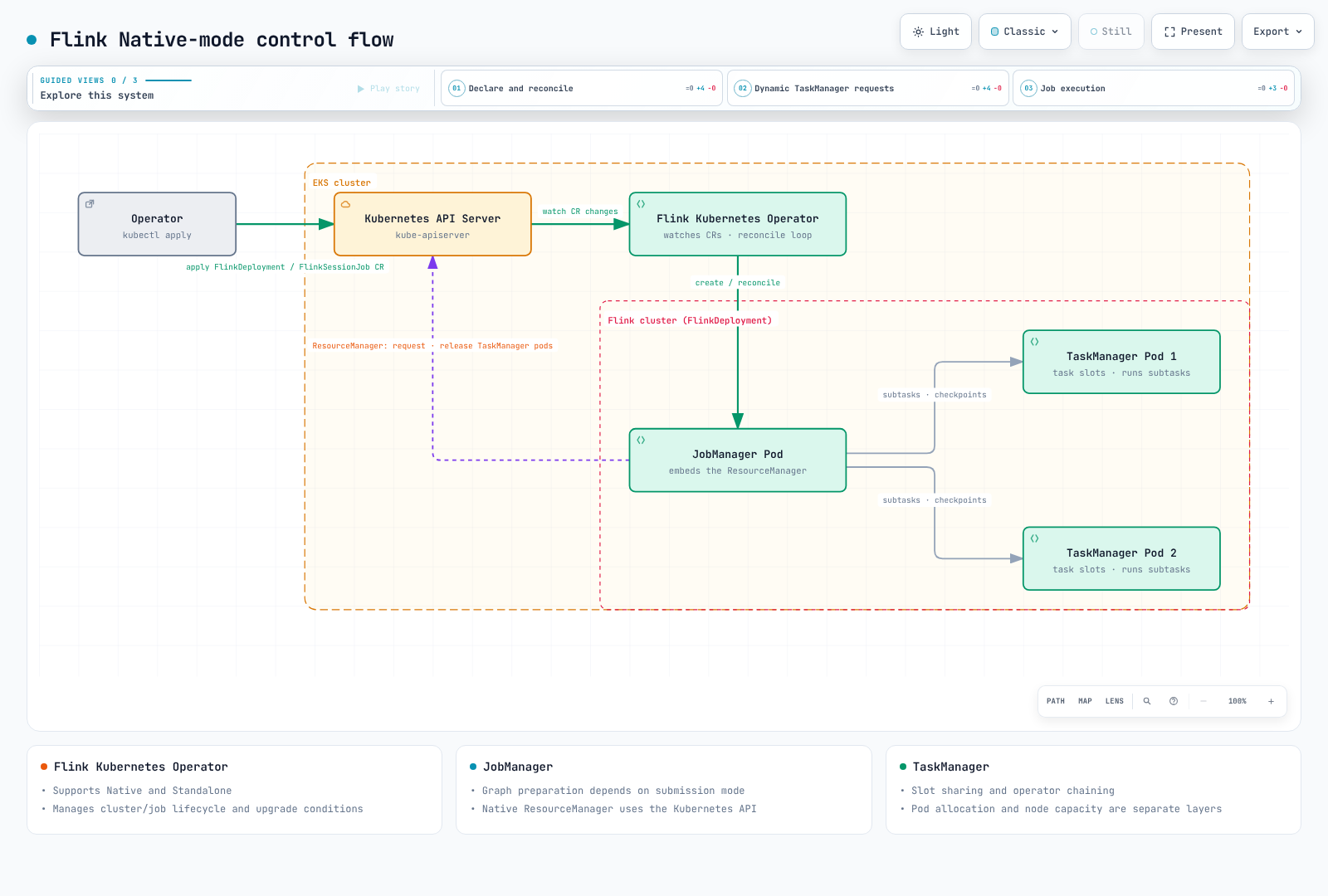
- In Native mode, the JobManager's Kubernetes ResourceManager requests/releases TaskManager pods. In Standalone mode, an external manager such as the Operator manages Kubernetes resources.
- A task slot is neither a CPU core nor exactly one operator subtask. Chaining and slot sharing can place several operators in a slot; size state, memory and CPU separately.
The following shows logical control flow in Native mode. Pod release depends on idle timeouts, capacity needs and cleanup policy; job completion does not immediately eliminate node costs.
Chapters
- Architecture: processes/slot sharing and the Application/Session versus Native/Standalone axes.
- Flink Kubernetes Operator: CRDs, installation, upgrades and autoscaling.
- State, checkpoints and streaming: backends, recovery and actual connector guarantees.
- Operations and HA: metrics, HA storage, node capacity and managed-service comparison.
Declarative Operator management is the main path here; CLI examples explain the runtime underneath it. Running without the Operator remains a supported choice.