Outlier Detection
Last Updated: September 11, 2026 · Istio 1.31. Independent sidecar examples; create the stated namespaces and real workloads/endpoints before testing. Same-host examples are alternatives. Values are illustrative and have not been load-tested.
Outlier Detection is a form of the Circuit Breaker pattern that automatically detects abnormally behaving service instances and removes them from the traffic pool.
Table of Contents
- Overview
- How It Works
- Basic Configuration
- Advanced Configuration
- Protecting External Services (ServiceEntry)
- Practical Examples
- Monitoring
- Troubleshooting
Overview
Outlier detection is passive and local to each observing proxy. With HTTP visibility, it counts qualifying upstream responses and/or local connection failures. It does not use a DestinationRule latency threshold or send periodic recovery probes. Ejection changes that proxy’s load-balancing eligibility; it does not delete a Pod or repair the service.
Key Features
- Detection: Counts configured consecutive HTTP or transport failures.
- Ejection: Excludes a host if the ejection limit and enforcement allow it.
- Re-entry: Makes the host eligible again after its ejection period; actual recovery still needs successful traffic.
How It Works
Outlier Detection Process
A success resets the relevant consecutive-error sequence. A qualifying failure reaching the threshold can trigger ejection inline, without waiting for interval. The ejection duration grows with repeated ejections (base duration × multiplier, capped by Envoy); this is not a fixed 30-second probe or exponential doubling.
Detection Methods
| Method | Description | Use Scenario |
|---|---|---|
| Consecutive Errors | Detect consecutive 5xx errors | Application crash |
| Gateway Errors | Detect 502, 503, 504 errors | Service overload |
| Connection Failures | Detect TCP connection failures | Network issues |
| Latency | Not a DestinationRule outlier threshold | Observe latency; set application/route timeouts separately |
Basic Configuration
Consecutive Error Based Detection
apiVersion: networking.istio.io/v1
kind: DestinationRule
metadata:
  name: reviews-outlier
  namespace: default
spec:
  host: reviews
  trafficPolicy:
    outlierDetection:
      consecutive5xxErrors: 5
      interval: 30s
      baseEjectionTime: 30s
      maxEjectionPercent: 50
      minHealthPercent: 0
Key Parameter Descriptions
consecutive5xxErrors
- Description: Threshold for consecutive error occurrences
- Default: 5
- Illustrative tuning range: 3-10 (depending on service characteristics)
# Sensitive service (fast detection)
consecutive5xxErrors: 3

# General service
---
consecutive5xxErrors: 5

# Lenient setting (prevent false positives)
---
consecutive5xxErrors: 10
interval
- Description: Periodic ejection sweep interval; consecutive-error detection runs inline
- Default: 10s
- Illustrative tuning range: 10s-60s
# Fast detection (high load)
interval: 10s

# General case
---
interval: 30s

# Stable service
---
interval: 60s
baseEjectionTime
- Description: Minimum time an instance is ejected
- Default: 30s
- Illustrative tuning range: 30s-300s
# Fast recovery attempt
baseEjectionTime: 30s

# General case
---
baseEjectionTime: 60s

# Cautious recovery
---
baseEjectionTime: 300s
maxEjectionPercent
- Description: Maximum percentage of instances that can be ejected simultaneously
- Default: 10%
- Illustrative tuning range: 10%-50%
# Conservative (stability first)
maxEjectionPercent: 10

# Balanced setting
---
maxEjectionPercent: 30

# Aggressive (quality first)
---
maxEjectionPercent: 50
Advanced Configuration
Gateway Error Based Detection
apiVersion: networking.istio.io/v1
kind: DestinationRule
metadata:
  name: reviews-gateway-errors
  namespace: default
spec:
  host: reviews
  trafficPolicy:
    outlierDetection:
      consecutiveGatewayErrors: 3
      interval: 10s
      baseEjectionTime: 60s
      maxEjectionPercent: 50
      minHealthPercent: 0
Healthy-Pool Panic Threshold
apiVersion: networking.istio.io/v1
kind: DestinationRule
metadata:
  name: reviews-panic-threshold-example
  namespace: default
spec:
  host: reviews
  trafficPolicy:
    outlierDetection:
      consecutive5xxErrors: 5
      interval: 30s
      baseEjectionTime: 30s
      minHealthPercent: 50
      maxEjectionPercent: 30
minHealthPercent: 50 is a fail-open/panic choice: below the healthy-host threshold, the proxy can use unhealthy hosts as well. It is not a minimum request count, healthy-capacity guarantee or split-brain prevention. The Istio default is0; other examples use0 to disable this panic threshold. The ejection cap does not make remaining endpoints healthy.
Connection Failure Based Detection
apiVersion: networking.istio.io/v1
kind: DestinationRule
metadata:
  name: reviews-connection-errors
  namespace: default
spec:
  host: reviews
  trafficPolicy:
    connectionPool:
      tcp:
        maxConnections: 100
      http:
        http1MaxPendingRequests: 10
        maxRequestsPerConnection: 2
    outlierDetection:
      consecutiveLocalOriginFailures: 5
      interval: 10s
      baseEjectionTime: 30s
      maxEjectionPercent: 50
      splitExternalLocalOriginErrors: true
      minHealthPercent: 0
Success Rate Based Detection (Advanced)
Envoy has statistical success-rate detection, with minimum host/request-volume and deviation parameters; it is not simply “below95%.” The Istio1.31 DestinationRule API does not expose enforcingConsecutiveErrors/enforcingSuccessRate or those statistical thresholds. The released implementation explicitly disables success-rate enforcement. splitExternalLocalOriginErrors separates error classes; it is not a minimum request count. Use the supported consecutive-error fields here. Advanced EnvoyFilter changes require version-specific configuration and runtime validation.
Protecting External Services (ServiceEntry)
Register external APIs or legacy systems as ServiceEntry and apply Outlier Detection to prevent failure propagation.
External API Protection Architecture
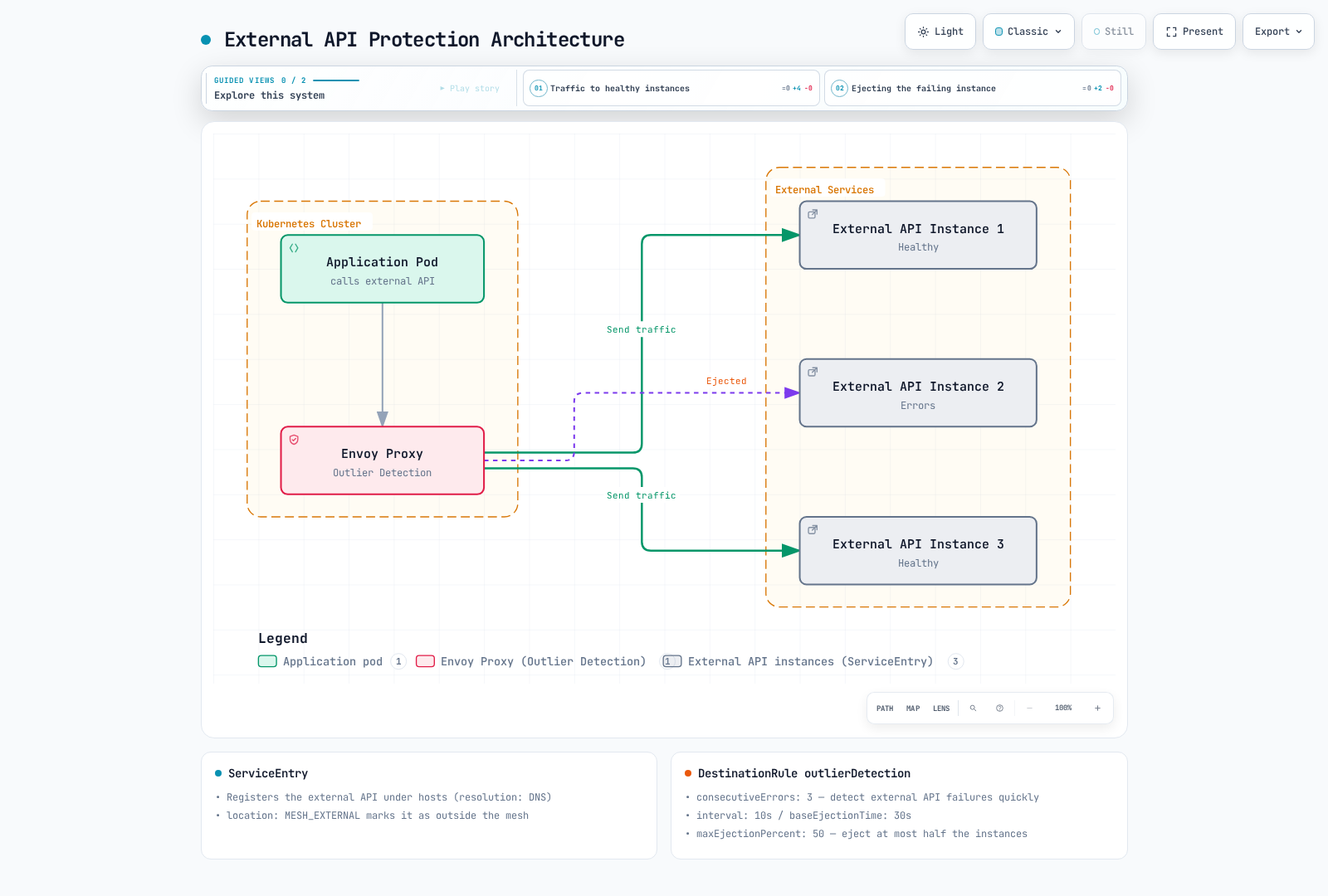
These HTTP-aware external API examples require the application to call HTTP port80 and the sidecar to originate TLS to target443. They set SNI/SAN and use the proxy OS trust store; mount an appropriate CA bundle for a private CA. Application-to-sidecar traffic is plaintext, so this is unsuitable when that hop must also be encrypted. For application-originated HTTPS, use passthrough without another SIMPLE TLS layer; Envoy then sees transport failures, not HTTP status/latency or HTTP retry rules. Verify enrollment, routing and certificate validation before sending credentials. Hosts/IPs below are examples, not provisioned services; substitute authorized endpoints.
Example 1: Single External API (DNS Based)
apiVersion: networking.istio.io/v1
kind: ServiceEntry
metadata:
  name: external-payment-api
  namespace: payment
spec:
  hosts:
  - api.payment-provider.com
  resolution: DNS
  ports:
  - number: 80
    name: http
    protocol: HTTP
    targetPort: 443
  location: MESH_EXTERNAL
---
apiVersion: networking.istio.io/v1
kind: DestinationRule
metadata:
  name: external-payment-api
  namespace: payment
spec:
  host: api.payment-provider.com
  trafficPolicy:
    connectionPool:
      tcp:
        maxConnections: 100
        connectTimeout: 3s
      http:
        http1MaxPendingRequests: 50
        http2MaxRequests: 100
        maxRequestsPerConnection: 10
        maxRetries: 3
    outlierDetection:
      consecutive5xxErrors: 3
      consecutiveGatewayErrors: 2
      interval: 10s
      baseEjectionTime: 30s
      maxEjectionPercent: 50
      splitExternalLocalOriginErrors: true
      consecutiveLocalOriginFailures: 3
      minHealthPercent: 0
    portLevelSettings:
    - port:
        number: 80
      tls:
        mode: SIMPLE
        sni: api.payment-provider.com
        subjectAltNames:
        - api.payment-provider.com
---
apiVersion: networking.istio.io/v1
kind: VirtualService
metadata:
  name: external-payment-api
  namespace: payment
spec:
  hosts:
  - api.payment-provider.com
  http:
  - name: no-retries
    route:
    - destination:
        host: api.payment-provider.com
        port:
          number: 80
    retries:
      attempts: 0
    timeout: 5s
Usage Example:
package payment

import (
    "bytes"
    "context"
    "fmt"
    "io"
    "net/http"
    "time"
)

var paymentClient = &http.Client{
    Timeout: 5 * time.Second,
    CheckRedirect: func(req *http.Request, via []*http.Request) error {
        return http.ErrUseLastResponse
    },
}

// payload, authentication and payment-provider idempotency are application concerns.
// Requires the port80-to443 sidecar TLS-origination policy above.
func processPayment(ctx context.Context, payload []byte) error {
    req, err := http.NewRequestWithContext(ctx, http.MethodPost,
        "http://api.payment-provider.com/v1/charge", bytes.NewReader(payload))
    if err != nil { return err }
    req.Header.Set("Content-Type", "application/json")
    resp, err := paymentClient.Do(req)
    if err != nil { return fmt.Errorf("payment transport failed: %w", err) }
    defer resp.Body.Close()
    _, _ = io.Copy(io.Discard, io.LimitReader(resp.Body, 1<<20))
    if resp.StatusCode < 200 || resp.StatusCode >= 300 {
        return fmt.Errorf("payment endpoint returned HTTP %d", resp.StatusCode)
    }
    return nil
}
Outlier detection affects later host selection; it does not retry or deduplicate a payment. The VirtualService explicitly disables mesh retries. A DNS name may expose only one Envoy host; ejection does not guarantee another provider endpoint exists. A transport error does not establish whether the remote transaction committed.
Example 2: Multiple External API Endpoints
apiVersion: networking.istio.io/v1
kind: ServiceEntry
metadata:
  name: external-weather-api
  namespace: weather
spec:
  hosts:
  - weather.api.com
  resolution: STATIC
  ports:
  - number: 80
    name: http
    protocol: HTTP
    targetPort: 443
  location: MESH_EXTERNAL
  endpoints:
  - address: 203.0.113.10
    labels:
      region: us-east-1
    locality: us-east-1
  - address: 203.0.113.20
    labels:
      region: us-west-2
    locality: us-west-2
  - address: 203.0.113.30
    labels:
      region: eu-central-1
    locality: eu-central-1
---
apiVersion: networking.istio.io/v1
kind: DestinationRule
metadata:
  name: external-weather-api
  namespace: weather
spec:
  host: weather.api.com
  trafficPolicy:
    loadBalancer:
      simple: LEAST_REQUEST
    connectionPool:
      tcp:
        maxConnections: 50
        connectTimeout: 5s
      http:
        http1MaxPendingRequests: 20
        maxRequestsPerConnection: 5
    outlierDetection:
      consecutive5xxErrors: 5
      consecutiveGatewayErrors: 3
      consecutiveLocalOriginFailures: 5
      interval: 30s
      baseEjectionTime: 60s
      maxEjectionPercent: 33
      splitExternalLocalOriginErrors: true
      minHealthPercent: 0
    portLevelSettings:
    - port:
        number: 80
      tls:
        mode: SIMPLE
        sni: weather.api.com
        subjectAltNames:
        - weather.api.com
---
apiVersion: networking.istio.io/v1
kind: VirtualService
metadata:
  name: external-weather-api
  namespace: weather
spec:
  hosts:
  - weather.api.com
  http:
  - name: no-retries
    route:
    - destination:
        host: weather.api.com
        port:
          number: 80
    retries:
      attempts: 0
    timeout: 5s
The three documentation IPs represent members of one upstream pool. maxEjectionPercent is a pool cap, not “one per region.” Labels are metadata; locality provides topology. Rounding, discovered host count and current ejections affect what is actually removed.
Example 3: Legacy Database Protection
apiVersion: networking.istio.io/v1
kind: ServiceEntry
metadata:
  name: legacy-postgres
  namespace: database
spec:
  hosts:
  - legacy-db.company.internal
  resolution: DNS
  ports:
  - number: 5432
    name: tcp-postgres
    protocol: TCP
  location: MESH_EXTERNAL
---
apiVersion: networking.istio.io/v1
kind: DestinationRule
metadata:
  name: legacy-postgres
  namespace: database
spec:
  host: legacy-db.company.internal
  trafficPolicy:
    connectionPool:
      tcp:
        maxConnections: 50
        connectTimeout: 10s
    outlierDetection:
      consecutive5xxErrors: 10
      consecutiveLocalOriginFailures: 5
      interval: 60s
      baseEjectionTime: 300s
      maxEjectionPercent: 20
      splitExternalLocalOriginErrors: true
      minHealthPercent: 0
This TCP example observes connection/transport failures, not SQL errors, locks or query latency. Ensure the ServiceEntry unambiguously identifies the destination; shared TCP ports may need DNS capture/VIP design. It does not elect a writable database primary or make replica failover safe.
Example 4: External API with Retry
apiVersion: networking.istio.io/v1
kind: ServiceEntry
metadata:
  name: external-geocoding-api
  namespace: location
spec:
  hosts:
  - maps.googleapis.com
  resolution: DNS
  ports:
  - number: 80
    name: http
    protocol: HTTP
    targetPort: 443
  location: MESH_EXTERNAL
---
apiVersion: networking.istio.io/v1
kind: VirtualService
metadata:
  name: external-geocoding-api
  namespace: location
spec:
  hosts:
  - maps.googleapis.com
  http:
  - name: writes-no-retry
    match:
    - method:
        regex: ^(POST|PUT|PATCH|DELETE)$
    route:
    - destination:
        host: maps.googleapis.com
        port:
          number: 80
    retries:
      attempts: 0
    timeout: 5s
  - timeout: 5s
    retries:
      attempts: 3
      perTryTimeout: 2s
      retryOn: gateway-error,connect-failure,refused-stream
    route:
    - destination:
        host: maps.googleapis.com
        port:
          number: 80
    name: idempotent-reads
    match:
    - method:
        regex: ^(GET|HEAD|OPTIONS)$
  - name: other-methods-no-retry
    route:
    - destination:
        host: maps.googleapis.com
        port:
          number: 80
    retries:
      attempts: 0
    timeout: 5s
---
apiVersion: networking.istio.io/v1
kind: DestinationRule
metadata:
  name: external-geocoding-api
  namespace: location
spec:
  host: maps.googleapis.com
  trafficPolicy:
    connectionPool:
      tcp:
        maxConnections: 100
        connectTimeout: 3s
      http:
        http1MaxPendingRequests: 50
        maxRequestsPerConnection: 10
        maxRetries: 3
    outlierDetection:
      consecutive5xxErrors: 3
      consecutiveGatewayErrors: 2
      consecutiveLocalOriginFailures: 3
      interval: 10s
      baseEjectionTime: 30s
      maxEjectionPercent: 50
      splitExternalLocalOriginErrors: true
      minHealthPercent: 0
    portLevelSettings:
    - port:
        number: 80
      tls:
        mode: SIMPLE
        sni: maps.googleapis.com
        subjectAltNames:
        - maps.googleapis.com
The geocoding example only retries matched idempotent reads. Call the HTTP port80 path so the proxy can see the method; HTTPS passthrough cannot use this HTTP policy. Three retries plus the initial attempt do not all fit if every attempt lasts2s within the5s total timeout.
Example 5: External Service with Rate Limiting
apiVersion: networking.istio.io/v1
kind: ServiceEntry
metadata:
  name: external-rate-limited-api
  namespace: api
spec:
  hosts:
  - api.third-party.com
  resolution: DNS
  ports:
  - number: 80
    name: http
    protocol: HTTP
    targetPort: 443
  location: MESH_EXTERNAL
---
apiVersion: v1
kind: ConfigMap
metadata:
  name: ratelimit-config
  namespace: api
data:
  config.yaml: "domain: external-api-ratelimit\ndescriptors:\n- key: destination_cluster\n  value: outbound|80||api.third-party.com\n  rate_limit:\n    unit: second\n    requests_per_unit: 100\n"
---
apiVersion: networking.istio.io/v1
kind: DestinationRule
metadata:
  name: external-rate-limited-api
  namespace: api
spec:
  host: api.third-party.com
  trafficPolicy:
    connectionPool:
      tcp:
        maxConnections: 100
      http:
        http1MaxPendingRequests: 50
        http2MaxRequests: 100
        maxRequestsPerConnection: 10
    outlierDetection:
      consecutive5xxErrors: 3
      consecutiveGatewayErrors: 2
      interval: 10s
      baseEjectionTime: 60s
      maxEjectionPercent: 50
      splitExternalLocalOriginErrors: true
      consecutiveLocalOriginFailures: 3
      minHealthPercent: 0
    portLevelSettings:
    - port:
        number: 80
      tls:
        mode: SIMPLE
        sni: api.third-party.com
        subjectAltNames:
        - api.third-party.com
---
apiVersion: networking.istio.io/v1
kind: VirtualService
metadata:
  name: external-rate-limited-api
  namespace: api
spec:
  hosts:
  - api.third-party.com
  http:
  - name: no-retries
    route:
    - destination:
        host: api.third-party.com
        port:
          number: 80
    retries:
      attempts: 0
    timeout: 5s
The ConfigMap is only a rate-limit-service configuration fragment. It must be mounted in a running compatible service with its backing store, outbound Envoy rate-limit filter and matching destination_cluster descriptor. Alone it enforces nothing. Gateway errors are502/503/504, not429; standard5xx detection does not treat429 as a gateway error. Ejection time is not synchronized with the provider’s quota reset. Prefer quota-aware handling and Retry-After/application backoff to ejecting every healthy quota-limited host.
External Service Outlier Detection Best Practices
1. Distinguish Error Types
outlierDetection:
  # Gateway errors (502, 503, 504)
  consecutiveGatewayErrors: 2  # Detect quickly

  # 5xx errors (500, 501, etc.)
  consecutive5xxErrors: 3

  # Local errors (timeout, connection failure)
  consecutiveLocalOriginFailures: 3

  # Track local and remote errors separately
splitExternalLocalOriginErrors: trueImportant: When setting splitExternalLocalOriginErrors: true:
- Local Origin Failures: Connection timeout/reset/refusal attributed to an upstream host; DNS resolution failure may leave no host to eject
- Upstream Failures: 5xx errors returned by external API
These are counted separately for more accurate detection.
2. Timeout Configuration
apiVersion: networking.istio.io/v1
kind: ServiceEntry
metadata:
  name: external-api
  namespace: default
spec:
  hosts:
  - api.external.com
  location: MESH_EXTERNAL
  resolution: DNS
  ports:
  - number: 80
    name: http
    protocol: HTTP
    targetPort: 443
---
apiVersion: networking.istio.io/v1
kind: VirtualService
metadata:
  name: external-api
  namespace: default
spec:
  hosts:
  - api.external.com
  http:
  - name: writes-no-retry
    match:
    - method:
        regex: ^(POST|PUT|PATCH|DELETE)$
    route:
    - destination:
        host: api.external.com
        port:
          number: 80
    retries:
      attempts: 0
    timeout: 5s
  - timeout: 5s
    retries:
      attempts: 3
      perTryTimeout: 2s
      retryOn: gateway-error,connect-failure,refused-stream
    route:
    - destination:
        host: api.external.com
        port:
          number: 80
    name: idempotent-reads
    match:
    - method:
        regex: ^(GET|HEAD|OPTIONS)$
  - name: other-methods-no-retry
    route:
    - destination:
        host: api.external.com
        port:
          number: 80
    retries:
      attempts: 0
    timeout: 5s
---
apiVersion: networking.istio.io/v1
kind: DestinationRule
metadata:
  name: external-api
  namespace: default
spec:
  host: api.external.com
  trafficPolicy:
    connectionPool:
      tcp:
        connectTimeout: 3s
    outlierDetection:
      consecutiveLocalOriginFailures: 3
      splitExternalLocalOriginErrors: true
      minHealthPercent: 0
    portLevelSettings:
    - port:
        number: 80
      tls:
        mode: SIMPLE
        sni: api.external.com
        subjectAltNames:
        - api.external.com
3. External Service Monitoring
# Outlier Detection metrics
# 1. Ejected external endpoints
envoy_cluster_outlier_detection_ejections_active{
  namespace="default", cluster_name=~"outbound.*api\\.external\\.com.*"
}

# 2. Local errors (timeout, connection failure)
rate(envoy_cluster_upstream_rq_timeout{
  namespace="default", cluster_name=~"outbound.*api\\.external\\.com.*"
}[5m])

# 3. External API 5xx errors
rate(istio_requests_total{
  reporter="source", source_workload_namespace="default",
  destination_service="api.external.com",
  response_code=~"5.."
}[5m])

# 4. External API response time
histogram_quantile(0.95,
  sum(rate(istio_request_duration_milliseconds_bucket{
    reporter="source", source_workload_namespace="default",
    destination_service="api.external.com"
  }[5m])) by (le)
)
4. Alert Configuration
This is a Prometheus rule-file fragment, not a Kubernetes resource. Mount/select it in Prometheus (or wrap groups in a selected PrometheusRule). Thresholds require traffic-volume, no-data and scrape-health handling; they are not validated SLOs. Latency below is milliseconds and rates are per second.
# Prometheus Alert Rules
groups:
- name: external_api_alerts
  interval: 1m
  rules:
  # High external API error rate
  - alert: ExternalAPIHighErrorRate
    expr: |
      (sum(rate(istio_requests_total{
        reporter="source", source_workload_namespace="default",
        destination_service=~".*external.*",
        response_code=~"5.."
      }[5m])) by (destination_service)
      /
      sum(rate(istio_requests_total{
        reporter="source", source_workload_namespace="default",
        destination_service=~".*external.*"
      }[5m])) by (destination_service))
      * 100 > 5
    for: 2m
    labels:
      severity: warning
    annotations:
      summary: "High error rate for external API {{ $labels.destination_service }}"
      description: "Error rate is {{ $value }}%"

  # External API instance ejected
  - alert: ExternalAPIInstanceEjected
    expr: |
      envoy_cluster_outlier_detection_ejections_active{
        namespace="default", cluster_name=~"outbound.*external.*"
      } > 0
    for: 1m
    labels:
      severity: warning
    annotations:
      summary: "External API instance ejected"
      description: "{{ $value }} instances ejected from {{ $labels.cluster_name }}"

  # Increased external API timeouts
  - alert: ExternalAPIHighTimeout
    expr: |
      rate(envoy_cluster_upstream_rq_timeout{
        namespace="default", cluster_name=~"outbound.*external.*"
      }[5m]) > 0.1
    for: 2m
    labels:
      severity: warning
    annotations:
      summary: "High timeout rate for external API"
      description: "Timeout rate is {{ $value }} req/s"
5. Troubleshooting
Run diagnostics on the calling proxy. The connectivity command requires curl in an authorized application/test container and a real read-only health endpoint; executing curl inside istio-proxy can bypass the application traffic path. These generic monitoring queries refer to the separate default/api.external.com example; adjust scope for the other examples.
# 1. Check ServiceEntry
kubectl get serviceentry -A
kubectl describe serviceentry external-api -n <namespace>

# 2. Verify DestinationRule application
istioctl proxy-config clusters <pod-name> -n <namespace> --fqdn api.external.com -o json | \
  jq '.[] | {name: .name, outlierDetection: .outlierDetection}'

# 3. Test external API connection
kubectl exec <client-pod> -n default -c <app-container> -- \
  curl --max-time 5 -v http://api.external.com/health

# 4. Check Envoy statistics
istioctl x envoy-stats <pod-name> -n <namespace> --output prom | grep "outbound.*external"

# 5. Outlier Detection status
istioctl x envoy-stats <pod-name> -n <namespace> --type clusters
External Service Failure Scenarios
Scenario 1: Temporary External API Failure
# Configuration: Fast detection and recovery
outlierDetection:
  consecutive5xxErrors: 3           # 3 consecutive errors
  consecutiveGatewayErrors: 2    # 2 gateway errors
  interval: 10s                  # Evaluate every 10 seconds
  baseEjectionTime: 30s          # Recovery attempt after 30 seconds
  maxEjectionPercent: 50         # Maximum 50% ejection
Expected behavior, subject to effective limits:
- Qualifying502/503 responses count toward the gateway threshold.
- Reaching two consecutive gateway failures can eject the host if enforcement/cap permit it.
- The host becomes eligible after its ejection period; no active probe is configured here.
- Repeated ejections increase the duration using Envoy’s multiplier/cap. Returning to the pool does not prove the provider recovered.
Scenario 2: Complete External API Down
apiVersion: networking.istio.io/v1
kind: ServiceEntry
metadata:
  name: external-api-ha
  namespace: default
spec:
  hosts:
  - api.external.com
  resolution: STATIC
  endpoints:
  - address: 203.0.113.10
    labels:
      tier: primary
  - address: 203.0.113.20
    labels:
      tier: secondary
  - address: 203.0.113.30
    labels:
      tier: tertiary
  ports:
  - number: 80
    name: http
    protocol: HTTP
    targetPort: 443
  location: MESH_EXTERNAL
---
apiVersion: networking.istio.io/v1
kind: DestinationRule
metadata:
  name: external-api-ha
  namespace: default
spec:
  host: api.external.com
  trafficPolicy:
    outlierDetection:
      consecutive5xxErrors: 3
      consecutiveLocalOriginFailures: 3
      interval: 10s
      baseEjectionTime: 60s
      maxEjectionPercent: 66
      minHealthPercent: 0
      splitExternalLocalOriginErrors: true
    portLevelSettings:
    - port:
        number: 80
      tls:
        mode: SIMPLE
        sni: api.external.com
        subjectAltNames:
        - api.external.com
---
apiVersion: networking.istio.io/v1
kind: VirtualService
metadata:
  name: external-api-ha
  namespace: default
spec:
  hosts:
  - api.external.com
  http:
  - name: no-retries
    route:
    - destination:
        host: api.external.com
        port:
          number: 80
    retries:
      attempts: 0
timeout: 5sInterpretation:
The three endpoints are members of one pool. tier: primary/secondary/tertiary labels do not define failover priorities; normal load balancing can select any eligible endpoint. A failed endpoint may be ejected locally and another selected, but an entirely failed external service cannot be repaired by routing. minHealthPercent: 0 disables panic use of unhealthy hosts; the percentage cap does not guarantee one healthy survivor. Use explicitly designed locality priorities or an application/provider failover mechanism if ordered failover is required. The documentation IPs must be replaced before any connectivity test.
Practical Examples
Example 1: Microservice Chain
apiVersion: networking.istio.io/v1
kind: DestinationRule
metadata:
  name: backend-outlier
  namespace: default
spec:
  host: backend
  trafficPolicy:
    outlierDetection:
      consecutive5xxErrors: 3
      interval: 10s
      baseEjectionTime: 30s
      maxEjectionPercent: 50
      minHealthPercent: 0
---
apiVersion: networking.istio.io/v1
kind: DestinationRule
metadata:
  name: database-outlier
  namespace: default
spec:
  host: database
  trafficPolicy:
    outlierDetection:
      consecutive5xxErrors: 10
      interval: 60s
      baseEjectionTime: 300s
      maxEjectionPercent: 20
      minHealthPercent: 0
Example 2: Use with Canary Deployment
apiVersion: networking.istio.io/v1
kind: VirtualService
metadata:
  name: reviews-canary
  namespace: default
spec:
  hosts:
  - reviews
  http:
  - route:
    - destination:
        host: reviews
        subset: v1
      weight: 90
    - destination:
        host: reviews
        subset: v2
      weight: 10
    retries:
      attempts: 0
---
apiVersion: networking.istio.io/v1
kind: DestinationRule
metadata:
  name: reviews
  namespace: default
spec:
  host: reviews
  subsets:
  - name: v1
    labels:
      version: v1
  - name: v2
    labels:
      version: v2
    trafficPolicy:
      outlierDetection:
        consecutive5xxErrors: 3
        interval: 10s
        baseEjectionTime: 60s
        maxEjectionPercent: 100
        minHealthPercent: 0
Ejecting every v2 endpoint does not move its10% route weight to v1. Requests selected for an empty canary subset can fail; a rollout controller must change the route weight/rollback based on observed health. The workload labels must match both subsets.
Example 3: Multi-Region Deployment
apiVersion: networking.istio.io/v1
kind: DestinationRule
metadata:
  name: api-multi-region
  namespace: default
spec:
  host: api
  trafficPolicy:
    loadBalancer:
      localityLbSetting:
        enabled: true
        distribute:
        - from: us-east-1/*
          to:
            us-east-1/*: 80
            us-west-2/*: 20
    outlierDetection:
      consecutive5xxErrors: 10
      interval: 60s
      baseEjectionTime: 120s
      maxEjectionPercent: 30
      minHealthPercent: 0
This80/20 policy intentionally sends traffic to both healthy regions. It is not standby failover and requires actual region-locality metadata, cross-region connectivity and capacity. A region name alone does not create a multi-cluster mesh.
Example 4: Connection Pool + Outlier Detection
apiVersion: networking.istio.io/v1
kind: DestinationRule
metadata:
  name: reviews-full-protection
  namespace: default
spec:
  host: reviews
  trafficPolicy:
    connectionPool:
      tcp:
        maxConnections: 100
      http:
        http1MaxPendingRequests: 50
        http2MaxRequests: 100
        maxRequestsPerConnection: 2
    outlierDetection:
      consecutive5xxErrors: 5
      consecutiveGatewayErrors: 3
      interval: 30s
      baseEjectionTime: 30s
      maxEjectionPercent: 50
      minHealthPercent: 0
Monitoring
Prometheus Metrics
Enable optional proxy statistics and scrape labels as described in the resilience overview. These examples preserve each proxy’s pod/cluster_name; summing ejections across callers does not count distinct server Pods. The released Istio bootstrap uses cluster_name; verify labels after your collector relabeling. enforced_* counters count actual ejections, while detected_* can increase when ejection is blocked by a cap.
# Current ejections, not a cumulative event counter
envoy_cluster_outlier_detection_ejections_active{namespace="default"}

# Enforced ejection events per second
rate(envoy_cluster_outlier_detection_ejections_enforced_total{namespace="default"}[5m])

# Percentage of the total observed pool, excluding zero-size pools
100 * envoy_cluster_outlier_detection_ejections_active{namespace="default"} /
(envoy_cluster_membership_total{namespace="default"} > 0)

rate(envoy_cluster_outlier_detection_ejections_enforced_consecutive_5xx{namespace="default"}[5m])
rate(envoy_cluster_outlier_detection_ejections_enforced_consecutive_gateway_failure{namespace="default"}[5m])
rate(envoy_cluster_outlier_detection_ejections_enforced_consecutive_local_origin_failure{namespace="default"}[5m])
Grafana Dashboard Example
Save this dashboard object using the dashboard file provisioning workflow. It expects datasource UID prometheus and actual namespace/pod/cluster_name labels. A ConfigMap alone does not load dashboards.
{
  "uid": "istio-outlier-detection",
  "title": "Istio Outlier Detection",
  "panels": [
    {
      "id": 1,
      "title": "Ejected Hosts",
      "type": "timeseries",
      "datasource": {
        "type": "prometheus",
        "uid": "prometheus"
      },
      "targets": [
        {
          "expr": "envoy_cluster_outlier_detection_ejections_active{namespace=\"default\"}",
          "legendFormat": "{{pod}} / {{cluster_name}}",
          "refId": "A"
        }
      ],
      "gridPos": {
        "x": 0,
        "y": 0,
        "w": 24,
        "h": 8
      },
      "fieldConfig": {
        "defaults": {
          "unit": "short"
        }
      }
    },
    {
      "id": 2,
      "title": "Enforced Ejections per Second",
      "type": "timeseries",
      "datasource": {
        "type": "prometheus",
        "uid": "prometheus"
      },
      "targets": [
        {
          "expr": "rate(envoy_cluster_outlier_detection_ejections_enforced_total{namespace=\"default\"}[5m])",
          "legendFormat": "{{pod}} / {{cluster_name}}",
          "refId": "A"
        }
      ],
      "gridPos": {
        "x": 0,
        "y": 8,
        "w": 24,
        "h": 8
      },
      "fieldConfig": {
        "defaults": {
          "unit": "short"
        }
      }
    },
    {
      "id": 3,
      "title": "Ejected Pool Percentage",
      "type": "timeseries",
      "datasource": {
        "type": "prometheus",
        "uid": "prometheus"
      },
      "targets": [
        {
          "expr": "100 * envoy_cluster_outlier_detection_ejections_active{namespace=\"default\"} / (envoy_cluster_membership_total{namespace=\"default\"} > 0)",
          "legendFormat": "{{pod}} / {{cluster_name}}",
          "refId": "A"
        }
      ],
      "gridPos": {
        "x": 0,
        "y": 16,
        "w": 24,
        "h": 8
      },
      "fieldConfig": {
        "defaults": {
          "unit": "percent"
        }
      }
    }
  ],
  "time": {
    "from": "now-1h",
    "to": "now"
  },
  "refresh": "30s"
}
Real-time Monitoring
# Check Envoy statistics
istioctl x envoy-stats <pod-name> -n <namespace> --output prom | grep outlier

# Key metrics:
# envoy_cluster_outlier_detection_ejections_active: Currently ejected instances
# envoy_cluster_outlier_detection_ejections_enforced_total: Total ejection count
# envoy_cluster_outlier_detection_ejections_enforced_consecutive_5xx: Ejections due to 5xx errors
Verify in Kiali
# Access Kiali
istioctl dashboard kiali

# Things to check:
# 1. Graph → Select service → Traffic tab
# 2. Graph health is aggregate telemetry, not every caller proxy’s ejection state
# 3. Check Outlier Detection metrics
Troubleshooting
Outlier Detection Not Working
# 1. Check DestinationRule
kubectl get destinationrule -n <namespace>
kubectl describe destinationrule <name> -n <namespace>

# 2. Check Envoy cluster configuration
istioctl proxy-config clusters <pod-name> -n <namespace> --fqdn <service-fqdn> -o json | \
  jq '.[] | .outlierDetection'

# 3. Check Envoy logs
kubectl logs -n <namespace> <pod-name> -c istio-proxy | grep outlier

# 4. Validate control-plane configuration (istiod does not perform per-proxy ejections)
istioctl analyze -n <namespace>
Too Many Instances Being Ejected
Inspect enforced/detected/overflow counters, remaining capacity and actual error types before changing thresholds. Increase a consecutive-error threshold if the application can tolerate the observed failures; reduce the cap only with an explicit availability tradeoff. Increasing interval does not delay inline consecutive-error ejection.
# DestinationRule trafficPolicy fragment; illustrative values
outlierDetection:
  consecutive5xxErrors: 10
  interval: 30s
  baseEjectionTime: 30s
  maxEjectionPercent: 30
  minHealthPercent: 0
No Healthy Upstream Hosts
This is not database split-brain. Check readiness, discovery, routing, endpoint health and caller-local ejections. Setting minHealthPercent: 50 may fail open to unhealthy hosts; it does not restore them. A 100%-ejected canary subset may require route rollback. Use effective endpoint/cluster state, not only DestinationRule YAML or a Kiali icon.
Recovery Too Slow After Ejection
Review repeated-ejection history and Envoy's effective duration cap. Reducing baseEjectionTime may make traffic retry an unhealthy host sooner; it is not a repair. Active health checking is a separate feature and is not enabled by this DestinationRule.
False Positives from Temporary Errors
Distinguish connection failures from application failures and check whether retries amplify them. A5xx may be an intentional response, while a slow successful response alone is not a latency-based outlier. Scope rollout and verify the changed proxy config; default logs need not contain outlier events.
Best Practices
1. Configuration by Service Type
# Critical service (fast detection)
outlierDetection:
  consecutive5xxErrors: 3
  interval: 10s
  baseEjectionTime: 30s
  maxEjectionPercent: 50

# General service
---
outlierDetection:
  consecutive5xxErrors: 5
  interval: 30s
  baseEjectionTime: 60s
  maxEjectionPercent: 30

# Stable service (lenient settings)
---
outlierDetection:
  consecutive5xxErrors: 10
  interval: 60s
  baseEjectionTime: 120s
  maxEjectionPercent: 20
2. Combine with Connection Pool When Needed
# Independent limits; size against measured caller/endpoint capacity
trafficPolicy:
  connectionPool:
    tcp:
      maxConnections: 100
    http:
      http1MaxPendingRequests: 50
  outlierDetection:
    consecutive5xxErrors: 5
    interval: 30s
3. Choose Panic Behavior Deliberately
minHealthPercent: 0 is the Istio default and disables the unhealthy-host panic threshold. Nonzero values allow an availability-versus-isolation tradeoff; they are not a guarantee that some hosts remain healthy. Connection-pool circuit breaking and outlier detection are independent controls.
4. Gradual Rollout
Collect a baseline, verify effective mesh/namespace/workload policy, then apply a measured setting to an isolated test cohort and expand only after validation. Do not use maxEjectionPercent: 0 as a monitor-only switch: in the Istio1.31 implementation, only values greater than0 set Envoy's field, so0 leaves Envoy's default rather than disabling ejection. Omitted settings can also inherit a mesh default. Observe actual enforced events and remaining endpoints before wider rollout.
5. Monitoring and Alerting
# Prometheus Alerting Rule
groups:
- name: istio_outlier_detection
  rules:
  - alert: HighEjectionRate
    expr: rate(envoy_cluster_outlier_detection_ejections_enforced_total{namespace="default"}[5m]) > 0.1
    for: 5m
    labels:
      severity: warning
    annotations:
      summary: "High outlier ejection rate"
      description: "{{ $labels.cluster_name }} has enforced ejection rate > 0.1 events/s"