Retry and Timeout
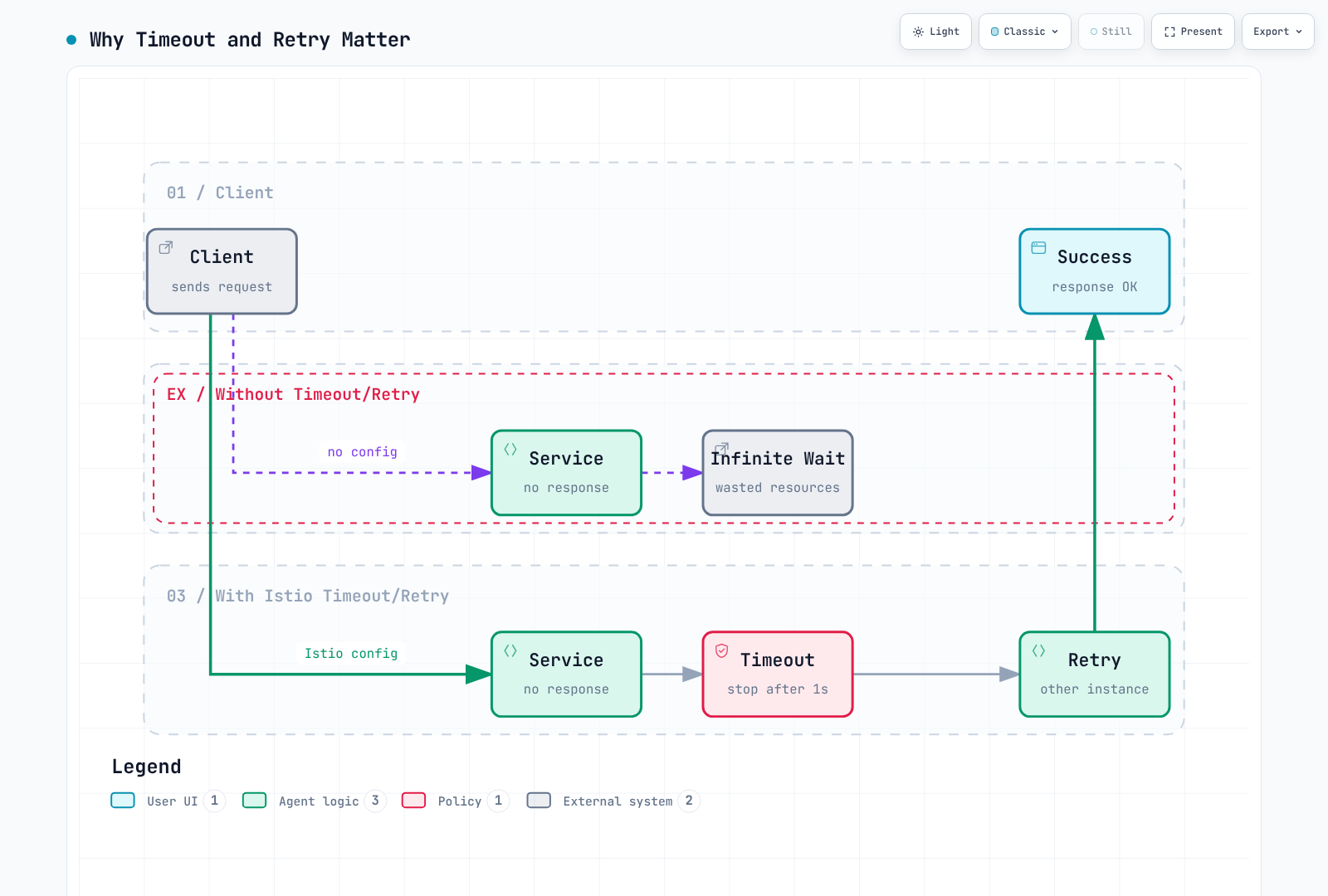
Retry and Timeout are core mechanisms for improving microservice resilience. With Istio, you can configure these policies without changing application code.
Table of Contents
- Overview
- Timeout Configuration
- Retry Configuration
- Combining Retry and Timeout
- Practical Examples
- Important Warnings
- Best Practices
- Troubleshooting
Overview
Examples are alternative HTTP sidecar policies and assume retry-safe operations unless a write policy is shown. Native SQL and opaque application HTTPS cannot use these HTTP retry/timeout rules. Set a caller deadline as well; retries at several layers multiply backend attempts and can outlive one layer’s local timeout.
Why Timeout and Retry?
Timeout Configuration
Basic Timeout
apiVersion: networking.istio.io/v1
kind: VirtualService
metadata:
  name: reviews-timeout
spec:
  hosts:
  - reviews
  http:
  - route:
    - destination:
        host: reviews
    timeout: 10s  # Timeout after 10 seconds
Path-specific Timeout
apiVersion: networking.istio.io/v1
kind: VirtualService
metadata:
  name: api-timeouts
spec:
  hosts:
  - api.example.com
  http:
  # Fast response API - short timeout
  - match:
    - uri:
        prefix: "/api/quick"
    route:
    - destination:
        host: api-service
    timeout: 1s

  # Standard API
  - match:
    - uri:
        prefix: "/api/standard"
    route:
    - destination:
        host: api-service
    timeout: 5s

  # Heavy operations - long timeout
  - match:
    - uri:
        prefix: "/api/batch"
    route:
    - destination:
        host: api-service
    timeout: 30s
Retry Configuration
Important: Omitting
retriesdoes not necessarily mean retry is off. The rendered Istio 1.31.0 default isattempts: 2withretryOn: connect-failure,refused-stream,unavailable,cancelled,retriable-status-codes.attemptscounts additional retries after the original request, so this can result in three total deliveries. Setattempts: 0on the route to disable proxy retries explicitly.
The HTTPRetry reference abbreviates that list; the released retry implementation also enables retriable-status-codes for configured codes. Cluster defaults can be overridden. An explicit retry policy must name the intended conditions; do not assume that every timeout is retried or that another healthy endpoint always exists.
Basic Retry
apiVersion: networking.istio.io/v1
kind: VirtualService
metadata:
  name: reviews-retry
spec:
  hosts:
  - reviews
  http:
  - route:
    - destination:
        host: reviews
    retries:
      attempts: 3  # Maximum 3 retries
      perTryTimeout: 2s  # 2s timeout per attempt
      retryOn: 5xx,reset,connect-failure,refused-stream  # Retry conditions
Retry Conditions
| Condition | Description |
|---|---|
5xx | HTTP 5xx errors |
gateway-error | 502, 503, 504 errors |
reset | Connection reset |
connect-failure | Connection failure |
refused-stream | HTTP/2 REFUSED_STREAM |
retriable-4xx | 409 Conflict |
retriable-status-codes | Custom status codes |
Advanced Retry Configuration
payment-service accepts non-idempotent writes (charge submission), so a single retry policy applied to every method would let the mesh replay a POST on reset or 5xx — exactly the ambiguous-replay risk this page warns against. Split the route by method instead: retry read-only status checks generously, and disable mesh retry entirely for the write path.
apiVersion: networking.istio.io/v1
kind: VirtualService
metadata:
  name: advanced-retry
spec:
  hosts:
  - payment-service
  http:
  - name: reads-retryable
    match:
    - method:
        regex: "^(GET|HEAD)$"
    route:
    - destination:
        host: payment-service
    retries:
      attempts: 3
      perTryTimeout: 2s
      retryOn: connect-failure,refused-stream
      retryRemoteLocalities: true  # Retry to other regions
  - name: writes-no-mesh-retry
    match:
    - method:
        regex: "^(POST|PUT|PATCH|DELETE)$"
    route:
    - destination:
        host: payment-service
    retries:
      attempts: 0
Combining Retry and Timeout
Layered Timeouts
apiVersion: networking.istio.io/v1
kind: VirtualService
metadata:
  name: layered-timeouts
spec:
  hosts:
  - frontend
  http:
  - route:
    - destination:
        host: frontend
    timeout: 10s  # Total timeout
    retries:
      attempts: 3
perTryTimeout: 3s # Timeout for each delivery, including the originalCalculation: the theoretical delivery-time bound is (1 + attempts) × perTryTimeout = 4 × 3s = 12s, but the route-level timeout: 10s applies first. Backoff and the remaining route timeout can reduce the number of retries actually attempted.
Split Retry Policy by HTTP Method
apiVersion: networking.istio.io/v1
kind: VirtualService
metadata:
  name: order-service
spec:
  hosts:
  - order-service
  http:
  # POST/PATCH: do not replay an ambiguous write in the mesh
  - name: writes-no-mesh-retry
    match:
    - method:
        regex: "^(POST|PUT|PATCH|DELETE)$"
    route:
    - destination:
        host: order-service
    timeout: 10s
    retries:
      attempts: 0

  # GET/HEAD: retry only connection establishment and REFUSED_STREAM failures
  - name: reads-limited-retry
    match:
    - method:
        regex: "^(GET|HEAD)$"
    route:
    - destination:
        host: order-service
    timeout: 5s
    retries:
      attempts: 2
      perTryTimeout: 2s
      retryOn: connect-failure,refused-stream
Disable mesh retries by default for POST/PATCH and any operation the domain defines as a write. Do not infer that PUT or DELETE is safe merely from the HTTP method: retry them only when the application's actual contract makes repeated execution safe.
Practical Examples
Example 1: Microservice Chain
# Frontend → Backend → Database
apiVersion: networking.istio.io/v1
kind: VirtualService
metadata:
  name: frontend
spec:
  hosts:
  - frontend
  http:
  - route:
    - destination:
        host: frontend
    timeout: 15s  # Consider entire chain
    retries:
      attempts: 2
      perTryTimeout: 7s
---
apiVersion: networking.istio.io/v1
kind: VirtualService
metadata:
  name: backend
spec:
  hosts:
  - backend
  http:
  - route:
    - destination:
        host: backend
    timeout: 10s  # Consider database call
    retries:
      attempts: 3
      perTryTimeout: 3s
      retryOn: 5xx,reset
---
apiVersion: networking.istio.io/v1
kind: VirtualService
metadata:
  name: database
spec:
  hosts:
  - database
  http:
  - route:
    - destination:
        host: database
    timeout: 5s
    retries:
      attempts: 2
      perTryTimeout: 2s
      retryOn: connect-failure,refused-stream
Example 2: External API Call
apiVersion: networking.istio.io/v1
kind: VirtualService
metadata:
  name: external-api
spec:
  hosts:
  - api.external.com
  http:
  - route:
    - destination:
        host: api.external.com
    timeout: 30s  # External APIs can be slow
    retries:
      attempts: 5  # External APIs have frequent transient failures
      perTryTimeout: 5s
      retryOn: 5xx,reset,connect-failure,gateway-error
---
apiVersion: networking.istio.io/v1
kind: ServiceEntry
metadata:
  name: external-api
spec:
  hosts:
  - api.external.com
  ports:
  - number: 80
    name: http
    protocol: HTTP
    targetPort: 443
  location: MESH_EXTERNAL
  resolution: DNS
---
apiVersion: networking.istio.io/v1
kind: DestinationRule
metadata:
  name: external-api-tls
spec:
  host: api.external.com
  trafficPolicy:
    tls:
      mode: SIMPLE
      sni: api.external.com
      subjectAltNames:
      - api.external.com
Call http://api.external.com from the application for this origination example; replace the hostname with the real service. If the application already starts HTTPS, its encrypted HTTP messages cannot be inspected for these retry conditions.
Example 3: Combined with Circuit Breaker
payment processes non-idempotent writes, so this example splits routes by method the same way as the earlier payment-service example: reads retry generously, writes disable mesh retry, and the circuit breaker below applies to both.
apiVersion: networking.istio.io/v1
kind: VirtualService
metadata:
  name: resilient-service
spec:
  hosts:
  - payment
  http:
  - name: reads-retryable
    match:
    - method:
        regex: "^(GET|HEAD)$"
    route:
    - destination:
        host: payment
    timeout: 10s
    retries:
      attempts: 3
      perTryTimeout: 3s
      retryOn: connect-failure,refused-stream
  - name: writes-no-mesh-retry
    match:
    - method:
        regex: "^(POST|PUT|PATCH|DELETE)$"
    route:
    - destination:
        host: payment
    timeout: 10s
    retries:
      attempts: 0
---
apiVersion: networking.istio.io/v1
kind: DestinationRule
metadata:
  name: payment-circuit-breaker
spec:
  host: payment
  trafficPolicy:
    connectionPool:
      tcp:
        maxConnections: 100
      http:
        http1MaxPendingRequests: 50
        maxRequestsPerConnection: 2
    outlierDetection:
      consecutive5xxErrors: 5
      interval: 30s
      baseEjectionTime: 30s
      maxEjectionPercent: 50
Important Warnings
Retry Risks for Non-Idempotent Requests
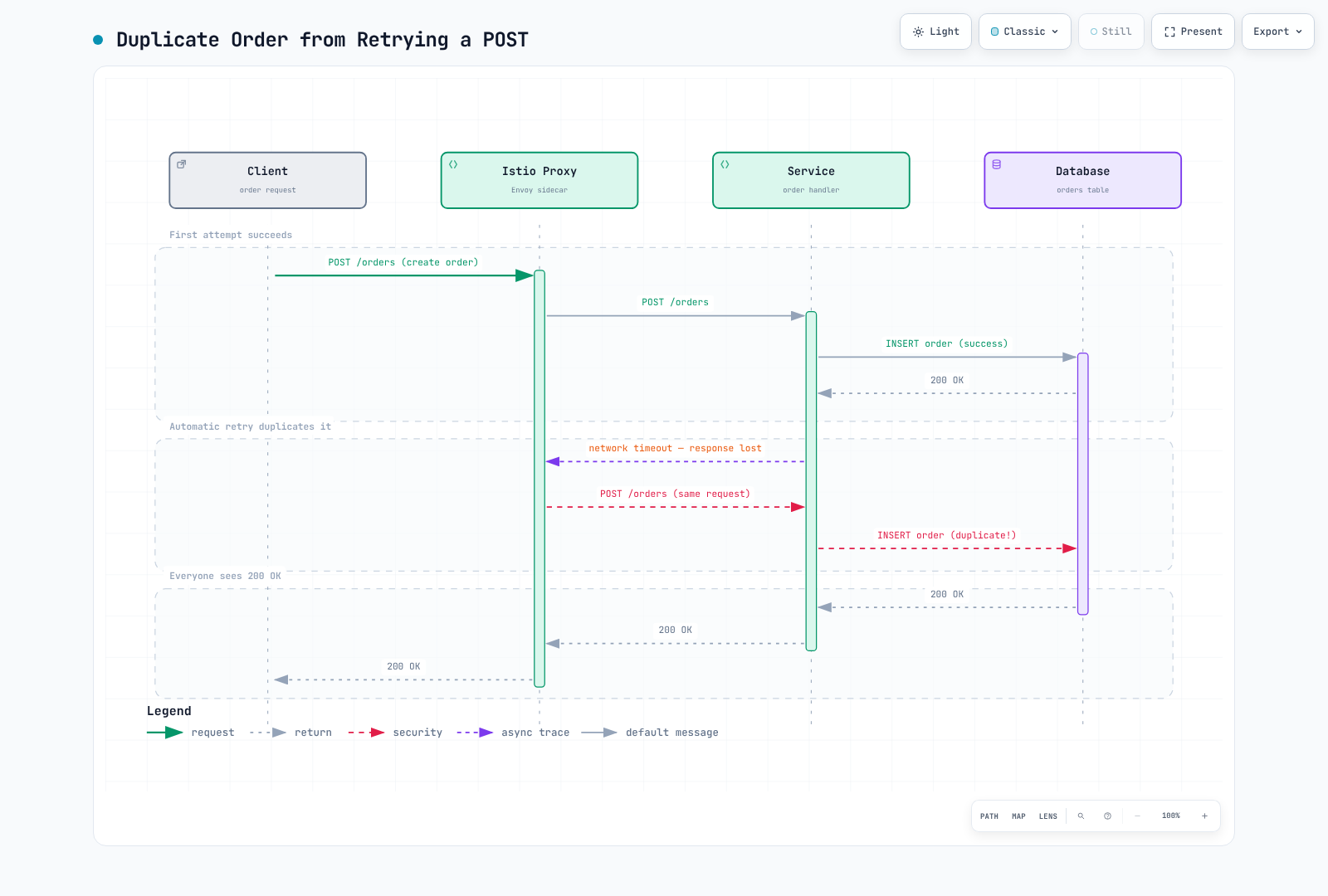
Core Principle: Automatic Istio Proxy retries for POST/PATCH and domain-defined non-idempotent writes can cause data consistency issues. Treat PUT/DELETE as exceptions only when the application's real contract guarantees idempotency.
Problem Scenario
Why Is This Dangerous?
- Duplicate Creation: POST request actually succeeded but response was lost due to network issues, Proxy retries creating duplicate records.
- Incorrect State Changes: Business-critical operations like payments, inventory deductions can execute multiple times.
- Unverifiable: Istio Proxy has no way to confirm if the request succeeded.
Safe Retry Strategy
Recommended: disable mesh retry and enforce application-level deduplication
# Istio: explicitly do not retry a non-idempotent write
apiVersion: networking.istio.io/v1
kind: VirtualService
metadata:
  name: order-service
spec:
  hosts:
  - order-service
  http:
  - match:
    - method:
        exact: POST
    route:
    - destination:
        host: order-service
    timeout: 10s
    retries:
attempts: 0 # No delivery after the original requestreset, 503, and timeout do not prove that the server rejected the request. The server can commit the database transaction and then lose only the response, so a proxy cannot determine whether replay is safe. After an ambiguous outcome, the application should query the operation status instead of blindly resending it.
# Client excerpt: requires an API with an atomic idempotency contract.
import requests
from requests.adapters import HTTPAdapter
from urllib3.util.retry import Retry


def create_order_with_idempotency(order_data, idempotency_key):
    # Persist one key per logical order; reuse it after ambiguous failures.
    if not idempotency_key:
        raise ValueError("A persisted operation idempotency key is required")
    retries = Retry(
        total=3,
        status_forcelist=[500, 502, 503, 504],
        allowed_methods=["POST"],
        backoff_factor=1,
    )
    with requests.Session() as session:
        adapter = HTTPAdapter(max_retries=retries)
        session.mount("http://", adapter)
        session.mount("https://", adapter)
        response = session.post(
            "http://order-service/orders",
            json=order_data,
            headers={"X-Idempotency-Key": idempotency_key},
            timeout=(3, 10),
        )
        response.raise_for_status()
        return response.json()
The server must enforce the contract atomically. A Redis exists check followed by order creation and separate cache writes allows concurrent duplicate orders and crash windows; it is not a safe deduplication implementation.
- Validate the key and bind it to the authenticated caller and a request-payload fingerprint.
- Use a unique database constraint to claim the key; serialize concurrent attempts.
- Commit the order mutation and stored status/response with that key in one transaction.
- Return the stored result for the same key/payload; reject reuse with a different payload.
- Coordinate irreversible external effects through an outbox/idempotent downstream API. Choose retention to cover the supported retry window.
The client example assumes this server contract already exists. A header by itself does not make POST safe, and the Requests timeout is per attempt/connect-read phase rather than a total retry deadline.
Combine these safeguards for production write APIs:
- an
Idempotency-Keybacked by a database unique constraint in the same transaction ETag/If-Matchor a version-field compare-and-swap for updates- transaction-ID or command-ID status lookup after a timeout/reset
- a transactional outbox for irreversible downstream effects such as payments or event publication
HTTP Method Retry Safety
| Method | Idempotent | Istio Retry Safety | Recommended Setting |
|---|---|---|---|
| GET | Yes | Safe | attempts: 3, retryOn: 5xx,reset |
| HEAD | Yes | Safe | attempts: 3, retryOn: 5xx,reset |
| OPTIONS | Yes | Safe | attempts: 3, retryOn: 5xx,reset |
| PUT | Contract-dependent | Caution | Real idempotency contract + conditional update |
| DELETE | Contract-dependent | Caution | Real idempotency contract + result lookup |
| POST | Usually no | Dangerous | attempts: 0, Idempotency Key |
| PATCH | Usually no | Dangerous | attempts: 0, version/ETag |
Safe Retry Cases
# Read-only requests - safe
apiVersion: networking.istio.io/v1
kind: VirtualService
metadata:
  name: api-service-reads
spec:
  hosts:
  - api-service
  http:
  - match:
    - method:
        regex: "GET|HEAD|OPTIONS"
    route:
    - destination:
        host: api-service
    retries:
      attempts: 3
      perTryTimeout: 2s
retryOn: 5xx,reset,connect-failure# Write requests with idempotency guaranteed
apiVersion: networking.istio.io/v1
kind: VirtualService
metadata:
name: idempotent-writes
spec:
hosts:
- api-service
http:
- match:
- method:
exact: PUT
headers:
x-idempotency-key:
regex: ".+" # Only when Idempotency Key present
route:
- destination:
host: api-service
retries:
attempts: 3
perTryTimeout: 2s
retryOn: 5xx,resetCaution When Using with Circuit Breaker
Circuit Breaker is effective for failure isolation, but it cannot prevent duplicate execution of non-idempotent requests.
# Bad example: POST + Circuit Breaker + Retry
apiVersion: networking.istio.io/v1
kind: VirtualService
metadata:
  name: payment-service
spec:
  hosts:
  - payment-service
  http:
  - route:
    - destination:
        host: payment-service
    retries:
      attempts: 3  # 3 retries for POST is dangerous
      retryOn: 5xx
---
apiVersion: networking.istio.io/v1
kind: DestinationRule
metadata:
  name: payment-circuit-breaker
spec:
  host: payment-service
  trafficPolicy:
    outlierDetection:
      consecutive5xxErrors: 5
      baseEjectionTime: 30s

# Result: Before the Circuit Breaker opens,
# duplicate payments can occur 3 times!# Good example: Use Circuit Breaker only, retry at application level
apiVersion: networking.istio.io/v1
kind: VirtualService
metadata:
name: payment-service
spec:
hosts:
- payment-service
http:
- route:
- destination:
host: payment-service
timeout: 10s
retries:
attempts: 0 # Completely disable retry
---
apiVersion: networking.istio.io/v1
kind: DestinationRule
metadata:
name: payment-circuit-breaker
spec:
host: payment-service
trafficPolicy:
outlierDetection:
consecutive5xxErrors: 5
baseEjectionTime: 30sPractical Guidelines
- GET/HEAD/OPTIONS: Can use Istio Proxy Retry
- POST/PATCH: Disable Istio Retry, use Application-level Retry + Idempotency Key
- PUT/DELETE: Use Istio Retry only when idempotency guaranteed
- Critical operations (payment/inventory/points): Must have Application-level validation + Idempotency Key
Best Practices
1. Timeout Configuration Guide
# Good example: Appropriate timeout per layer
# Frontend: 15s
# API Gateway: 10s
# Backend Service: 5s
# Database: 3s

apiVersion: networking.istio.io/v1
kind: VirtualService
metadata:
  name: api-gateway
spec:
  hosts:
  - api-gateway
  http:
  - route:
    - destination:
        host: api-gateway
    timeout: 10s
    retries:
      attempts: 2
perTryTimeout: 4s# Bad example: Timeout too long
apiVersion: networking.istio.io/v1
kind: VirtualService
metadata:
name: api-gateway
spec:
hosts:
- api-gateway
http:
- route:
- destination:
host: api-gateway
timeout: 300s # Illustrative poor fit for a short interactive request; streaming differs2. Retry Strategy
# Good example: Consider idempotency
apiVersion: networking.istio.io/v1
kind: VirtualService
metadata:
  name: api-service
spec:
  hosts:
  - api-service
  http:
  # GET - safe to retry
  - match:
    - method:
        exact: GET
    route:
    - destination:
        host: api-service
    retries:
      attempts: 3
      perTryTimeout: 2s
      retryOn: 5xx,reset,connect-failure

  # POST/PATCH - explicitly disable mesh retry
  - match:
    - method:
        regex: "^(POST|PUT|PATCH|DELETE)$"
    route:
    - destination:
        host: api-service
    retries:
      attempts: 0
3. Exponential Backoff
Envoy uses fully jittered exponential backoff with a default 25ms base interval; actual delays are not a fixed 25/50/100ms sequence. The example sets a custom base for reads and explicitly disables retries on the write path:
apiVersion: networking.istio.io/v1
kind: VirtualService
metadata:
  name: backoff-retry
spec:
  hosts:
  - payment
  http:
  - match:
    - method:
        regex: "^(GET|HEAD)$"
    route:
    - destination:
        host: payment
    retries:
      attempts: 5
      perTryTimeout: 2s
      retryOn: connect-failure,refused-stream
      backoff: 100ms
  - route:
    - destination:
        host: payment
    retries:
      attempts: 0
4. Total System Timeout Calculation
# Frontend → API Gateway → Backend → Database
# Frontend: 20s
# API Gateway: 15s (must be less than Frontend)
# Backend: 10s (must be less than API Gateway)
# Database: 5s (must be less than Backend)

# Each layer should consider downstream timeout + overhead
Troubleshooting
Timeout Not Working
# 1. Check VirtualService
kubectl get virtualservice -n <namespace>
kubectl describe virtualservice <name> -n <namespace>

# 2. Check Envoy configuration
istioctl proxy-config routes <pod-name> -n <namespace> -o json | grep timeout

# 3. Test actual timeout
kubectl exec -it <pod-name> -n <namespace> -c <app-container> -- \
  curl -v --max-time 15 http://backend-service
Too Many Retries
Generate traffic from an application container with curl installed, not from the istio-proxy UID (which can bypass interception). Set curl's deadline above the configured route timeout for that test. Use Envoy retry counters, enabled by the proxy stats matcher, to measure retries; the UR response flag means upstream remote reset and is not a retry counter.
sum(rate(envoy_cluster_upstream_rq_retry[5m]))Preventing Retry Storm
# Use with Circuit Breaker
apiVersion: networking.istio.io/v1
kind: DestinationRule
metadata:
  name: prevent-retry-storm
spec:
  host: backend
  trafficPolicy:
    connectionPool:
      tcp:
        maxConnections: 100
      http:
        http1MaxPendingRequests: 10  # Limit pending requests
        http2MaxRequests: 100
        maxRequestsPerConnection: 1
    outlierDetection:
      consecutive5xxErrors: 3  # Fast circuit break
      interval: 10s
      baseEjectionTime: 30s