Infrastructure Advanced
Supported Versions: Terraform >= 1.5, AWS Provider >= 5.40, EKS >= 1.29 Last Updated: February 19, 2026
< Previous: Terraform 3-Layer Infrastructure | Table of Contents | Next: CI Pipelines >
Overview
This guide covers advanced infrastructure patterns for running production EKS workloads with high availability and zero-downtime deployments. The Blue/Green cluster architecture enables seamless cluster upgrades, disaster recovery, and traffic management across multiple availability zones.
Key Topics:
- Blue/Green dual-cluster architecture
- NLB weighted target groups for traffic distribution
- DNS-based traffic switching with Route53
- Zone-aware data placement for stateful workloads
- Automated failover with CloudWatch and Lambda
1. Blue/Green Architecture Overview
Why Blue/Green Clusters?
Traditional in-place cluster upgrades carry significant risk:
- Workload disruption during control plane updates
- Node draining can cause capacity issues
- Rollback complexity when issues arise
- Extended maintenance windows
The Blue/Green architecture eliminates these risks by maintaining two independent clusters:
| Aspect | In-Place Upgrade | Blue/Green |
|---|---|---|
| Downtime Risk | Medium-High | Near Zero |
| Rollback Time | 30-60 minutes | Seconds (DNS/NLB) |
| Testing | Limited | Full production traffic |
| Cost | Single cluster | 2x cluster (during transition) |
Architecture Diagram
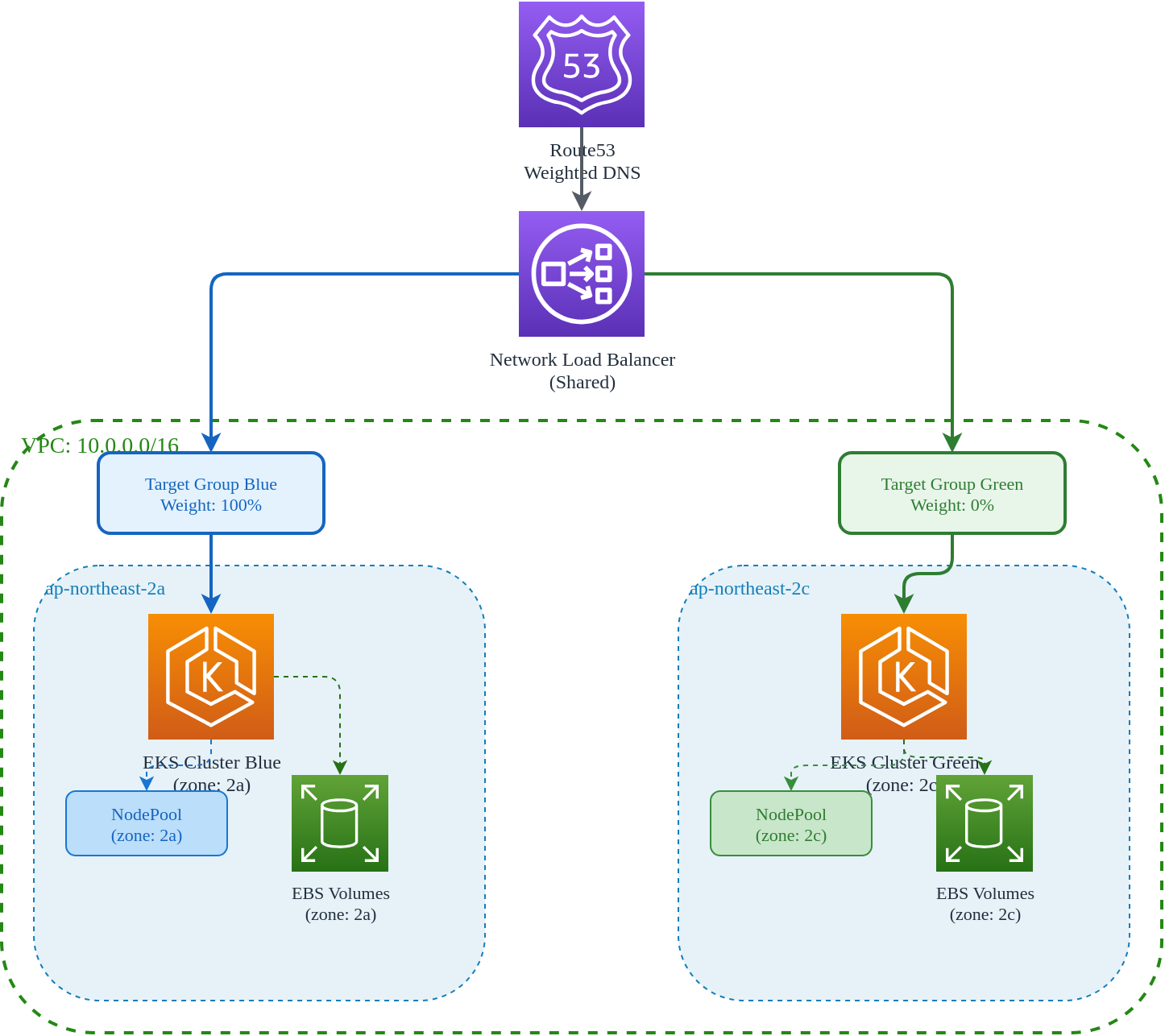
Single-Zone Design Rationale
Each cluster operates in a single availability zone:
Advantages:
- Data Locality: Pods always schedule near their storage volumes
- Cost Optimization: Zero cross-AZ data transfer costs
- Failure Isolation: AZ failure affects only one cluster
- Simplified Networking: No complex multi-AZ load balancing
Trade-offs:
- Higher single-AZ risk (mitigated by Blue/Green failover)
- Requires careful capacity planning per zone
Zone Assignment
| Cluster | Availability Zone | Purpose |
|---|---|---|
| Blue | ap-northeast-2a | Primary production |
| Green | ap-northeast-2c | Secondary/upgrade target |
2. NLB Weighted Target Groups
Network Load Balancer Configuration
The shared NLB distributes traffic between Blue and Green clusters based on target group weights.
# nlb/main.tf

terraform {
  required_version = ">= 1.5.0"
  required_providers {
    aws = {
      source  = "hashicorp/aws"
      version = ">= 5.40.0"
    }
  }
}

provider "aws" {
  region = var.region

  default_tags {
    tags = local.tags
  }
}

locals {
  name_prefix = "${var.project_name}-${var.environment}"

  tags = {
    Environment = var.environment
    Project     = var.project_name
    ManagedBy   = "terraform"
    Component   = "nlb"
  }
}

# Reference network layer for VPC and subnets
data "terraform_remote_state" "network" {
  backend = "s3"

  config = {
    bucket = "${var.project_name}-${var.environment}-tfstate"
    key    = "network/terraform.tfstate"
    region = var.region
  }
}

#------------------------------------------------------------------------------
# Network Load Balancer
#------------------------------------------------------------------------------

resource "aws_lb" "main" {
  name               = "${local.name_prefix}-nlb"
  internal           = false
  load_balancer_type = "network"

  # Deploy in both AZs for high availability
  subnets = data.terraform_remote_state.network.outputs.public_subnet_ids

  enable_deletion_protection = var.environment == "prod"
  enable_cross_zone_load_balancing = true

  tags = merge(local.tags, {
    Name = "${local.name_prefix}-nlb"
  })
}

#------------------------------------------------------------------------------
# Target Groups - Blue Cluster
#------------------------------------------------------------------------------

resource "aws_lb_target_group" "blue_http" {
  name        = "${local.name_prefix}-blue-http"
  port        = 80
  protocol    = "TCP"
  vpc_id      = data.terraform_remote_state.network.outputs.vpc_id
  target_type = "ip"

  health_check {
    enabled             = true
    protocol            = "HTTP"
    port                = "traffic-port"
    path                = "/healthz"
    healthy_threshold   = 2
    unhealthy_threshold = 2
    interval            = 10
    timeout             = 5
  }

  # Deregistration delay for graceful shutdown
  deregistration_delay = 30

  tags = merge(local.tags, {
    Name    = "${local.name_prefix}-blue-http"
    Cluster = "blue"
  })
}

resource "aws_lb_target_group" "blue_https" {
  name        = "${local.name_prefix}-blue-https"
  port        = 443
  protocol    = "TCP"
  vpc_id      = data.terraform_remote_state.network.outputs.vpc_id
  target_type = "ip"

  health_check {
    enabled             = true
    protocol            = "HTTPS"
    port                = "traffic-port"
    path                = "/healthz"
    healthy_threshold   = 2
    unhealthy_threshold = 2
    interval            = 10
    timeout             = 5
  }

  deregistration_delay = 30

  tags = merge(local.tags, {
    Name    = "${local.name_prefix}-blue-https"
    Cluster = "blue"
  })
}

#------------------------------------------------------------------------------
# Target Groups - Green Cluster
#------------------------------------------------------------------------------

resource "aws_lb_target_group" "green_http" {
  name        = "${local.name_prefix}-green-http"
  port        = 80
  protocol    = "TCP"
  vpc_id      = data.terraform_remote_state.network.outputs.vpc_id
  target_type = "ip"

  health_check {
    enabled             = true
    protocol            = "HTTP"
    port                = "traffic-port"
    path                = "/healthz"
    healthy_threshold   = 2
    unhealthy_threshold = 2
    interval            = 10
    timeout             = 5
  }

  deregistration_delay = 30

  tags = merge(local.tags, {
    Name    = "${local.name_prefix}-green-http"
    Cluster = "green"
  })
}

resource "aws_lb_target_group" "green_https" {
  name        = "${local.name_prefix}-green-https"
  port        = 443
  protocol    = "TCP"
  vpc_id      = data.terraform_remote_state.network.outputs.vpc_id
  target_type = "ip"

  health_check {
    enabled             = true
    protocol            = "HTTPS"
    port                = "traffic-port"
    path                = "/healthz"
    healthy_threshold   = 2
    unhealthy_threshold = 2
    interval            = 10
    timeout             = 5
  }

  deregistration_delay = 30

  tags = merge(local.tags, {
    Name    = "${local.name_prefix}-green-https"
    Cluster = "green"
  })
}

#------------------------------------------------------------------------------
# Listeners with Weighted Target Groups
#------------------------------------------------------------------------------

resource "aws_lb_listener" "http" {
  load_balancer_arn = aws_lb.main.arn
  port              = 80
  protocol          = "TCP"

  default_action {
    type = "forward"

    forward {
      target_group {
        arn    = aws_lb_target_group.blue_http.arn
        weight = var.blue_weight
      }
      target_group {
        arn    = aws_lb_target_group.green_http.arn
        weight = var.green_weight
      }

      stickiness {
        enabled  = true
        duration = 3600  # 1 hour session stickiness
      }
    }
  }

  tags = merge(local.tags, {
    Name = "${local.name_prefix}-http-listener"
  })
}

resource "aws_lb_listener" "https" {
  load_balancer_arn = aws_lb.main.arn
  port              = 443
  protocol          = "TCP"

  default_action {
    type = "forward"

    forward {
      target_group {
        arn    = aws_lb_target_group.blue_https.arn
        weight = var.blue_weight
      }
      target_group {
        arn    = aws_lb_target_group.green_https.arn
        weight = var.green_weight
      }

      stickiness {
        enabled  = true
        duration = 3600
      }
    }
  }

  tags = merge(local.tags, {
    Name = "${local.name_prefix}-https-listener"
  })
}
Variables
# nlb/variables.tf

variable "region" {
  description = "AWS region"
  type        = string
  default     = "ap-northeast-2"
}

variable "environment" {
  description = "Environment name"
  type        = string
  default     = "prod"
}

variable "project_name" {
  description = "Project name"
  type        = string
  default     = "eks-platform"
}

variable "blue_weight" {
  description = "Traffic weight for blue cluster (0-100)"
  type        = number
  default     = 100

  validation {
    condition     = var.blue_weight >= 0 && var.blue_weight <= 100
    error_message = "Blue weight must be between 0 and 100."
  }
}

variable "green_weight" {
  description = "Traffic weight for green cluster (0-100)"
  type        = number
  default     = 0

  validation {
    condition     = var.green_weight >= 0 && var.green_weight <= 100
    error_message = "Green weight must be between 0 and 100."
  }
}
Outputs
# nlb/outputs.tf

output "nlb_arn" {
  description = "NLB ARN"
  value       = aws_lb.main.arn
}

output "nlb_dns_name" {
  description = "NLB DNS name"
  value       = aws_lb.main.dns_name
}

output "nlb_zone_id" {
  description = "NLB hosted zone ID"
  value       = aws_lb.main.zone_id
}

output "blue_http_target_group_arn" {
  description = "Blue HTTP target group ARN"
  value       = aws_lb_target_group.blue_http.arn
}

output "blue_https_target_group_arn" {
  description = "Blue HTTPS target group ARN"
  value       = aws_lb_target_group.blue_https.arn
}

output "green_http_target_group_arn" {
  description = "Green HTTP target group ARN"
  value       = aws_lb_target_group.green_http.arn
}

output "green_https_target_group_arn" {
  description = "Green HTTPS target group ARN"
  value       = aws_lb_target_group.green_https.arn
}

output "current_weights" {
  description = "Current traffic weights"
  value = {
    blue  = var.blue_weight
    green = var.green_weight
  }
}
Weight Adjustment for Deployments
Adjust weights progressively for canary-style deployments:
# terraform.tfvars examples for different deployment stages

# Stage 1: All traffic to Blue (default)
blue_weight  = 100
green_weight = 0

# Stage 2: Canary - 10% to Green
blue_weight  = 90
green_weight = 10

# Stage 3: 50/50 split
blue_weight  = 50
green_weight = 50

# Stage 4: All traffic to Green
blue_weight  = 0
green_weight = 100
Apply weight changes:
# Update weights
terraform apply -var="blue_weight=90" -var="green_weight=10"

# Verify listener configuration
aws elbv2 describe-listeners \
  --load-balancer-arn $(terraform output -raw nlb_arn) \
  --query 'Listeners[*].DefaultActions[*].ForwardConfig.TargetGroups'
3. DNS-Based Traffic Switching
Route53 Weighted Routing
For more granular control and global routing, use Route53 weighted records alongside or instead of NLB weights.
# dns/main.tf

terraform {
  required_version = ">= 1.5.0"
  required_providers {
    aws = {
      source  = "hashicorp/aws"
      version = ">= 5.40.0"
    }
  }
}

provider "aws" {
  region = var.region
}

locals {
  name_prefix = "${var.project_name}-${var.environment}"
}

# Reference NLB outputs
data "terraform_remote_state" "nlb" {
  backend = "s3"

  config = {
    bucket = "${var.project_name}-${var.environment}-tfstate"
    key    = "nlb/terraform.tfstate"
    region = var.region
  }
}

#------------------------------------------------------------------------------
# Route53 Hosted Zone
#------------------------------------------------------------------------------

data "aws_route53_zone" "main" {
  name         = var.domain_name
  private_zone = false
}

#------------------------------------------------------------------------------
# Health Checks
#------------------------------------------------------------------------------

resource "aws_route53_health_check" "blue" {
  fqdn              = "blue.${var.domain_name}"
  port              = 443
  type              = "HTTPS"
  resource_path     = "/healthz"
  failure_threshold = 3
  request_interval  = 10

  tags = {
    Name        = "${local.name_prefix}-blue-health"
    Environment = var.environment
    Cluster     = "blue"
  }
}

resource "aws_route53_health_check" "green" {
  fqdn              = "green.${var.domain_name}"
  port              = 443
  type              = "HTTPS"
  resource_path     = "/healthz"
  failure_threshold = 3
  request_interval  = 10

  tags = {
    Name        = "${local.name_prefix}-green-health"
    Environment = var.environment
    Cluster     = "green"
  }
}

#------------------------------------------------------------------------------
# Weighted DNS Records
#------------------------------------------------------------------------------

# Primary record - Blue cluster
resource "aws_route53_record" "app_blue" {
  zone_id = data.aws_route53_zone.main.zone_id
  name    = "app.${var.domain_name}"
  type    = "A"

  set_identifier = "blue"
  weighted_routing_policy {
    weight = var.blue_dns_weight
  }

  alias {
    name                   = data.terraform_remote_state.nlb.outputs.nlb_dns_name
    zone_id                = data.terraform_remote_state.nlb.outputs.nlb_zone_id
    evaluate_target_health = true
  }

  health_check_id = aws_route53_health_check.blue.id
}

# Secondary record - Green cluster
resource "aws_route53_record" "app_green" {
  zone_id = data.aws_route53_zone.main.zone_id
  name    = "app.${var.domain_name}"
  type    = "A"

  set_identifier = "green"
  weighted_routing_policy {
    weight = var.green_dns_weight
  }

  alias {
    name                   = data.terraform_remote_state.nlb.outputs.nlb_dns_name
    zone_id                = data.terraform_remote_state.nlb.outputs.nlb_zone_id
    evaluate_target_health = true
  }

  health_check_id = aws_route53_health_check.green.id
}

#------------------------------------------------------------------------------
# Direct Cluster Access Records
#------------------------------------------------------------------------------

# Blue cluster direct access
resource "aws_route53_record" "blue_direct" {
  zone_id = data.aws_route53_zone.main.zone_id
  name    = "blue.${var.domain_name}"
  type    = "A"

  alias {
    name                   = data.terraform_remote_state.nlb.outputs.nlb_dns_name
    zone_id                = data.terraform_remote_state.nlb.outputs.nlb_zone_id
    evaluate_target_health = true
  }
}

# Green cluster direct access
resource "aws_route53_record" "green_direct" {
  zone_id = data.aws_route53_zone.main.zone_id
  name    = "green.${var.domain_name}"
  type    = "A"

  alias {
    name                   = data.terraform_remote_state.nlb.outputs.nlb_dns_name
    zone_id                = data.terraform_remote_state.nlb.outputs.nlb_zone_id
    evaluate_target_health = true
  }
}

#------------------------------------------------------------------------------
# Failover Configuration
#------------------------------------------------------------------------------

# Primary failover record
resource "aws_route53_record" "app_primary" {
  zone_id = data.aws_route53_zone.main.zone_id
  name    = "failover.${var.domain_name}"
  type    = "A"

  set_identifier = "primary"
  failover_routing_policy {
    type = "PRIMARY"
  }

  alias {
    name                   = data.terraform_remote_state.nlb.outputs.nlb_dns_name
    zone_id                = data.terraform_remote_state.nlb.outputs.nlb_zone_id
    evaluate_target_health = true
  }

  health_check_id = aws_route53_health_check.blue.id
}

# Secondary failover record
resource "aws_route53_record" "app_secondary" {
  zone_id = data.aws_route53_zone.main.zone_id
  name    = "failover.${var.domain_name}"
  type    = "A"

  set_identifier = "secondary"
  failover_routing_policy {
    type = "SECONDARY"
  }

  alias {
    name                   = data.terraform_remote_state.nlb.outputs.nlb_dns_name
    zone_id                = data.terraform_remote_state.nlb.outputs.nlb_zone_id
    evaluate_target_health = true
  }

  health_check_id = aws_route53_health_check.green.id
}
Variables
# dns/variables.tf

variable "region" {
  description = "AWS region"
  type        = string
  default     = "ap-northeast-2"
}

variable "environment" {
  description = "Environment name"
  type        = string
  default     = "prod"
}

variable "project_name" {
  description = "Project name"
  type        = string
  default     = "eks-platform"
}

variable "domain_name" {
  description = "Domain name for Route53 records"
  type        = string
}

variable "blue_dns_weight" {
  description = "DNS weight for blue cluster (0-255)"
  type        = number
  default     = 255

  validation {
    condition     = var.blue_dns_weight >= 0 && var.blue_dns_weight <= 255
    error_message = "DNS weight must be between 0 and 255."
  }
}

variable "green_dns_weight" {
  description = "DNS weight for green cluster (0-255)"
  type        = number
  default     = 0

  validation {
    condition     = var.green_dns_weight >= 0 && var.green_dns_weight <= 255
    error_message = "DNS weight must be between 0 and 255."
  }
}
TTL Strategy
DNS TTL affects how quickly traffic shifts when weights change:
| TTL Value | Switch Time | Use Case |
|---|---|---|
| 60 seconds | ~2-3 minutes | Rapid failover |
| 300 seconds | ~10-15 minutes | Normal operations |
| 3600 seconds | ~1-2 hours | Stable routing |
For Route53 Alias records, TTL is inherited from the target (NLB). For explicit TTL control, use non-alias records with IP addresses.
4. Data Node Placement
Zone Affinity Concepts
For stateful workloads, pods must schedule in the same zone as their persistent volumes. EKS Auto Mode handles much of this automatically, but understanding the concepts helps with troubleshooting.
NodePool Zone Configuration
The actual NodePool YAML is managed by ArgoCD GitOps (see GitOps Pipeline Configuration), but here are the key concepts:
# Conceptual NodePool for Blue cluster (zone: ap-northeast-2a)
# Actual resource managed by ArgoCD, not Terraform
apiVersion: karpenter.sh/v1
kind: NodePool
metadata:
  name: blue-data-nodes
spec:
  template:
    spec:
      requirements:
        - key: topology.kubernetes.io/zone
          operator: In
          values:
            - ap-northeast-2a
        - key: karpenter.sh/capacity-type
          operator: In
          values:
            - on-demand
        - key: node.kubernetes.io/instance-type
          operator: In
          values:
            - r6i.xlarge
            - r6i.2xlarge
            - r6i.4xlarge
      nodeClassRef:
        group: eks.amazonaws.com
        kind: NodeClass
        name: default
  limits:
    cpu: 1000
    memory: 4000Gi
  disruption:
    consolidationPolicy: WhenEmpty
    consolidateAfter: 30m
TopologySpreadConstraints
Ensure workloads spread correctly within a single-zone cluster:
# Example Deployment with topology constraints
apiVersion: apps/v1
kind: Deployment
metadata:
  name: api-server
spec:
  replicas: 3
  selector:
    matchLabels:
      app: api-server
  template:
    metadata:
      labels:
        app: api-server
    spec:
      topologySpreadConstraints:
        # Spread across nodes within the zone
        - maxSkew: 1
          topologyKey: kubernetes.io/hostname
          whenUnsatisfiable: DoNotSchedule
          labelSelector:
            matchLabels:
              app: api-server
      containers:
        - name: api-server
          image: myapp/api-server:latest
          resources:
            requests:
              cpu: 500m
              memory: 512Mi
Pod Affinity for Co-location
Co-locate related pods for reduced latency:
# Cache pods should be near API pods
apiVersion: apps/v1
kind: Deployment
metadata:
  name: cache
spec:
  replicas: 3
  selector:
    matchLabels:
      app: cache
  template:
    metadata:
      labels:
        app: cache
    spec:
      affinity:
        podAffinity:
          preferredDuringSchedulingIgnoredDuringExecution:
            - weight: 100
              podAffinityTerm:
                labelSelector:
                  matchLabels:
                    app: api-server
                topologyKey: kubernetes.io/hostname
        podAntiAffinity:
          requiredDuringSchedulingIgnoredDuringExecution:
            - labelSelector:
                matchLabels:
                  app: cache
              topologyKey: kubernetes.io/hostname
      containers:
        - name: redis
          image: redis:7-alpine
StatefulSet with Zone-Specific Storage
For databases and other stateful workloads:
# PostgreSQL StatefulSet with zone-locked storage
apiVersion: apps/v1
kind: StatefulSet
metadata:
  name: postgresql
spec:
  serviceName: postgresql
  replicas: 1
  selector:
    matchLabels:
      app: postgresql
  template:
    metadata:
      labels:
        app: postgresql
    spec:
      # Node selector ensures pod schedules in correct zone
      nodeSelector:
        topology.kubernetes.io/zone: ap-northeast-2a
      containers:
        - name: postgresql
          image: postgres:15
          ports:
            - containerPort: 5432
          volumeMounts:
            - name: data
              mountPath: /var/lib/postgresql/data
          env:
            - name: POSTGRES_DB
              value: myapp
            - name: PGDATA
              value: /var/lib/postgresql/data/pgdata
  volumeClaimTemplates:
    - metadata:
        name: data
      spec:
        accessModes:
          - ReadWriteOnce
        storageClassName: ebs-sc  # Auto Mode managed
        resources:
          requests:
            storage: 100Gi
Storage Class for Zone-Specific Provisioning
# StorageClass that provisions in specific zone
apiVersion: storage.k8s.io/v1
kind: StorageClass
metadata:
  name: ebs-sc-zone-a
provisioner: ebs.csi.aws.com
parameters:
  type: gp3
  iops: "3000"
  throughput: "125"
  encrypted: "true"
allowedTopologies:
  - matchLabelExpressions:
      - key: topology.kubernetes.io/zone
        values:
          - ap-northeast-2a
volumeBindingMode: WaitForFirstConsumer
reclaimPolicy: Retain
5. Failover Automation
CloudWatch Alarms
Monitor cluster health and trigger automated failover:
# failover/cloudwatch.tf

resource "aws_cloudwatch_metric_alarm" "blue_unhealthy" {
  alarm_name          = "${local.name_prefix}-blue-unhealthy"
  comparison_operator = "LessThanThreshold"
  evaluation_periods  = 2
  metric_name         = "HealthyHostCount"
  namespace           = "AWS/NetworkELB"
  period              = 60
  statistic           = "Average"
  threshold           = 1
  alarm_description   = "Blue cluster has no healthy targets"

  dimensions = {
    TargetGroup  = aws_lb_target_group.blue_http.arn_suffix
    LoadBalancer = aws_lb.main.arn_suffix
  }

  alarm_actions = [
    aws_sns_topic.alerts.arn,
    aws_lambda_function.failover.arn
  ]

  ok_actions = [
    aws_sns_topic.alerts.arn
  ]

  tags = local.tags
}

resource "aws_cloudwatch_metric_alarm" "green_unhealthy" {
  alarm_name          = "${local.name_prefix}-green-unhealthy"
  comparison_operator = "LessThanThreshold"
  evaluation_periods  = 2
  metric_name         = "HealthyHostCount"
  namespace           = "AWS/NetworkELB"
  period              = 60
  statistic           = "Average"
  threshold           = 1
  alarm_description   = "Green cluster has no healthy targets"

  dimensions = {
    TargetGroup  = aws_lb_target_group.green_http.arn_suffix
    LoadBalancer = aws_lb.main.arn_suffix
  }

  alarm_actions = [
    aws_sns_topic.alerts.arn
  ]

  tags = local.tags
}

# SNS Topic for alerts
resource "aws_sns_topic" "alerts" {
  name = "${local.name_prefix}-failover-alerts"
  tags = local.tags
}

resource "aws_sns_topic_subscription" "email" {
  topic_arn = aws_sns_topic.alerts.arn
  protocol  = "email"
  endpoint  = var.alert_email
}
Lambda Failover Function
Automated weight switching when a cluster becomes unhealthy:
# failover/lambda.tf

resource "aws_lambda_function" "failover" {
  filename         = data.archive_file.failover.output_path
  function_name    = "${local.name_prefix}-failover"
  role             = aws_iam_role.failover_lambda.arn
  handler          = "index.handler"
  source_code_hash = data.archive_file.failover.output_base64sha256
  runtime          = "python3.11"
  timeout          = 30

  environment {
    variables = {
      LISTENER_ARN_HTTP  = aws_lb_listener.http.arn
      LISTENER_ARN_HTTPS = aws_lb_listener.https.arn
      BLUE_TG_ARN_HTTP   = aws_lb_target_group.blue_http.arn
      BLUE_TG_ARN_HTTPS  = aws_lb_target_group.blue_https.arn
      GREEN_TG_ARN_HTTP  = aws_lb_target_group.green_http.arn
      GREEN_TG_ARN_HTTPS = aws_lb_target_group.green_https.arn
      SNS_TOPIC_ARN      = aws_sns_topic.alerts.arn
    }
  }

  tags = local.tags
}

data "archive_file" "failover" {
  type        = "zip"
  source_file = "${path.module}/lambda/failover.py"
  output_path = "${path.module}/lambda/failover.zip"
}

# Lambda IAM Role
resource "aws_iam_role" "failover_lambda" {
  name = "${local.name_prefix}-failover-lambda-role"

  assume_role_policy = jsonencode({
    Version = "2012-10-17"
    Statement = [
      {
        Action = "sts:AssumeRole"
        Effect = "Allow"
        Principal = {
          Service = "lambda.amazonaws.com"
        }
      }
    ]
  })

  tags = local.tags
}

resource "aws_iam_role_policy" "failover_lambda" {
  name = "failover-policy"
  role = aws_iam_role.failover_lambda.id

  policy = jsonencode({
    Version = "2012-10-17"
    Statement = [
      {
        Effect = "Allow"
        Action = [
          "logs:CreateLogGroup",
          "logs:CreateLogStream",
          "logs:PutLogEvents"
        ]
        Resource = "arn:aws:logs:*:*:*"
      },
      {
        Effect = "Allow"
        Action = [
          "elasticloadbalancing:ModifyListener",
          "elasticloadbalancing:DescribeListeners",
          "elasticloadbalancing:DescribeTargetGroups",
          "elasticloadbalancing:DescribeTargetHealth"
        ]
        Resource = "*"
      },
      {
        Effect = "Allow"
        Action = [
          "sns:Publish"
        ]
        Resource = aws_sns_topic.alerts.arn
      }
    ]
  })
}

# CloudWatch permission to invoke Lambda
resource "aws_lambda_permission" "cloudwatch" {
  statement_id  = "AllowCloudWatch"
  action        = "lambda:InvokeFunction"
  function_name = aws_lambda_function.failover.function_name
  principal     = "lambda.alarms.cloudwatch.amazonaws.com"
  source_arn    = aws_cloudwatch_metric_alarm.blue_unhealthy.arn
}
Lambda Function Code
# failover/lambda/failover.py
"""
Automated failover handler for Blue/Green EKS clusters.
Triggered by CloudWatch alarms when a cluster becomes unhealthy.
"""

import json
import os
import boto3
from datetime import datetime

elbv2 = boto3.client('elbv2')
sns = boto3.client('sns')

def handler(event, context):
    """
    Handle CloudWatch alarm and adjust NLB weights.
    """
    print(f"Event received: {json.dumps(event)}")

    # Parse CloudWatch alarm
    alarm_name = event.get('alarmName', '')
    alarm_state = event.get('newStateValue', '')

    if alarm_state != 'ALARM':
        print(f"Alarm state is {alarm_state}, not ALARM. No action needed.")
        return {'statusCode': 200, 'body': 'No action needed'}

    # Determine which cluster is unhealthy
    if 'blue' in alarm_name.lower():
        unhealthy_cluster = 'blue'
        healthy_cluster = 'green'
    elif 'green' in alarm_name.lower():
        unhealthy_cluster = 'green'
        healthy_cluster = 'blue'
    else:
        print(f"Cannot determine cluster from alarm name: {alarm_name}")
        return {'statusCode': 400, 'body': 'Unknown alarm'}

    print(f"Unhealthy cluster: {unhealthy_cluster}")
    print(f"Switching traffic to: {healthy_cluster}")

    # Get environment variables
    listener_arns = [
        os.environ['LISTENER_ARN_HTTP'],
        os.environ['LISTENER_ARN_HTTPS']
    ]

    target_groups = {
        'blue': {
            'http': os.environ['BLUE_TG_ARN_HTTP'],
            'https': os.environ['BLUE_TG_ARN_HTTPS']
        },
        'green': {
            'http': os.environ['GREEN_TG_ARN_HTTP'],
            'https': os.environ['GREEN_TG_ARN_HTTPS']
        }
    }

    # Check health of target cluster before switching
    healthy_tg_arn = target_groups[healthy_cluster]['http']
    health_response = elbv2.describe_target_health(TargetGroupArn=healthy_tg_arn)
    healthy_targets = [
        t for t in health_response['TargetHealthDescriptions']
        if t['TargetHealth']['State'] == 'healthy'
    ]

    if len(healthy_targets) == 0:
        message = f"CRITICAL: Both clusters unhealthy! Cannot failover."
        print(message)
        notify(message, 'CRITICAL')
        return {'statusCode': 500, 'body': message}

    # Update listener weights
    for listener_arn in listener_arns:
        protocol = 'https' if '443' in listener_arn else 'http'

        new_action = {
            'Type': 'forward',
            'ForwardConfig': {
                'TargetGroups': [
                    {
                        'TargetGroupArn': target_groups[unhealthy_cluster][protocol],
                        'Weight': 0
                    },
                    {
                        'TargetGroupArn': target_groups[healthy_cluster][protocol],
                        'Weight': 100
                    }
                ],
                'TargetGroupStickinessConfig': {
                    'Enabled': True,
                    'DurationSeconds': 3600
                }
            }
        }

        elbv2.modify_listener(
            ListenerArn=listener_arn,
            DefaultActions=[new_action]
        )

        print(f"Updated listener {listener_arn}")

    # Send notification
    message = (
        f"FAILOVER EXECUTED\n"
        f"Time: {datetime.utcnow().isoformat()}Z\n"
        f"Unhealthy Cluster: {unhealthy_cluster}\n"
        f"Traffic Redirected To: {healthy_cluster}\n"
        f"Healthy Targets in {healthy_cluster}: {len(healthy_targets)}\n"
        f"\n"
        f"Action Required: Investigate {unhealthy_cluster} cluster health."
    )
    notify(message, 'FAILOVER')

    return {
        'statusCode': 200,
        'body': f'Failover to {healthy_cluster} completed'
    }


def notify(message, severity):
    """Send notification via SNS."""
    sns_topic_arn = os.environ.get('SNS_TOPIC_ARN')
    if sns_topic_arn:
        sns.publish(
            TopicArn=sns_topic_arn,
            Subject=f'[{severity}] EKS Cluster Failover Alert',
            Message=message
        )
EventBridge Rule
Trigger failover checks on a schedule:
# failover/eventbridge.tf

resource "aws_cloudwatch_event_rule" "health_check" {
  name                = "${local.name_prefix}-health-check"
  description         = "Periodic health check for EKS clusters"
  schedule_expression = "rate(1 minute)"

  tags = local.tags
}

resource "aws_cloudwatch_event_target" "health_check" {
  rule      = aws_cloudwatch_event_rule.health_check.name
  target_id = "HealthCheckLambda"
  arn       = aws_lambda_function.health_check.arn
}

resource "aws_lambda_permission" "eventbridge" {
  statement_id  = "AllowEventBridge"
  action        = "lambda:InvokeFunction"
  function_name = aws_lambda_function.health_check.function_name
  principal     = "events.amazonaws.com"
  source_arn    = aws_cloudwatch_event_rule.health_check.arn
}
Manual Switchover Procedure
For planned maintenance or manual failover:
#!/bin/bash
# manual-switchover.sh - Manually switch traffic between clusters

set -e

TARGET_CLUSTER="${1:-green}"  # Target cluster to receive traffic
REGION="${2:-ap-northeast-2}"

echo "=== Manual Cluster Switchover ==="
echo "Target: $TARGET_CLUSTER"
echo "Region: $REGION"
echo ""

# Validate target
if [[ "$TARGET_CLUSTER" != "blue" && "$TARGET_CLUSTER" != "green" ]]; then
  echo "ERROR: Target cluster must be 'blue' or 'green'"
  exit 1
fi

# Set weights based on target
if [ "$TARGET_CLUSTER" == "blue" ]; then
  BLUE_WEIGHT=100
  GREEN_WEIGHT=0
else
  BLUE_WEIGHT=0
  GREEN_WEIGHT=100
fi

echo "Setting weights: Blue=$BLUE_WEIGHT%, Green=$GREEN_WEIGHT%"
echo ""

# Confirm with user
read -p "Proceed with switchover? (yes/no): " CONFIRM
if [ "$CONFIRM" != "yes" ]; then
  echo "Aborted."
  exit 0
fi

# Apply Terraform changes
cd "$(dirname "$0")/../nlb"
terraform apply \
  -var="blue_weight=$BLUE_WEIGHT" \
  -var="green_weight=$GREEN_WEIGHT" \
  -auto-approve

echo ""
echo "=== Switchover Complete ==="
echo "Traffic is now routed to: $TARGET_CLUSTER"
echo ""
echo "Verify with:"
echo "  aws elbv2 describe-listeners --load-balancer-arn \$(terraform output -raw nlb_arn)"
Gradual Rollback Script
#!/bin/bash
# gradual-rollback.sh - Gradually shift traffic back to original cluster

set -e

FROM_CLUSTER="${1:-green}"
TO_CLUSTER="${2:-blue}"
STEP="${3:-10}"  # Percentage step
INTERVAL="${4:-60}"  # Seconds between steps

echo "=== Gradual Traffic Shift ==="
echo "From: $FROM_CLUSTER"
echo "To: $TO_CLUSTER"
echo "Step: $STEP%"
echo "Interval: ${INTERVAL}s"
echo ""

cd "$(dirname "$0")/../nlb"

# Current weights
CURRENT_FROM=100
CURRENT_TO=0

while [ $CURRENT_TO -lt 100 ]; do
  CURRENT_FROM=$((CURRENT_FROM - STEP))
  CURRENT_TO=$((CURRENT_TO + STEP))

  # Clamp values
  [ $CURRENT_FROM -lt 0 ] && CURRENT_FROM=0
  [ $CURRENT_TO -gt 100 ] && CURRENT_TO=100

  echo "Setting: $FROM_CLUSTER=$CURRENT_FROM%, $TO_CLUSTER=$CURRENT_TO%"

  if [ "$TO_CLUSTER" == "blue" ]; then
    terraform apply \
      -var="blue_weight=$CURRENT_TO" \
      -var="green_weight=$CURRENT_FROM" \
      -auto-approve
  else
    terraform apply \
      -var="blue_weight=$CURRENT_FROM" \
      -var="green_weight=$CURRENT_TO" \
      -auto-approve
  fi

  if [ $CURRENT_TO -lt 100 ]; then
    echo "Waiting ${INTERVAL}s before next step..."
    sleep $INTERVAL
  fi
done

echo ""
echo "=== Traffic Shift Complete ==="
echo "All traffic now routed to: $TO_CLUSTER"
Summary
The Blue/Green cluster architecture with NLB weighted routing provides:
- Zero-Downtime Deployments: Shift traffic gradually or instantly
- Rapid Rollback: Seconds to switch back to previous cluster
- Isolated Failure Domains: AZ failures affect only one cluster
- Testing in Production: Route small percentage to new cluster
- Automated Recovery: CloudWatch + Lambda for automatic failover
Related Documentation
- Terraform 3-Layer Infrastructure
- CI Pipelines
- GitOps Pipeline Configuration
- Getting Started with EKS Auto Mode
< Previous: Terraform 3-Layer Infrastructure | Table of Contents | Next: CI Pipelines >