Argo Rollouts and Istio Integration
Supported Versions: Argo Rollouts 1.6+, Istio 1.18+ Last Updated: February 19, 2026 Difficulty: ⭐⭐⭐⭐ (Advanced)
This document explains in detail how to implement Progressive Delivery by integrating Argo Rollouts with Istio Service Mesh.
Table of Contents
- Overview
- Architecture
- Core Concepts
- Setup and Configuration
- Traffic Routing Strategies
- Analysis and Metrics
- Advanced Deployment Patterns
- Troubleshooting
- Best Practices
Overview
What is Argo Rollouts?
Argo Rollouts is a Progressive Delivery controller for Kubernetes that provides advanced deployment strategies:
- Canary deployment: Gradual traffic shifting
- Blue/Green deployment: Instant switching and rollback
- Analysis-based automation: Metric-based automatic progression/rollback
- Traffic management integration: Support for Istio, Nginx, ALB, etc.
Benefits of Istio Integration
Key Benefits:
- ✅ Automated Canary deployment: Automatic VirtualService weight adjustment
- ✅ Metric-based verification: Automatic progression/rollback with Prometheus metrics
- ✅ Fine-grained traffic control: Leveraging Istio's L7 routing
- ✅ Zero-downtime deployment: No downtime during traffic switching
- ✅ Automatic rollback: Automatic rollback on error rate increase
Supported Istio Resources
| Resource | Purpose | Argo Rollouts Management |
|---|---|---|
| VirtualService | Traffic routing rules | ✅ Automatic weight adjustment of routes |
| DestinationRule | Subset definition | ⚠️ Manual creation required |
| Service | Stable/Canary endpoints | ⚠️ Manual creation required |
Architecture
Overall Architecture
Traffic Flow
Core Concepts
1. Rollout Resource
Rollout is a custom resource that replaces Deployment and supports advanced deployment strategies.
Comparison with Deployment:
| Feature | Deployment | Rollout |
|---|---|---|
| Basic rollout | ✅ RollingUpdate | ✅ RollingUpdate |
| Canary deployment | ❌ | ✅ Traffic weight control |
| Blue/Green | ❌ | ✅ Instant switching |
| Analysis-based automation | ❌ | ✅ AnalysisTemplate |
| Traffic management integration | ❌ | ✅ Istio, Nginx, ALB |
| Automatic rollback | ❌ | ✅ Metric-based |
2. VirtualService Management Method
Important: Argo Rollouts overwrites the entire destinations array of the specified route name.
# VirtualService initial state
apiVersion: networking.istio.io/v1
kind: VirtualService
metadata:
  name: test
spec:
  http:
  - name: primary  # Route managed by Rollout
    route:
    - destination: {host: test, subset: stable}
      weight: 100
    - destination: {host: test, subset: canary}
      weight: 0
Rollout configuration:
apiVersion: argoproj.io/v1alpha1
kind: Rollout
spec:
  strategy:
    canary:
      trafficRouting:
        istio:
          virtualService:
            name: test          # VirtualService name
            routes:
            - primary           # Route name to manage
          destinationRule:
            name: test          # DestinationRule name
            canarySubsetName: canary
            stableSubsetName: stable
      steps:
      - setWeight: 10  # → Modifies primary route of VirtualService
When setWeight: 10 executes:
# Automatically modified by Argo Rollouts
http:
- name: primary
  route:
  - destination: {host: test, subset: stable}
    weight: 90   # ← Auto adjusted
  - destination: {host: test, subset: canary}
weight: 10 # ← Auto adjustedCautions:
- ⚠️ Conflict occurs if multiple Rollouts reference the same route name
- ⚠️ Rollout manages all destinations of the route
- ⚠️ Same route cannot be shared even with different subset names
3. Subset and Service
DestinationRule Subset:
apiVersion: networking.istio.io/v1
kind: DestinationRule
metadata:
  name: test
spec:
  host: test  # Matches Service name
  subsets:
  - name: stable
    labels: {}  # ← Empty labels (uses Service selector)
  - name: canary
    labels: {}  # ← Empty labels (uses Service selector)
Stable/Canary Service:
# Stable Service
apiVersion: v1
kind: Service
metadata:
  name: test-stable
spec:
  selector:
    app: test
    # Label automatically added by Rollout
    rollouts-pod-template-hash: <stable-hash>
  ports:
  - port: 8080

---
# Canary Service
apiVersion: v1
kind: Service
metadata:
  name: test-canary
spec:
  selector:
    app: test
    # Label automatically added by Rollout
    rollouts-pod-template-hash: <canary-hash>
  ports:
  - port: 8080
Operation method:
- When Rollout deploys new version, creates new
rollouts-pod-template-hashlabel - Automatically adds that hash label to Canary pods
- Canary Service selects only those pods
- When Rollout completes, Stable Service updates with new hash
4. Analysis and Metrics
AnalysisTemplate:
apiVersion: argoproj.io/v1alpha1
kind: AnalysisTemplate
metadata:
  name: success-rate
spec:
  args:
  - name: service-name
  - name: canary-hash
  metrics:
  - name: success-rate
    interval: 30s              # Measure every 30 seconds
    count: 5                   # 5 measurements
    successCondition: result >= 0.95  # Must be 95% or above for success
    failureLimit: 2            # Entire failure after 2 failures
    provider:
      prometheus:
        address: http://prometheus.istio-system:9090
        query: |
          sum(rate(
            istio_requests_total{
              destination_service_name="{{args.service-name}}",
              destination_workload_label_rollouts_pod_template_hash="{{args.canary-hash}}",
              response_code!~"5.*"
            }[2m]
          ))
          /
          sum(rate(
            istio_requests_total{
              destination_service_name="{{args.service-name}}",
              destination_workload_label_rollouts_pod_template_hash="{{args.canary-hash}}"
            }[2m]
))AnalysisRun:
Setup and Configuration
Required Resource Creation
1. Rollout Resource
apiVersion: argoproj.io/v1alpha1
kind: Rollout
metadata:
  name: test
  namespace: default
spec:
  replicas: 3
  revisionHistoryLimit: 2  # Number of ReplicaSets to keep
  selector:
    matchLabels:
      app: test
  template:
    metadata:
      labels:
        app: test
    spec:
      containers:
      - name: app
        image: myapp:v1
        ports:
        - containerPort: 8080
        resources:
          requests:
            cpu: 100m
            memory: 128Mi
          limits:
            cpu: 200m
            memory: 256Mi
  strategy:
    canary:
      # Stable/Canary Service specification
      canaryService: test-canary
      stableService: test-stable

      # Istio traffic routing
      trafficRouting:
        istio:
          virtualService:
            name: test              # VirtualService name
            routes:
            - primary               # Route name to manage
          destinationRule:
            name: test              # DestinationRule name
            canarySubsetName: canary
            stableSubsetName: stable

      # Deployment steps
      steps:
      - setWeight: 10
      - pause: {duration: 5m}
      - setWeight: 20
      - pause: {duration: 5m}
      - setWeight: 50
      - pause: {duration: 5m}
      - setWeight: 80
      - pause: {duration: 5m}
2. Stable/Canary Service
# Stable Service
apiVersion: v1
kind: Service
metadata:
  name: test-stable
  namespace: default
spec:
  selector:
    app: test
    # rollouts-pod-template-hash is auto-added by Rollout
  ports:
  - name: http
    port: 8080
    targetPort: 8080

---
# Canary Service
apiVersion: v1
kind: Service
metadata:
  name: test-canary
  namespace: default
spec:
  selector:
    app: test
    # rollouts-pod-template-hash is auto-added by Rollout
  ports:
  - name: http
    port: 8080
    targetPort: 8080

---
# Unified Service (referenced by VirtualService)
apiVersion: v1
kind: Service
metadata:
  name: test
  namespace: default
spec:
  selector:
    app: test
  ports:
  - name: http
    port: 8080
    targetPort: 8080
3. VirtualService
apiVersion: networking.istio.io/v1
kind: VirtualService
metadata:
  name: test
  namespace: default
spec:
  hosts:
  - test
  - test.default.svc.cluster.local
  http:
  - name: primary  # Route managed by Rollout
    route:
    - destination:
        host: test
        subset: stable
      weight: 100  # ← Auto adjusted by Rollout
    - destination:
        host: test
        subset: canary
      weight: 0    # ← Auto adjusted by Rollout
4. DestinationRule
apiVersion: networking.istio.io/v1
kind: DestinationRule
metadata:
  name: test
  namespace: default
spec:
  host: test
  trafficPolicy:
    loadBalancer:
      simple: LEAST_REQUEST
  subsets:
  - name: stable
    labels: {}  # Empty labels (uses Service selector)
  - name: canary
    labels: {}  # Empty labels (uses Service selector)
Deployment Workflow
# 1. Deploy new version
kubectl argo rollouts set image test app=myapp:v2

# 2. Check status (real-time monitoring)
kubectl argo rollouts get rollout test --watch

# Output example:
# Name:            test
# Namespace:       default
# Status:          ॥ Paused
# Strategy:        Canary
#   Step:          1/8
#   SetWeight:     10
#   ActualWeight:  10
# Images:          myapp:v1 (stable)
#                  myapp:v2 (canary)
# Replicas:
#   Desired:       3
#   Current:       4
#   Updated:       1
#   Ready:         4
#   Available:     4

# 3. Manually proceed to next step (after pause)
kubectl argo rollouts promote test

# 4. Immediate rollback (if issues occur)
kubectl argo rollouts abort test

# 5. Retry after rollback
kubectl argo rollouts retry rollout test
Traffic Routing Strategies
1. Basic Canary (Weight-based)
spec:
  strategy:
    canary:
      steps:
      - setWeight: 10   # 10% traffic
      - pause: {duration: 5m}
      - setWeight: 30
      - pause: {duration: 5m}
      - setWeight: 50
      - pause: {duration: 10m}
      - setWeight: 80
      - pause: {duration: 10m}
      # 100% auto transition
Traffic transition graph:
2. Header-based Routing
Use case: Expose Canary version only to specific user groups (internal testers)
# VirtualService configuration
apiVersion: networking.istio.io/v1
kind: VirtualService
metadata:
  name: test
spec:
  http:
  # Priority 1: Header matching (Beta users → Canary)
  - name: header-route
    match:
    - headers:
        x-beta-user:
          exact: "true"
    route:
    - destination:
        host: test
        subset: canary
      weight: 100

  # Priority 2: Normal traffic (weight-based)
  - name: primary
    route:
    - destination:
        host: test
        subset: stable
      weight: 90
    - destination:
        host: test
        subset: canary
weight: 10# Rollout configuration
spec:
strategy:
canary:
trafficRouting:
istio:
virtualService:
name: test
routes:
- primary # Manages only primary route
steps:
- setWeight: 10
- pause: {duration: 5m}
- setWeight: 50
- pause: {duration: 10m}Behavior:
- Requests with
x-beta-user: trueheader → 100% Canary - Normal requests → Weight managed by Rollout (10% → 50% → 100%)
3. Mirror Traffic (Shadow Testing)
Use case: Copy production traffic to Canary (ignore response)
apiVersion: networking.istio.io/v1
kind: VirtualService
metadata:
  name: test
spec:
  http:
  - name: primary
    route:
    - destination:
        host: test
        subset: stable
      weight: 100  # Actual traffic 100% Stable
    mirror:
      host: test
      subset: canary
    mirrorPercentage:
value: 10.0 # Copy 10% to Canary (ignore response)Characteristics:
- ✅ No impact on actual users (response only from Stable)
- ✅ Verify Canary performance/errors with production traffic
- ⚠️ Be careful with Canary write operations (potential data duplication)
4. Managing Multiple Routes
Use case: Adjust traffic for multiple paths simultaneously
# VirtualService configuration
apiVersion: networking.istio.io/v1
kind: VirtualService
metadata:
  name: test
spec:
  http:
  - name: api-route  # API path
    match:
    - uri:
        prefix: /api
    route:
    - destination: {host: test, subset: stable}
      weight: 100
    - destination: {host: test, subset: canary}
      weight: 0

  - name: web-route  # Web path
    match:
    - uri:
        prefix: /web
    route:
    - destination: {host: test, subset: stable}
      weight: 100
    - destination: {host: test, subset: canary}
weight: 0# Rollout configuration
spec:
strategy:
canary:
trafficRouting:
istio:
virtualService:
name: test
routes:
- api-route # Manage both routes
- web-route
steps:
- setWeight: 10 # Adjusts both routes to 10%Analysis and Metrics
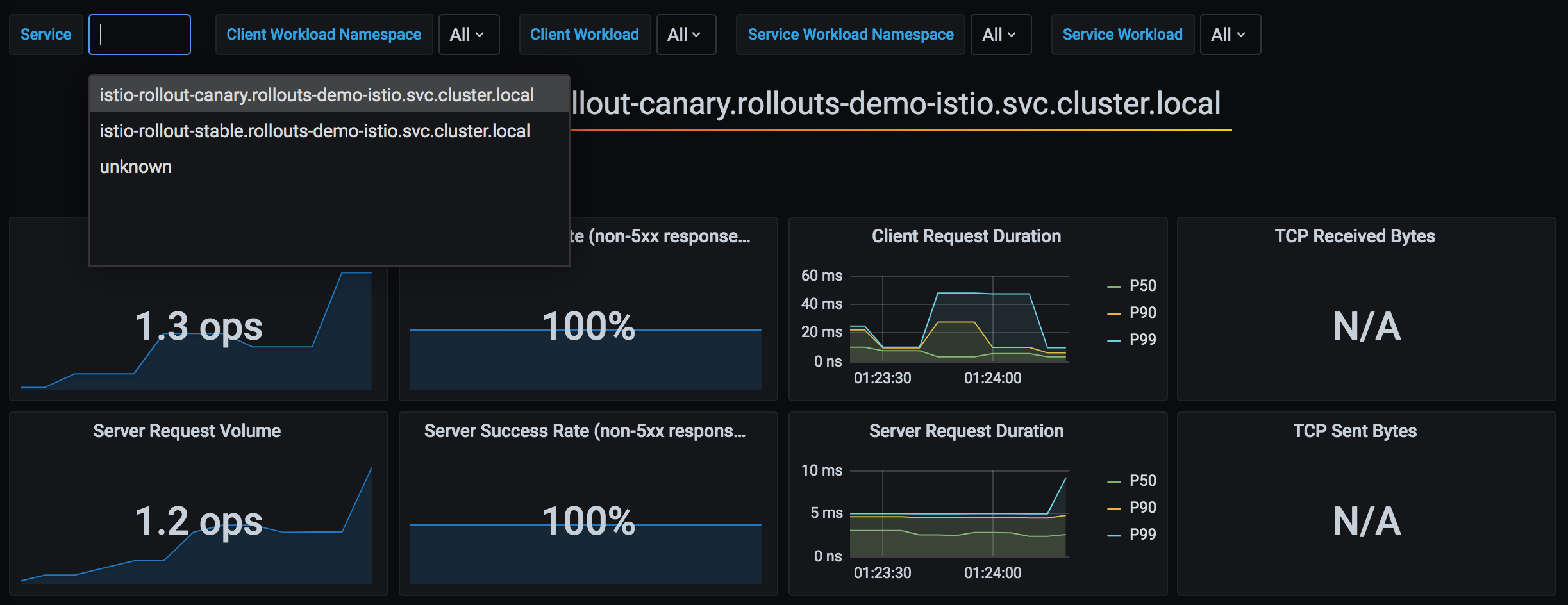
Argo Rollouts uses Prometheus metrics collected by Istio to automatically determine the success of Canary deployments. Here is the integration architecture of Argo Rollouts and Istio metrics:
Source: Argo Rollouts Official Documentation
1. Basic Analysis Integration
apiVersion: argoproj.io/v1alpha1
kind: Rollout
spec:
  strategy:
    canary:
      analysis:
        templates:
        - templateName: success-rate
        args:
        - name: service-name
          value: test
      steps:
      - setWeight: 10
      - pause: {duration: 5m}
      - analysis:  # ← Analysis runs at this step
          templates:
          - templateName: success-rate
          args:
          - name: service-name
            value: test
      - setWeight: 50
2. Background Analysis
spec:
  strategy:
    canary:
      analysis:
        templates:
        - templateName: success-rate
        startingStep: 2  # Runs continuously in background from step 2
        args:
        - name: service-name
          value: test
      steps:
      - setWeight: 10
      - pause: {duration: 2m}
      - setWeight: 30
      - pause: {duration: 2m}
- setWeight: 50Behavior:
3. Composite Metric Analysis
apiVersion: argoproj.io/v1alpha1
kind: AnalysisTemplate
metadata:
  name: comprehensive-analysis
spec:
  args:
  - name: service-name
  - name: canary-hash
  metrics:
  # Metric 1: Success rate
  - name: success-rate
    interval: 30s
    count: 5
    successCondition: result >= 0.95
    failureLimit: 2
    provider:
      prometheus:
        address: http://prometheus.istio-system:9090
        query: |
          sum(rate(
            istio_requests_total{
              destination_service_name="{{args.service-name}}",
              destination_workload_label_rollouts_pod_template_hash="{{args.canary-hash}}",
              response_code!~"5.*"
            }[2m]
          ))
          /
          sum(rate(
            istio_requests_total{
              destination_service_name="{{args.service-name}}",
              destination_workload_label_rollouts_pod_template_hash="{{args.canary-hash}}"
            }[2m]
          ))

  # Metric 2: P95 Latency
  - name: latency-p95
    interval: 30s
    count: 5
    successCondition: result <= 0.5  # 500ms or less
    failureLimit: 2
    provider:
      prometheus:
        address: http://prometheus.istio-system:9090
        query: |
          histogram_quantile(0.95,
            sum(rate(
              istio_request_duration_milliseconds_bucket{
                destination_service_name="{{args.service-name}}",
                destination_workload_label_rollouts_pod_template_hash="{{args.canary-hash}}"
              }[2m]
            )) by (le)
          ) / 1000

  # Metric 3: Error rate
  - name: error-rate
    interval: 30s
    count: 5
    successCondition: result <= 0.01  # 1% or less
    failureLimit: 2
    provider:
      prometheus:
        address: http://prometheus.istio-system:9090
        query: |
          sum(rate(
            istio_requests_total{
              destination_service_name="{{args.service-name}}",
              destination_workload_label_rollouts_pod_template_hash="{{args.canary-hash}}",
              response_code=~"5.*"
            }[2m]
          ))
          /
          sum(rate(
            istio_requests_total{
              destination_service_name="{{args.service-name}}",
              destination_workload_label_rollouts_pod_template_hash="{{args.canary-hash}}"
            }[2m]
          ))
4. Pre/Post Analysis
spec:
  strategy:
    canary:
      # Pre-analysis (before deployment)
      analysis:
        templates:
        - templateName: pre-deployment-check
        args:
        - name: service-name
          value: test

      steps:
      - setWeight: 10
      - pause: {duration: 5m}
      - setWeight: 50

      # Post-analysis (after deployment)
      analysis:
        templates:
        - templateName: post-deployment-check
        args:
        - name: service-name
          value: test
Advanced Deployment Patterns
1. Blue/Green Deployment
apiVersion: argoproj.io/v1alpha1
kind: Rollout
metadata:
  name: test
spec:
  replicas: 3
  strategy:
    blueGreen:
      # Preview/Active Service specification
      previewService: test-preview
      activeService: test-active

      # Auto promotion (default: manual)
      autoPromotionEnabled: false

      # Pre-analysis
      prePromotionAnalysis:
        templates:
        - templateName: smoke-test

      # Post-analysis
      postPromotionAnalysis:
        templates:
        - templateName: comprehensive-analysis
        args:
        - name: service-name
          value: test

      # Previous version retention time
      scaleDownDelaySeconds: 600  # Delete previous version after 10 minutes
VirtualService (Blue/Green):
apiVersion: networking.istio.io/v1
kind: VirtualService
metadata:
  name: test
spec:
  http:
  - route:
    - destination:
        host: test-active  # ← Auto switched by Rollout
      weight: 100
Operation flow:
2. Canary with Experiment
Use case: Test multiple versions simultaneously during Canary deployment
apiVersion: argoproj.io/v1alpha1
kind: Rollout
spec:
  strategy:
    canary:
      steps:
      - setWeight: 10
      - pause: {duration: 2m}

      # Experiment execution
      - experiment:
          duration: 10m
          templates:
          - name: canary-v2
            specRef: canary
            weight: 10
          - name: experimental-v3
            specRef: experimental
            weight: 5
          analyses:
          - name: compare-versions
            templateName: version-comparison

      - setWeight: 50
      - pause: {duration: 5m}
3. Progressive Rollout
spec:
  strategy:
    canary:
      # Very slow rollout
      steps:
      - setWeight: 1    # Start from 1%
      - pause: {duration: 1h}
      - setWeight: 5
      - pause: {duration: 1h}
      - setWeight: 10
      - pause: {duration: 2h}
      - setWeight: 25
      - pause: {duration: 4h}
      - setWeight: 50
      - pause: {duration: 8h}
      - setWeight: 75
      - pause: {duration: 8h}
      # 100% (total 24+ hours)

      # Background Analysis
      analysis:
        templates:
        - templateName: comprehensive-analysis
        startingStep: 1
Troubleshooting
1. VirtualService Not Updating
Symptom:
kubectl argo rollouts get rollout test
# Status: ॥ Paused
# Message: CannotUpdateVirtualService: ...Cause:
- VirtualService doesn't exist
- Route name is incorrect
- Istio is not installed
Solution:
# 1. Check VirtualService
kubectl get virtualservice test -o yaml

# 2. Check route name
kubectl get virtualservice test -o jsonpath='{.spec.http[*].name}'

# 3. Check Rollout configuration
kubectl get rollout test -o jsonpath='{.spec.strategy.canary.trafficRouting.istio}'
2. Canary Pod Not Receiving Traffic
Symptom: No traffic to Canary pod even though setWeight: 10
Cause:
- DestinationRule subset incorrectly configured
- Service selector not finding pods
Verification:
# 1. Check pod labels
kubectl get pods -l app=test --show-labels

# Output:
# NAME                    LABELS
# test-abc123-xyz         app=test,rollouts-pod-template-hash=abc123
# test-def456-xyz         app=test,rollouts-pod-template-hash=def456

# 2. Check if Canary Service selects correct pods
kubectl get endpoints test-canary

# 3. Check VirtualService → DestinationRule → Service path
istioctl proxy-config clusters <pod-name> | grep test
3. Analysis Failure
Symptom:
kubectl get analysisrun
# NAME                       STATUS   AGE
# test-abc123-1 Failed 5mVerification:
# Check Analysis logs
kubectl describe analysisrun test-abc123-1

# Test Prometheus query
kubectl port-forward -n istio-system svc/prometheus 9090:9090

# Run query in browser
# http://localhost:9090/graph
Common issues:
- Prometheus address is incorrect
- Metric doesn't exist (insufficient traffic)
- Query syntax error
4. Rollback Not Working
Symptom: kubectl argo rollouts abort not working
Cause: All steps already completed (100%)
Solution:
# 1. Check current status
kubectl argo rollouts status test

# 2. Revert to previous version
kubectl argo rollouts undo test

# Or to specific revision
kubectl argo rollouts undo test --to-revision=2
5. Debugging Commands
# 1. Rollout status (detailed)
kubectl argo rollouts get rollout test

# 2. Rollout events
kubectl describe rollout test

# 3. Check ReplicaSet
kubectl get replicaset -l app=test

# 4. Check VirtualService weight
kubectl get virtualservice test -o yaml | grep -A 10 "name: primary"

# 5. Check Istio proxy configuration
istioctl proxy-config route <pod-name> --name 8080

# 6. Check AnalysisRun
kubectl get analysisrun -l rollout=test

# 7. Rollout Controller logs
kubectl logs -n argo-rollouts deployment/argo-rollouts
Best Practices
1. Deployment Step Design
Recommended steps:
steps:
- setWeight: 5      # Very small start
  pause: {duration: 5m}
- setWeight: 10     # Small-scale verification
  pause: {duration: 10m}
- setWeight: 25     # Meaningful traffic
  pause: {duration: 15m}
- setWeight: 50     # Half transition
  pause: {duration: 30m}
- setWeight: 75     # Most transition
  pause: {duration: 30m}
# 100% auto completePrinciples:
- ✅ Start with small steps (5-10%)
- ✅ Sufficient verification time at each step
- ✅ Longer wait time after 50% (most of traffic)
- ✅ Transition last 20-30% quickly
2. Analysis Configuration
metrics:
- name: success-rate
  interval: 30s        # Not too short (minimum 30s)
  count: 5             # Sufficient samples (minimum 5)
  successCondition: result >= 0.95  # Reasonable threshold
failureLimit: 2 # Don't fail immediatelyPrinciples:
- ✅ Multiple metric combinations (success rate + latency + error rate)
- ✅ Sufficient measurement time (minimum 2-3 minutes)
- ✅ Allow temporary errors with
failureLimit - ✅ Monitor entire deployment with background Analysis
3. Service Configuration
# ❌ Wrong example: version label in selector
apiVersion: v1
kind: Service
metadata:
  name: test-stable
spec:
  selector:
    app: test
    version: v1  # ← Wrong! Should use hash managed by Rollout

---
# ✅ Correct example: Rollout manages hash
apiVersion: v1
kind: Service
metadata:
  name: test-stable
spec:
  selector:
    app: test
    # rollouts-pod-template-hash is auto-added
4. Resource Management
spec:
  revisionHistoryLimit: 2  # Minimum 2 (for rollback)
  progressDeadlineSeconds: 600  # 10 minute timeout

  template:
    spec:
      containers:
      - name: app
        resources:
          requests:
            cpu: 100m
            memory: 128Mi
          limits:
            cpu: 200m      # 2x of request
            memory: 256Mi  # 2x of request
5. HA Configuration
spec:
  replicas: 3  # Minimum 3 (1 per AZ)

  strategy:
    canary:
      maxSurge: 1         # Maximum 1 extra pod
maxUnavailable: 0 # Maintain minimum replicasPodDisruptionBudget:
apiVersion: policy/v1
kind: PodDisruptionBudget
metadata:
  name: test-pdb
spec:
  minAvailable: 2  # Maintain minimum 2
  selector:
    matchLabels:
      app: test
6. Deployment Checklist
Before deployment:
- [ ] Stable/Canary Service created
- [ ] VirtualService and DestinationRule created
- [ ] AnalysisTemplate defined
- [ ] Prometheus metric collection verified
- [ ] Rollout steps reviewed
During deployment:
- [ ] Monitor with
kubectl argo rollouts get rollout --watch - [ ] Verify Canary pod traffic reception
- [ ] Confirm Analysis metrics are normal
- [ ] Monitor error logs
After deployment:
- [ ] Confirm 100% transition
- [ ] Verify previous ReplicaSet deletion
- [ ] Final metric verification
7. Gradual Adoption
Step 1: Basic Canary
steps:
- setWeight: 10
- pause: {}  # Manual approval
Step 2: Add automatic Analysis
steps:
- setWeight: 10
- pause: {duration: 5m}
- analysis:
    templates:
    - templateName: success-rate
Step 3: Background Analysis
analysis:
  templates:
  - templateName: success-rate
  startingStep: 1
Step 4: Composite metrics
analysis:
  templates:
  - templateName: comprehensive-analysis  # Success rate + latency + error rate