高级基础设施
支持版本: Terraform >= 1.5, AWS Provider >= 5.40, EKS >= 1.29 最后更新: February 19, 2026
< 上一篇:Terraform 3 层基础设施 | 目录 | 下一篇:CI Pipelines >
概述
本指南介绍用于运行生产级 EKS workload 的高级基础设施模式,重点包括高可用性和零停机部署。Blue/Green cluster 架构支持无缝 cluster 升级、灾难恢复,以及跨多个 Availability Zone(可用区)的流量管理。
主要主题:
- Blue/Green 双 cluster 架构
- 用于流量分发的 NLB 加权 target group
- 使用 Route53 进行基于 DNS 的流量切换
- 用于有状态 workload 的 zone-aware 数据放置
- 使用 CloudWatch 和 Lambda 实现自动 failover
1. Blue/Green 架构概述
为什么使用 Blue/Green Cluster?
传统的原地 cluster 升级存在显著风险:
- control plane 更新期间 workload 中断
- Node drain 可能导致容量问题
- 出现问题时 rollback 复杂
- 维护窗口较长
Blue/Green 架构通过维护两个独立 cluster 来消除这些风险:
| 方面 | 原地升级 | Blue/Green |
|---|---|---|
| 停机风险 | 中高 | 接近零 |
| Rollback 时间 | 30-60 分钟 | 秒级(DNS/NLB) |
| 测试 | 有限 | 完整生产流量 |
| 成本 | 单 cluster | 2x cluster(过渡期间) |
架构图
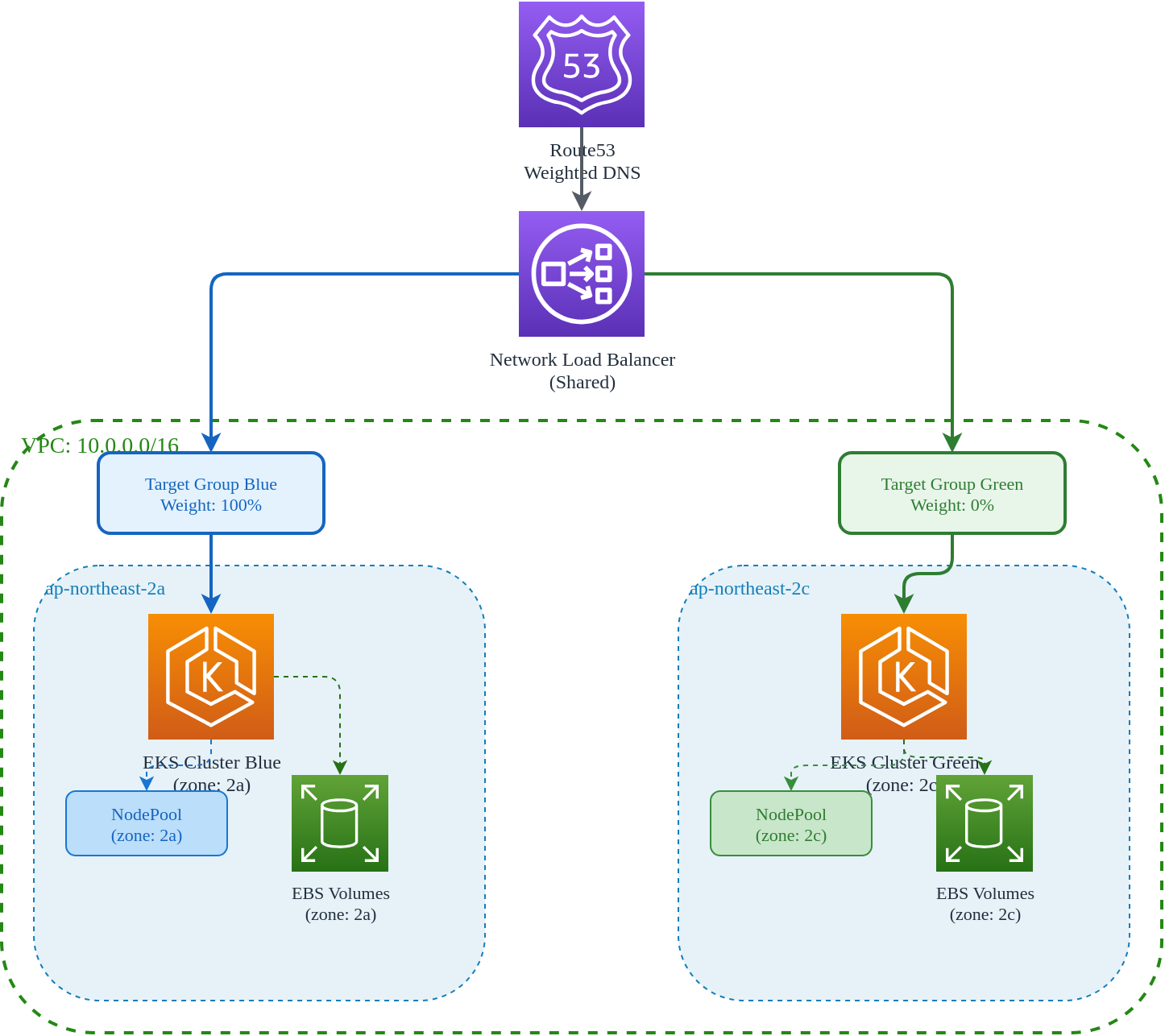
单 Zone 设计依据
每个 cluster 在单个 Availability Zone 中运行:
优势:
- 数据本地性:Pod 始终调度到靠近其 storage volume 的位置
- 成本优化:跨 AZ 数据传输成本为零
- 故障隔离:AZ 故障只影响一个 cluster
- 简化网络:无需复杂的 multi-AZ load balancing
权衡:
- 单 AZ 风险更高(通过 Blue/Green failover 缓解)
- 需要针对每个 zone 进行谨慎的容量规划
Zone 分配
| Cluster | Availability Zone | 用途 |
|---|---|---|
| Blue | ap-northeast-2a | 主生产环境 |
| Green | ap-northeast-2c | 次要/升级目标 |
2. NLB 加权 Target Group
Network Load Balancer 配置
共享 NLB 根据 target group 权重在 Blue 和 Green cluster 之间分发流量。
# nlb/main.tf

terraform {
  required_version = ">= 1.5.0"
  required_providers {
    aws = {
      source  = "hashicorp/aws"
      version = ">= 5.40.0"
    }
  }
}

provider "aws" {
  region = var.region

  default_tags {
    tags = local.tags
  }
}

locals {
  name_prefix = "${var.project_name}-${var.environment}"

  tags = {
    Environment = var.environment
    Project     = var.project_name
    ManagedBy   = "terraform"
    Component   = "nlb"
  }
}

# Reference network layer for VPC and subnets
data "terraform_remote_state" "network" {
  backend = "s3"

  config = {
    bucket = "${var.project_name}-${var.environment}-tfstate"
    key    = "network/terraform.tfstate"
    region = var.region
  }
}

#------------------------------------------------------------------------------
# Network Load Balancer
#------------------------------------------------------------------------------

resource "aws_lb" "main" {
  name               = "${local.name_prefix}-nlb"
  internal           = false
  load_balancer_type = "network"

  # Deploy in both AZs for high availability
  subnets = data.terraform_remote_state.network.outputs.public_subnet_ids

  enable_deletion_protection = var.environment == "prod"
  enable_cross_zone_load_balancing = true

  tags = merge(local.tags, {
    Name = "${local.name_prefix}-nlb"
  })
}

#------------------------------------------------------------------------------
# Target Groups - Blue Cluster
#------------------------------------------------------------------------------

resource "aws_lb_target_group" "blue_http" {
  name        = "${local.name_prefix}-blue-http"
  port        = 80
  protocol    = "TCP"
  vpc_id      = data.terraform_remote_state.network.outputs.vpc_id
  target_type = "ip"

  health_check {
    enabled             = true
    protocol            = "HTTP"
    port                = "traffic-port"
    path                = "/healthz"
    healthy_threshold   = 2
    unhealthy_threshold = 2
    interval            = 10
    timeout             = 5
  }

  # Deregistration delay for graceful shutdown
  deregistration_delay = 30

  tags = merge(local.tags, {
    Name    = "${local.name_prefix}-blue-http"
    Cluster = "blue"
  })
}

resource "aws_lb_target_group" "blue_https" {
  name        = "${local.name_prefix}-blue-https"
  port        = 443
  protocol    = "TCP"
  vpc_id      = data.terraform_remote_state.network.outputs.vpc_id
  target_type = "ip"

  health_check {
    enabled             = true
    protocol            = "HTTPS"
    port                = "traffic-port"
    path                = "/healthz"
    healthy_threshold   = 2
    unhealthy_threshold = 2
    interval            = 10
    timeout             = 5
  }

  deregistration_delay = 30

  tags = merge(local.tags, {
    Name    = "${local.name_prefix}-blue-https"
    Cluster = "blue"
  })
}

#------------------------------------------------------------------------------
# Target Groups - Green Cluster
#------------------------------------------------------------------------------

resource "aws_lb_target_group" "green_http" {
  name        = "${local.name_prefix}-green-http"
  port        = 80
  protocol    = "TCP"
  vpc_id      = data.terraform_remote_state.network.outputs.vpc_id
  target_type = "ip"

  health_check {
    enabled             = true
    protocol            = "HTTP"
    port                = "traffic-port"
    path                = "/healthz"
    healthy_threshold   = 2
    unhealthy_threshold = 2
    interval            = 10
    timeout             = 5
  }

  deregistration_delay = 30

  tags = merge(local.tags, {
    Name    = "${local.name_prefix}-green-http"
    Cluster = "green"
  })
}

resource "aws_lb_target_group" "green_https" {
  name        = "${local.name_prefix}-green-https"
  port        = 443
  protocol    = "TCP"
  vpc_id      = data.terraform_remote_state.network.outputs.vpc_id
  target_type = "ip"

  health_check {
    enabled             = true
    protocol            = "HTTPS"
    port                = "traffic-port"
    path                = "/healthz"
    healthy_threshold   = 2
    unhealthy_threshold = 2
    interval            = 10
    timeout             = 5
  }

  deregistration_delay = 30

  tags = merge(local.tags, {
    Name    = "${local.name_prefix}-green-https"
    Cluster = "green"
  })
}

#------------------------------------------------------------------------------
# Listeners with Weighted Target Groups
#------------------------------------------------------------------------------

resource "aws_lb_listener" "http" {
  load_balancer_arn = aws_lb.main.arn
  port              = 80
  protocol          = "TCP"

  default_action {
    type = "forward"

    forward {
      target_group {
        arn    = aws_lb_target_group.blue_http.arn
        weight = var.blue_weight
      }
      target_group {
        arn    = aws_lb_target_group.green_http.arn
        weight = var.green_weight
      }

      stickiness {
        enabled  = true
        duration = 3600  # 1 hour session stickiness
      }
    }
  }

  tags = merge(local.tags, {
    Name = "${local.name_prefix}-http-listener"
  })
}

resource "aws_lb_listener" "https" {
  load_balancer_arn = aws_lb.main.arn
  port              = 443
  protocol          = "TCP"

  default_action {
    type = "forward"

    forward {
      target_group {
        arn    = aws_lb_target_group.blue_https.arn
        weight = var.blue_weight
      }
      target_group {
        arn    = aws_lb_target_group.green_https.arn
        weight = var.green_weight
      }

      stickiness {
        enabled  = true
        duration = 3600
      }
    }
  }

  tags = merge(local.tags, {
    Name = "${local.name_prefix}-https-listener"
  })
}
变量
# nlb/variables.tf

variable "region" {
  description = "AWS region"
  type        = string
  default     = "ap-northeast-2"
}

variable "environment" {
  description = "Environment name"
  type        = string
  default     = "prod"
}

variable "project_name" {
  description = "Project name"
  type        = string
  default     = "eks-platform"
}

variable "blue_weight" {
  description = "Traffic weight for blue cluster (0-100)"
  type        = number
  default     = 100

  validation {
    condition     = var.blue_weight >= 0 && var.blue_weight <= 100
    error_message = "Blue weight must be between 0 and 100."
  }
}

variable "green_weight" {
  description = "Traffic weight for green cluster (0-100)"
  type        = number
  default     = 0

  validation {
    condition     = var.green_weight >= 0 && var.green_weight <= 100
    error_message = "Green weight must be between 0 and 100."
  }
}
输出
# nlb/outputs.tf

output "nlb_arn" {
  description = "NLB ARN"
  value       = aws_lb.main.arn
}

output "nlb_dns_name" {
  description = "NLB DNS name"
  value       = aws_lb.main.dns_name
}

output "nlb_zone_id" {
  description = "NLB hosted zone ID"
  value       = aws_lb.main.zone_id
}

output "blue_http_target_group_arn" {
  description = "Blue HTTP target group ARN"
  value       = aws_lb_target_group.blue_http.arn
}

output "blue_https_target_group_arn" {
  description = "Blue HTTPS target group ARN"
  value       = aws_lb_target_group.blue_https.arn
}

output "green_http_target_group_arn" {
  description = "Green HTTP target group ARN"
  value       = aws_lb_target_group.green_http.arn
}

output "green_https_target_group_arn" {
  description = "Green HTTPS target group ARN"
  value       = aws_lb_target_group.green_https.arn
}

output "current_weights" {
  description = "Current traffic weights"
  value = {
    blue  = var.blue_weight
    green = var.green_weight
  }
}
部署的权重调整
针对 canary 风格部署逐步调整权重:
# terraform.tfvars examples for different deployment stages

# Stage 1: All traffic to Blue (default)
blue_weight  = 100
green_weight = 0

# Stage 2: Canary - 10% to Green
blue_weight  = 90
green_weight = 10

# Stage 3: 50/50 split
blue_weight  = 50
green_weight = 50

# Stage 4: All traffic to Green
blue_weight  = 0
green_weight = 100
应用权重变更:
# Update weights
terraform apply -var="blue_weight=90" -var="green_weight=10"

# Verify listener configuration
aws elbv2 describe-listeners \
  --load-balancer-arn $(terraform output -raw nlb_arn) \
  --query 'Listeners[*].DefaultActions[*].ForwardConfig.TargetGroups'
3. 基于 DNS 的流量切换
Route53 加权路由
如需更细粒度的控制和全局路由,可在 NLB 权重之外或替代 NLB 权重使用 Route53 weighted record。
# dns/main.tf

terraform {
  required_version = ">= 1.5.0"
  required_providers {
    aws = {
      source  = "hashicorp/aws"
      version = ">= 5.40.0"
    }
  }
}

provider "aws" {
  region = var.region
}

locals {
  name_prefix = "${var.project_name}-${var.environment}"
}

# Reference NLB outputs
data "terraform_remote_state" "nlb" {
  backend = "s3"

  config = {
    bucket = "${var.project_name}-${var.environment}-tfstate"
    key    = "nlb/terraform.tfstate"
    region = var.region
  }
}

#------------------------------------------------------------------------------
# Route53 Hosted Zone
#------------------------------------------------------------------------------

data "aws_route53_zone" "main" {
  name         = var.domain_name
  private_zone = false
}

#------------------------------------------------------------------------------
# Health Checks
#------------------------------------------------------------------------------

resource "aws_route53_health_check" "blue" {
  fqdn              = "blue.${var.domain_name}"
  port              = 443
  type              = "HTTPS"
  resource_path     = "/healthz"
  failure_threshold = 3
  request_interval  = 10

  tags = {
    Name        = "${local.name_prefix}-blue-health"
    Environment = var.environment
    Cluster     = "blue"
  }
}

resource "aws_route53_health_check" "green" {
  fqdn              = "green.${var.domain_name}"
  port              = 443
  type              = "HTTPS"
  resource_path     = "/healthz"
  failure_threshold = 3
  request_interval  = 10

  tags = {
    Name        = "${local.name_prefix}-green-health"
    Environment = var.environment
    Cluster     = "green"
  }
}

#------------------------------------------------------------------------------
# Weighted DNS Records
#------------------------------------------------------------------------------

# Primary record - Blue cluster
resource "aws_route53_record" "app_blue" {
  zone_id = data.aws_route53_zone.main.zone_id
  name    = "app.${var.domain_name}"
  type    = "A"

  set_identifier = "blue"
  weighted_routing_policy {
    weight = var.blue_dns_weight
  }

  alias {
    name                   = data.terraform_remote_state.nlb.outputs.nlb_dns_name
    zone_id                = data.terraform_remote_state.nlb.outputs.nlb_zone_id
    evaluate_target_health = true
  }

  health_check_id = aws_route53_health_check.blue.id
}

# Secondary record - Green cluster
resource "aws_route53_record" "app_green" {
  zone_id = data.aws_route53_zone.main.zone_id
  name    = "app.${var.domain_name}"
  type    = "A"

  set_identifier = "green"
  weighted_routing_policy {
    weight = var.green_dns_weight
  }

  alias {
    name                   = data.terraform_remote_state.nlb.outputs.nlb_dns_name
    zone_id                = data.terraform_remote_state.nlb.outputs.nlb_zone_id
    evaluate_target_health = true
  }

  health_check_id = aws_route53_health_check.green.id
}

#------------------------------------------------------------------------------
# Direct Cluster Access Records
#------------------------------------------------------------------------------

# Blue cluster direct access
resource "aws_route53_record" "blue_direct" {
  zone_id = data.aws_route53_zone.main.zone_id
  name    = "blue.${var.domain_name}"
  type    = "A"

  alias {
    name                   = data.terraform_remote_state.nlb.outputs.nlb_dns_name
    zone_id                = data.terraform_remote_state.nlb.outputs.nlb_zone_id
    evaluate_target_health = true
  }
}

# Green cluster direct access
resource "aws_route53_record" "green_direct" {
  zone_id = data.aws_route53_zone.main.zone_id
  name    = "green.${var.domain_name}"
  type    = "A"

  alias {
    name                   = data.terraform_remote_state.nlb.outputs.nlb_dns_name
    zone_id                = data.terraform_remote_state.nlb.outputs.nlb_zone_id
    evaluate_target_health = true
  }
}

#------------------------------------------------------------------------------
# Failover Configuration
#------------------------------------------------------------------------------

# Primary failover record
resource "aws_route53_record" "app_primary" {
  zone_id = data.aws_route53_zone.main.zone_id
  name    = "failover.${var.domain_name}"
  type    = "A"

  set_identifier = "primary"
  failover_routing_policy {
    type = "PRIMARY"
  }

  alias {
    name                   = data.terraform_remote_state.nlb.outputs.nlb_dns_name
    zone_id                = data.terraform_remote_state.nlb.outputs.nlb_zone_id
    evaluate_target_health = true
  }

  health_check_id = aws_route53_health_check.blue.id
}

# Secondary failover record
resource "aws_route53_record" "app_secondary" {
  zone_id = data.aws_route53_zone.main.zone_id
  name    = "failover.${var.domain_name}"
  type    = "A"

  set_identifier = "secondary"
  failover_routing_policy {
    type = "SECONDARY"
  }

  alias {
    name                   = data.terraform_remote_state.nlb.outputs.nlb_dns_name
    zone_id                = data.terraform_remote_state.nlb.outputs.nlb_zone_id
    evaluate_target_health = true
  }

  health_check_id = aws_route53_health_check.green.id
}
变量
# dns/variables.tf

variable "region" {
  description = "AWS region"
  type        = string
  default     = "ap-northeast-2"
}

variable "environment" {
  description = "Environment name"
  type        = string
  default     = "prod"
}

variable "project_name" {
  description = "Project name"
  type        = string
  default     = "eks-platform"
}

variable "domain_name" {
  description = "Domain name for Route53 records"
  type        = string
}

variable "blue_dns_weight" {
  description = "DNS weight for blue cluster (0-255)"
  type        = number
  default     = 255

  validation {
    condition     = var.blue_dns_weight >= 0 && var.blue_dns_weight <= 255
    error_message = "DNS weight must be between 0 and 255."
  }
}

variable "green_dns_weight" {
  description = "DNS weight for green cluster (0-255)"
  type        = number
  default     = 0

  validation {
    condition     = var.green_dns_weight >= 0 && var.green_dns_weight <= 255
    error_message = "DNS weight must be between 0 and 255."
  }
}
TTL 策略
DNS TTL 会影响权重变更时流量切换的速度:
| TTL 值 | 切换时间 | 使用场景 |
|---|---|---|
| 60 秒 | ~2-3 分钟 | 快速 failover |
| 300 秒 | ~10-15 分钟 | 正常运维 |
| 3600 秒 | ~1-2 小时 | 稳定路由 |
对于 Route53 Alias record,TTL 继承自目标(NLB)。如需显式控制 TTL,请使用带 IP 地址的非 alias record。
4. Data Node 放置
Zone Affinity 概念
对于有状态 workload,Pod 必须调度到与其 persistent volume 相同的 zone。EKS Auto Mode 会自动处理其中的大部分工作,但理解这些概念有助于故障排查。
NodePool Zone 配置
实际的 NodePool YAML 由 ArgoCD GitOps 管理(参见 GitOps Pipeline 配置),但以下是关键概念:
# Conceptual NodePool for Blue cluster (zone: ap-northeast-2a)
# Actual resource managed by ArgoCD, not Terraform
apiVersion: karpenter.sh/v1
kind: NodePool
metadata:
  name: blue-data-nodes
spec:
  template:
    spec:
      requirements:
        - key: topology.kubernetes.io/zone
          operator: In
          values:
            - ap-northeast-2a
        - key: karpenter.sh/capacity-type
          operator: In
          values:
            - on-demand
        - key: node.kubernetes.io/instance-type
          operator: In
          values:
            - r6i.xlarge
            - r6i.2xlarge
            - r6i.4xlarge
      nodeClassRef:
        group: eks.amazonaws.com
        kind: NodeClass
        name: default
  limits:
    cpu: 1000
    memory: 4000Gi
  disruption:
    consolidationPolicy: WhenEmpty
    consolidateAfter: 30m
TopologySpreadConstraints
确保 workload 在单 zone cluster 内正确分散:
# Example Deployment with topology constraints
apiVersion: apps/v1
kind: Deployment
metadata:
  name: api-server
spec:
  replicas: 3
  selector:
    matchLabels:
      app: api-server
  template:
    metadata:
      labels:
        app: api-server
    spec:
      topologySpreadConstraints:
        # Spread across nodes within the zone
        - maxSkew: 1
          topologyKey: kubernetes.io/hostname
          whenUnsatisfiable: DoNotSchedule
          labelSelector:
            matchLabels:
              app: api-server
      containers:
        - name: api-server
          image: myapp/api-server:latest
          resources:
            requests:
              cpu: 500m
              memory: 512Mi
用于共置的 Pod Affinity
将相关 Pod 共置以降低延迟:
# Cache pods should be near API pods
apiVersion: apps/v1
kind: Deployment
metadata:
  name: cache
spec:
  replicas: 3
  selector:
    matchLabels:
      app: cache
  template:
    metadata:
      labels:
        app: cache
    spec:
      affinity:
        podAffinity:
          preferredDuringSchedulingIgnoredDuringExecution:
            - weight: 100
              podAffinityTerm:
                labelSelector:
                  matchLabels:
                    app: api-server
                topologyKey: kubernetes.io/hostname
        podAntiAffinity:
          requiredDuringSchedulingIgnoredDuringExecution:
            - labelSelector:
                matchLabels:
                  app: cache
              topologyKey: kubernetes.io/hostname
      containers:
        - name: redis
          image: redis:7-alpine
带 Zone-Specific Storage 的 StatefulSet
适用于数据库和其他有状态 workload:
# PostgreSQL StatefulSet with zone-locked storage
apiVersion: apps/v1
kind: StatefulSet
metadata:
  name: postgresql
spec:
  serviceName: postgresql
  replicas: 1
  selector:
    matchLabels:
      app: postgresql
  template:
    metadata:
      labels:
        app: postgresql
    spec:
      # Node selector ensures pod schedules in correct zone
      nodeSelector:
        topology.kubernetes.io/zone: ap-northeast-2a
      containers:
        - name: postgresql
          image: postgres:15
          ports:
            - containerPort: 5432
          volumeMounts:
            - name: data
              mountPath: /var/lib/postgresql/data
          env:
            - name: POSTGRES_DB
              value: myapp
            - name: PGDATA
              value: /var/lib/postgresql/data/pgdata
  volumeClaimTemplates:
    - metadata:
        name: data
      spec:
        accessModes:
          - ReadWriteOnce
        storageClassName: ebs-sc  # Auto Mode managed
        resources:
          requests:
            storage: 100Gi
用于 Zone-Specific Provisioning 的 Storage Class
# StorageClass that provisions in specific zone
apiVersion: storage.k8s.io/v1
kind: StorageClass
metadata:
  name: ebs-sc-zone-a
provisioner: ebs.csi.aws.com
parameters:
  type: gp3
  iops: "3000"
  throughput: "125"
  encrypted: "true"
allowedTopologies:
  - matchLabelExpressions:
      - key: topology.kubernetes.io/zone
        values:
          - ap-northeast-2a
volumeBindingMode: WaitForFirstConsumer
reclaimPolicy: Retain
5. Failover 自动化
CloudWatch Alarm
监控 cluster 健康状况并触发自动 failover:
# failover/cloudwatch.tf

resource "aws_cloudwatch_metric_alarm" "blue_unhealthy" {
  alarm_name          = "${local.name_prefix}-blue-unhealthy"
  comparison_operator = "LessThanThreshold"
  evaluation_periods  = 2
  metric_name         = "HealthyHostCount"
  namespace           = "AWS/NetworkELB"
  period              = 60
  statistic           = "Average"
  threshold           = 1
  alarm_description   = "Blue cluster has no healthy targets"

  dimensions = {
    TargetGroup  = aws_lb_target_group.blue_http.arn_suffix
    LoadBalancer = aws_lb.main.arn_suffix
  }

  alarm_actions = [
    aws_sns_topic.alerts.arn,
    aws_lambda_function.failover.arn
  ]

  ok_actions = [
    aws_sns_topic.alerts.arn
  ]

  tags = local.tags
}

resource "aws_cloudwatch_metric_alarm" "green_unhealthy" {
  alarm_name          = "${local.name_prefix}-green-unhealthy"
  comparison_operator = "LessThanThreshold"
  evaluation_periods  = 2
  metric_name         = "HealthyHostCount"
  namespace           = "AWS/NetworkELB"
  period              = 60
  statistic           = "Average"
  threshold           = 1
  alarm_description   = "Green cluster has no healthy targets"

  dimensions = {
    TargetGroup  = aws_lb_target_group.green_http.arn_suffix
    LoadBalancer = aws_lb.main.arn_suffix
  }

  alarm_actions = [
    aws_sns_topic.alerts.arn
  ]

  tags = local.tags
}

# SNS Topic for alerts
resource "aws_sns_topic" "alerts" {
  name = "${local.name_prefix}-failover-alerts"
  tags = local.tags
}

resource "aws_sns_topic_subscription" "email" {
  topic_arn = aws_sns_topic.alerts.arn
  protocol  = "email"
  endpoint  = var.alert_email
}
Lambda Failover Function
当 cluster 变为不健康时自动切换权重:
# failover/lambda.tf

resource "aws_lambda_function" "failover" {
  filename         = data.archive_file.failover.output_path
  function_name    = "${local.name_prefix}-failover"
  role             = aws_iam_role.failover_lambda.arn
  handler          = "index.handler"
  source_code_hash = data.archive_file.failover.output_base64sha256
  runtime          = "python3.11"
  timeout          = 30

  environment {
    variables = {
      LISTENER_ARN_HTTP  = aws_lb_listener.http.arn
      LISTENER_ARN_HTTPS = aws_lb_listener.https.arn
      BLUE_TG_ARN_HTTP   = aws_lb_target_group.blue_http.arn
      BLUE_TG_ARN_HTTPS  = aws_lb_target_group.blue_https.arn
      GREEN_TG_ARN_HTTP  = aws_lb_target_group.green_http.arn
      GREEN_TG_ARN_HTTPS = aws_lb_target_group.green_https.arn
      SNS_TOPIC_ARN      = aws_sns_topic.alerts.arn
    }
  }

  tags = local.tags
}

data "archive_file" "failover" {
  type        = "zip"
  source_file = "${path.module}/lambda/failover.py"
  output_path = "${path.module}/lambda/failover.zip"
}

# Lambda IAM Role
resource "aws_iam_role" "failover_lambda" {
  name = "${local.name_prefix}-failover-lambda-role"

  assume_role_policy = jsonencode({
    Version = "2012-10-17"
    Statement = [
      {
        Action = "sts:AssumeRole"
        Effect = "Allow"
        Principal = {
          Service = "lambda.amazonaws.com"
        }
      }
    ]
  })

  tags = local.tags
}

resource "aws_iam_role_policy" "failover_lambda" {
  name = "failover-policy"
  role = aws_iam_role.failover_lambda.id

  policy = jsonencode({
    Version = "2012-10-17"
    Statement = [
      {
        Effect = "Allow"
        Action = [
          "logs:CreateLogGroup",
          "logs:CreateLogStream",
          "logs:PutLogEvents"
        ]
        Resource = "arn:aws:logs:*:*:*"
      },
      {
        Effect = "Allow"
        Action = [
          "elasticloadbalancing:ModifyListener",
          "elasticloadbalancing:DescribeListeners",
          "elasticloadbalancing:DescribeTargetGroups",
          "elasticloadbalancing:DescribeTargetHealth"
        ]
        Resource = "*"
      },
      {
        Effect = "Allow"
        Action = [
          "sns:Publish"
        ]
        Resource = aws_sns_topic.alerts.arn
      }
    ]
  })
}

# CloudWatch permission to invoke Lambda
resource "aws_lambda_permission" "cloudwatch" {
  statement_id  = "AllowCloudWatch"
  action        = "lambda:InvokeFunction"
  function_name = aws_lambda_function.failover.function_name
  principal     = "lambda.alarms.cloudwatch.amazonaws.com"
  source_arn    = aws_cloudwatch_metric_alarm.blue_unhealthy.arn
}
Lambda Function 代码
# failover/lambda/failover.py
"""
Automated failover handler for Blue/Green EKS clusters.
Triggered by CloudWatch alarms when a cluster becomes unhealthy.
"""

import json
import os
import boto3
from datetime import datetime

elbv2 = boto3.client('elbv2')
sns = boto3.client('sns')

def handler(event, context):
    """
    Handle CloudWatch alarm and adjust NLB weights.
    """
    print(f"Event received: {json.dumps(event)}")

    # Parse CloudWatch alarm
    alarm_name = event.get('alarmName', '')
    alarm_state = event.get('newStateValue', '')

    if alarm_state != 'ALARM':
        print(f"Alarm state is {alarm_state}, not ALARM. No action needed.")
        return {'statusCode': 200, 'body': 'No action needed'}

    # Determine which cluster is unhealthy
    if 'blue' in alarm_name.lower():
        unhealthy_cluster = 'blue'
        healthy_cluster = 'green'
    elif 'green' in alarm_name.lower():
        unhealthy_cluster = 'green'
        healthy_cluster = 'blue'
    else:
        print(f"Cannot determine cluster from alarm name: {alarm_name}")
        return {'statusCode': 400, 'body': 'Unknown alarm'}

    print(f"Unhealthy cluster: {unhealthy_cluster}")
    print(f"Switching traffic to: {healthy_cluster}")

    # Get environment variables
    listener_arns = [
        os.environ['LISTENER_ARN_HTTP'],
        os.environ['LISTENER_ARN_HTTPS']
    ]

    target_groups = {
        'blue': {
            'http': os.environ['BLUE_TG_ARN_HTTP'],
            'https': os.environ['BLUE_TG_ARN_HTTPS']
        },
        'green': {
            'http': os.environ['GREEN_TG_ARN_HTTP'],
            'https': os.environ['GREEN_TG_ARN_HTTPS']
        }
    }

    # Check health of target cluster before switching
    healthy_tg_arn = target_groups[healthy_cluster]['http']
    health_response = elbv2.describe_target_health(TargetGroupArn=healthy_tg_arn)
    healthy_targets = [
        t for t in health_response['TargetHealthDescriptions']
        if t['TargetHealth']['State'] == 'healthy'
    ]

    if len(healthy_targets) == 0:
        message = f"CRITICAL: Both clusters unhealthy! Cannot failover."
        print(message)
        notify(message, 'CRITICAL')
        return {'statusCode': 500, 'body': message}

    # Update listener weights
    for listener_arn in listener_arns:
        protocol = 'https' if '443' in listener_arn else 'http'

        new_action = {
            'Type': 'forward',
            'ForwardConfig': {
                'TargetGroups': [
                    {
                        'TargetGroupArn': target_groups[unhealthy_cluster][protocol],
                        'Weight': 0
                    },
                    {
                        'TargetGroupArn': target_groups[healthy_cluster][protocol],
                        'Weight': 100
                    }
                ],
                'TargetGroupStickinessConfig': {
                    'Enabled': True,
                    'DurationSeconds': 3600
                }
            }
        }

        elbv2.modify_listener(
            ListenerArn=listener_arn,
            DefaultActions=[new_action]
        )

        print(f"Updated listener {listener_arn}")

    # Send notification
    message = (
        f"FAILOVER EXECUTED\n"
        f"Time: {datetime.utcnow().isoformat()}Z\n"
        f"Unhealthy Cluster: {unhealthy_cluster}\n"
        f"Traffic Redirected To: {healthy_cluster}\n"
        f"Healthy Targets in {healthy_cluster}: {len(healthy_targets)}\n"
        f"\n"
        f"Action Required: Investigate {unhealthy_cluster} cluster health."
    )
    notify(message, 'FAILOVER')

    return {
        'statusCode': 200,
        'body': f'Failover to {healthy_cluster} completed'
    }


def notify(message, severity):
    """Send notification via SNS."""
    sns_topic_arn = os.environ.get('SNS_TOPIC_ARN')
    if sns_topic_arn:
        sns.publish(
            TopicArn=sns_topic_arn,
            Subject=f'[{severity}] EKS Cluster Failover Alert',
            Message=message
        )
EventBridge Rule
按计划触发 failover 检查:
# failover/eventbridge.tf

resource "aws_cloudwatch_event_rule" "health_check" {
  name                = "${local.name_prefix}-health-check"
  description         = "Periodic health check for EKS clusters"
  schedule_expression = "rate(1 minute)"

  tags = local.tags
}

resource "aws_cloudwatch_event_target" "health_check" {
  rule      = aws_cloudwatch_event_rule.health_check.name
  target_id = "HealthCheckLambda"
  arn       = aws_lambda_function.health_check.arn
}

resource "aws_lambda_permission" "eventbridge" {
  statement_id  = "AllowEventBridge"
  action        = "lambda:InvokeFunction"
  function_name = aws_lambda_function.health_check.function_name
  principal     = "events.amazonaws.com"
  source_arn    = aws_cloudwatch_event_rule.health_check.arn
}
手动切换流程
用于计划维护或手动 failover:
#!/bin/bash
# manual-switchover.sh - Manually switch traffic between clusters

set -e

TARGET_CLUSTER="${1:-green}"  # Target cluster to receive traffic
REGION="${2:-ap-northeast-2}"

echo "=== Manual Cluster Switchover ==="
echo "Target: $TARGET_CLUSTER"
echo "Region: $REGION"
echo ""

# Validate target
if [[ "$TARGET_CLUSTER" != "blue" && "$TARGET_CLUSTER" != "green" ]]; then
  echo "ERROR: Target cluster must be 'blue' or 'green'"
  exit 1
fi

# Set weights based on target
if [ "$TARGET_CLUSTER" == "blue" ]; then
  BLUE_WEIGHT=100
  GREEN_WEIGHT=0
else
  BLUE_WEIGHT=0
  GREEN_WEIGHT=100
fi

echo "Setting weights: Blue=$BLUE_WEIGHT%, Green=$GREEN_WEIGHT%"
echo ""

# Confirm with user
read -p "Proceed with switchover? (yes/no): " CONFIRM
if [ "$CONFIRM" != "yes" ]; then
  echo "Aborted."
  exit 0
fi

# Apply Terraform changes
cd "$(dirname "$0")/../nlb"
terraform apply \
  -var="blue_weight=$BLUE_WEIGHT" \
  -var="green_weight=$GREEN_WEIGHT" \
  -auto-approve

echo ""
echo "=== Switchover Complete ==="
echo "Traffic is now routed to: $TARGET_CLUSTER"
echo ""
echo "Verify with:"
echo "  aws elbv2 describe-listeners --load-balancer-arn \$(terraform output -raw nlb_arn)"
渐进式 Rollback 脚本
#!/bin/bash
# gradual-rollback.sh - Gradually shift traffic back to original cluster

set -e

FROM_CLUSTER="${1:-green}"
TO_CLUSTER="${2:-blue}"
STEP="${3:-10}"  # Percentage step
INTERVAL="${4:-60}"  # Seconds between steps

echo "=== Gradual Traffic Shift ==="
echo "From: $FROM_CLUSTER"
echo "To: $TO_CLUSTER"
echo "Step: $STEP%"
echo "Interval: ${INTERVAL}s"
echo ""

cd "$(dirname "$0")/../nlb"

# Current weights
CURRENT_FROM=100
CURRENT_TO=0

while [ $CURRENT_TO -lt 100 ]; do
  CURRENT_FROM=$((CURRENT_FROM - STEP))
  CURRENT_TO=$((CURRENT_TO + STEP))

  # Clamp values
  [ $CURRENT_FROM -lt 0 ] && CURRENT_FROM=0
  [ $CURRENT_TO -gt 100 ] && CURRENT_TO=100

  echo "Setting: $FROM_CLUSTER=$CURRENT_FROM%, $TO_CLUSTER=$CURRENT_TO%"

  if [ "$TO_CLUSTER" == "blue" ]; then
    terraform apply \
      -var="blue_weight=$CURRENT_TO" \
      -var="green_weight=$CURRENT_FROM" \
      -auto-approve
  else
    terraform apply \
      -var="blue_weight=$CURRENT_FROM" \
      -var="green_weight=$CURRENT_TO" \
      -auto-approve
  fi

  if [ $CURRENT_TO -lt 100 ]; then
    echo "Waiting ${INTERVAL}s before next step..."
    sleep $INTERVAL
  fi
done

echo ""
echo "=== Traffic Shift Complete ==="
echo "All traffic now routed to: $TO_CLUSTER"
总结
采用 NLB 加权路由的 Blue/Green cluster 架构提供:
- 零停机部署:逐步或即时切换流量
- 快速 Rollback:数秒内切回之前的 cluster
- 隔离的故障域:AZ 故障只影响一个 cluster
- 生产环境测试:将小比例流量路由到新 cluster
- 自动恢复:使用 CloudWatch + Lambda 实现自动 failover
相关文档
< 上一篇:Terraform 3 层基础设施 | 目录 | 下一篇:CI Pipelines >